
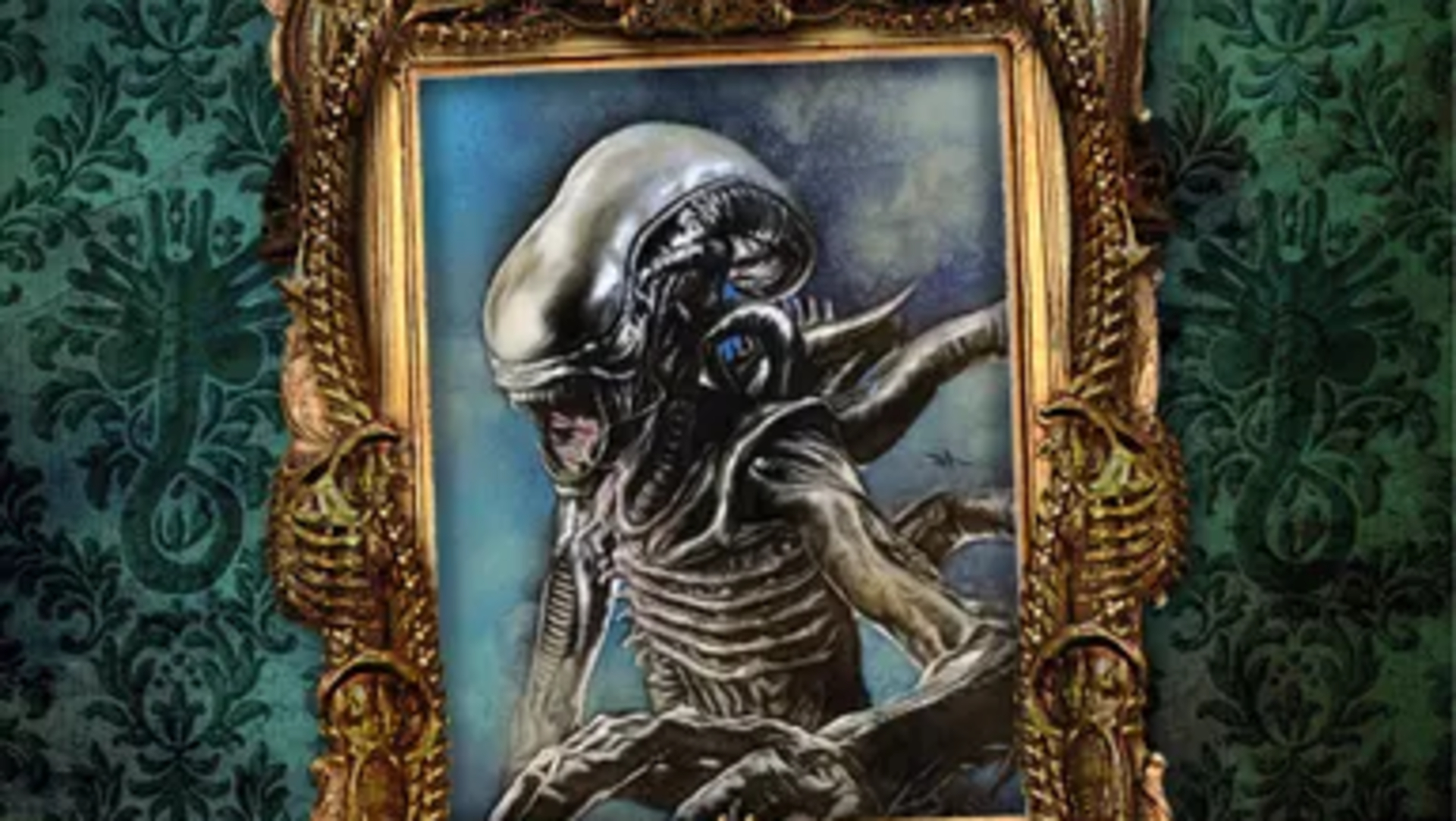
Title: Alien: Perfect Organisms
Authors: Shaun Hamill
Publisher: Titan Books, 20th Century Studios
Release Date: UK: 28 October 2025; US: 18 November 2025
Price: US/Canada $18.99; UK/Rest of World £9.99
Certain sections of the following review contain spoilers, some mild and others major. These sections are clearly marked above the section heading and contain directions about skipping ahead should you wish to avoid spoilers.
To see our reviews of other Alien novels and coverage of content within the Alien or Predator franchises’ narrative universes, click here.
With the success (albeit controversial) of Alien: Earth, many new and old fans alike might be interested in exploring what the expanded universe has to offer; and the Alien novels from Titan Books are a great place to start. Shaun Hamill’s Alien: Perfect Organisms is a refreshing change of pace from the typical “trapped on a spaceship” or “secure the bio-weapon” tropes that have been heavily represented in recent franchise entries, opting instead to focus on many themes originally explored in the Dark Horse Comics stories. In this case, Alien: Perfect Organisms follows a for-hire crew tasked with tracking down a missing artist, who has a taste for darker subject matters. Don’t let the cheesy cover fool you (seriously Titan Books, I love you, but we need to have a conversation about some of the recent book covers…); if you’re looking for a fresh Alien story, this one is worth picking up!
Synopsis
Titan Books describes Alien: Perfect Organisms as the following:
“Desperate, depressed and nearly destitute, Cynthia Goodwin goes against her better judgement to keep her ship the Chariot and its crew in work: she agrees to meet with the reclusive billionaire Roman Fade.
Fade’s request is unorthodox: go to the abandoned colony of New Providence and bring back his former lover, the renowned artist Corinth Bloch.
The job is rife with uncertainty. No one knows what happened on New Providence or why it is under quarantine. And Bloch may be brilliant, but he is also deranged. As Cynthia follows his path to the colony, she learns of a mind obsessed with images of dark and horrifying creatures… Of an almost religious fervor for the ultimate subject for his art… Of the drive to capture the sublime terror of the perfect organism…”
The following section contains mild spoilers.
Connections Expanded

Image: 20th Century Studios
The novel knows its Alien history, with story notes connecting back to Dark Horse Comics lore from Aliens: Music of the Spears, Havoc, and Labyrinth, as well as novels such as Alien: Covenant – Origins and Aliens: Bishop; the novel also makes extensive references to Robert Morse from the film Alien 3.
I’ll keep it vague here, but I particularly enjoyed the exploration of a psychic connection between certain humans and Xenomorphs. While this was a controversial aspect of Wendy’s relationship with the Xenomorph in Alien: Earth (though it’s not actually psychic; she can simply operate at an audio frequency outside of human capability), it’s an idea that goes way back in the lore and comic book history. The films, on the other hand, have largely stayed away from this storyline, likely assuming it would be too fantastical or far-fetched for audiences; however, I appreciate how it develops the Xenomorph beyond a simple space bug and gives the XX-121 strange, alien-like qualities.
“Yes, the dragon cometh, friend!” he shouted. “They don’t want you to know. They want you to keep being good little boys and girls, going to work, spending your money, making their fortunes. But we know the truth, and we will not be silenced!” (213).
—Alien: Perfect Organisms
Ever since seeing Alien 3 in my younger years, the character of Robert Morse has fascinated me. He survived the frightening ordeal on Fiorina-161 and had seen what few had lived to tell, particularly with Weyland-Yutani’s desire to keep things quiet. The Expanded Universe builds out his character, and fans learn that he eventually writes about his experience in a book called Space Beast, but Wey-Yu suppresses it. I love that it becomes part of a fringe conspiracy and eventually plays a role in Alien: Perfect Organisms.
The following section contains MAJOR spoilers. If you wish to avoid these for now, skip down to the section marked “About the Author.”
Story Analysis

For this portion of the review, I’m going to explore what I loved and what didn’t really work for me in Alien: Perfect Organisms; there will be significant spoilers, so consider this fair warning. I’ll start by saying that while I didn’t love everything in this novel, it did a lot that was a welcomed change of pace from the areas of focus in recent franchise installments. Ultimately, it was more than worth the time to read.
One thing I appreciated was the focus on a small independent crew looking for hire rather than major players like Weyland-Yutani or even the Colonial Marines. (Don’t get me wrong—I would kill for a new novel focused on Colonial Marines, but as that’s the primary focus of most franchise-related video games, I’ll say that’s well-trodden ground, for now.) Cynthia Goodwin’s crew on the Chariot are complex and feel very real with a range of wants, needs, desires, and interests. The chemistry, and more often tension, between the crew felt believable as they fought to keep their business afloat. When Goodwin pitches the idea of taking the shady job offer from the super-wealthy Roman Fade, it makes sense—it’s clear that luck hasn’t favored this rag-tag bunch and that this might be their only path forward.
Another aspect I really enjoyed in the novel was the portion taking place on the planet DSJ-1020, the home of the colony New Providence, which has mysteriously gone dark. It gave me similar vibes to how I felt when I first watched Aliens, when the Colonial Marines were trying to sort out what had happened on LV-426, but with enough variation to keep it fresh. As the crew of the Chariot survives a crash landing and attempts to locate Corinth Bloch, they are forced to traverse a dense and arduous landscape, seemingly devoid of life. Of course, the indigenous life on the planet is gone because there’s been a Xenomorph outbreak and nothing survived. As the crew pushes through a nearly impassable forest, they enter a clearing that has been partially turned into a hive; colonists have been webbed to the trunks of trees, their chests long-ago burst open, and empty Ovomorphs fill the clearing. I loved this scene! So much of Alien takes place in dark corridors of space ships and colonies, but a true outbreak (like that of Aliens: Earth Hive) would appear in more natural environments. And this is something I would really like to see on the big screen one day. (And hopefully done much better than Alien: Earth‘s attempts at having the Xenomorph outdoors.) Without giving away the specifics, there is at least one life-form that survives, but a Xenomorph eventually ruptures from its chest, with characteristics from that animal. More of this please!
This gets to one of my frustrations with the novel. The story is structured in such a way that it switches between the experience of the Chariot’s crew and the journal logs of Corinth Bloch, the wealthy and famous artist whom the crew has been tasked with tracking down. The in-story justification for this is that Roman Fade has given Captain Goodwin these logs in order for her to better understand the situation with Bloch. She dives into these entries as an escape from her frustrations with the crew and mission; for huge chunks of the novel at a time, we are completely swept away in Bloch’s backstory.
While I eventually did come to enjoy the storytelling device of the “Bloch Dossier,” it didn’t grab me at first. The early accounts tell the experiences of the nine-years-old Bloch and the way the company killed off his father by forcing him into the mines to collect Black Goo jars among an ancient temple. The child simply behaves too much like an adult and has too great of insight into the very-adult motivations and actions of the company and workers. Now I do recognize that a certain suspension of belief is necessary for the enjoyment of storytelling. How else do you establish certain facts while maintaining a child as the narrative means of perception? It’s just that it didn’t really work for me and took me out of the story. Thankfully, this represents a relatively small portion of the Bloch Dossier, which gets considerably better, and by novel’s end, had me fully engrossed. I will say that I don’t believe it ever fully solves the problem of disrupting the momentum of the story portion following Goodwin’s crew.

Another frustration I had with the novel is that certain key moments only happen because of character stupidity. This seems to be a continuing problem within the Alien franchise, which fans have bemoaned for years. (Prometheus, anyone?) Moments such as when Goodwin’s crew sees the dead colonists in the hive clearing of the forest bothered me; why wouldn’t they immediately turn back rather than barreling headfirst into a Xenomorph infestation that kills most of them soon after (or at least get weapons from the crashed ship)? To be fair, Hamill does establish that they are low on supplies and stranded, making the colony of New Providence their only real hope of survival. But the characters themselves never seriously debate turning back beyond a few passing conversations. That didn’t feel real enough to me.
There are several other moments of character stupidity pushing the plot forward, but to Hamill’s credit, he does provide at least some rationale for why the characters make those decisions. For example, when Goodwin seemingly abandons her previously held love for her crew in favor of putting them directly in harm’s path with the Xenomorphs, it is likely because of the psychic influence the Queen is exerting over her.
Speaking of the Xenomorph Queen, I will say that I really enjoyed the final sections of this novel. Once Goodwin and Sam (the only surviving crew members) make it to Bloch and are securely inside the compound, they are given spiked tea and pass out. When they awake, they find themselves vertically strapped to a gurneys in a hallway; but most-shocking is that it is not just Goodwin and Sam—Bloch had his synthetics strap himself in as well. Placed between the three of them is an Ovomorph, ready to release a Facehugger. As the horror unfolds, Bloch explains that he needs a human host to travel into the hive with a camera to film the Xenomorph Queen, so that he can finish his masterpiece, a stunning portrait of the Queen. He explains that he couldn’t send his synthetics since the nest guardians tore them to pieces every time.
I loved this twist. I had figured that Bloch was more psychotic than genius and knew that he was depicting the Xenomorph in his art, but I didn’t expect him to put himself in danger for the art. Talk about dedication! The Facehugger ultimately chooses Captain Goodwin as host, and she complies with Bloch’s demands in order to save the life of Sam and with the hope that Bloch can really deliver on his promise to put her in cryo-sleep and get her to a surgeon who can remove the Chestburster. This section made for excellent drama.
Finally, I appreciated the way Hamill chose to end Alien: Perfect Organisms. He doesn’t give in to the pressure for a “happy” or “clean” ending. It’s messy and uncertain, which adds an element of realism to the storytelling. We don’t know if Goodwin will end up surviving or not. We also never get reunited with beloved characters that went missing early in the story, like Goodwin’s kind and helpful synthetic. This isn’t a Disney-fied Alien story; it’s a delightfully grim and philosophical tale that fits in well with the Dark Horse Comics era of the Alien franchise.
About the Author

Shaun Hamill is a veteran of the monster-verse and a passionate expert in the comic world with published works A Cosmology of Monsters and The 616 Files: An Unofficial History of the Marvel Comics Universe. He is a frequent co-host on The Dungeons & Dragons Lorecast. Hamill earned his MFA from the Iowa Writer’s Workshop. For more about Shaun Hamill, click here.
The following section is spoiler-free and does briefly repeat some of the analysis from the spoiler review sections, but does so in general terms.
Final Score
Ultimately, Alien: Perfect Organisms was a fun read that fell just short of being great. There’s a lot of fresh ideas (in that they are call-backs to classic ideas from the Dark Horse Comics era) that haven’t been explored in the modern Alien context, either in the Expanded Universe or canonical films. The novel is also well-written on a technical level: Shaun Hamill is a talented writer, and I hope Titan Books will encourage more novels form him going forward.
It took me a while to warm up to the Bloch dossier as the alternating narrative device for half the novel, but it did hold my interest, particularly after the childhood-years entries. Those early portions just didn’t grab me and at times strained credibility. Generally, I don’t like when storytellers give adult traits to children; in this case, having a nine-year-old Bloch deducing what’s going on behind the scenes with the company and the adults in his colony wasn’t believable for me, even if he’s supposed to be a genius (which would really only apply to his artistic abilities—we don’t get indicators that his overall intelligence is genius level).
Alien: Perfect Organisms also does at times struggle from a frequent ailment in the franchise universe: highly capable individuals making inexplicably dumb decisions. While it’s not a major problem in the narrative, it does surface at times; and this left the experience below a four- or five-star review for me.
I will give the novel some serious credit, however, for avoiding a “happy” ending; Shaun Hamill leaves the outcome somewhat ambiguous, allowing readers to decide for themselves what will happen to the survivors. (For a more in-depth explanation of this, read the spoiler sections above.) I loved this decision and feel that tonally it fits well with the Alien universe.
Finally, I appreciated how Alien: Perfect Organisms works to restore the mystery of the Xenomorph. Between exploration of the various cults that arose around this creature, the unknowable terror of what is waiting for humanity in space, and the artistic obsession of Bloch, the novel re-mystifies the beast, at least as much as can be done at this point in the franchise. I loved the idea that the Xenomorph is “…part of the great mystery. The dark secret at the heart of all things” (300). Hamill’s strong writing abilities are featured in beautiful and moving passages like this one, which are frequent in the novel, making the read an enjoyable experience.
Alien: Perfect Organisms is an enjoyable read that fans of the franchise, and particularly those who enjoy the novels, will be glad they picked up.
Boss Rush Network awards Alien: Perfect Organisms three and a half stars out of five.
Tell us what you think! Have you read Alien: Perfect Organisms? Where does it fall on your list of favorite Alien stories? Share your reactions in the comments below or join the conversation on Boss Rush Network’s Discord, Facebook, and Twitter.
Featured Image: Titan Books
David Lasby is the Editor-in-Chief for Boss Rush Network. His favorite video games are The Legend of Zelda, Metroid, and the Aliens franchise. You can find him on Twitter to talk all things Nintendo, sci-fi / fantasy, and creative writing.

Leave a Reply