
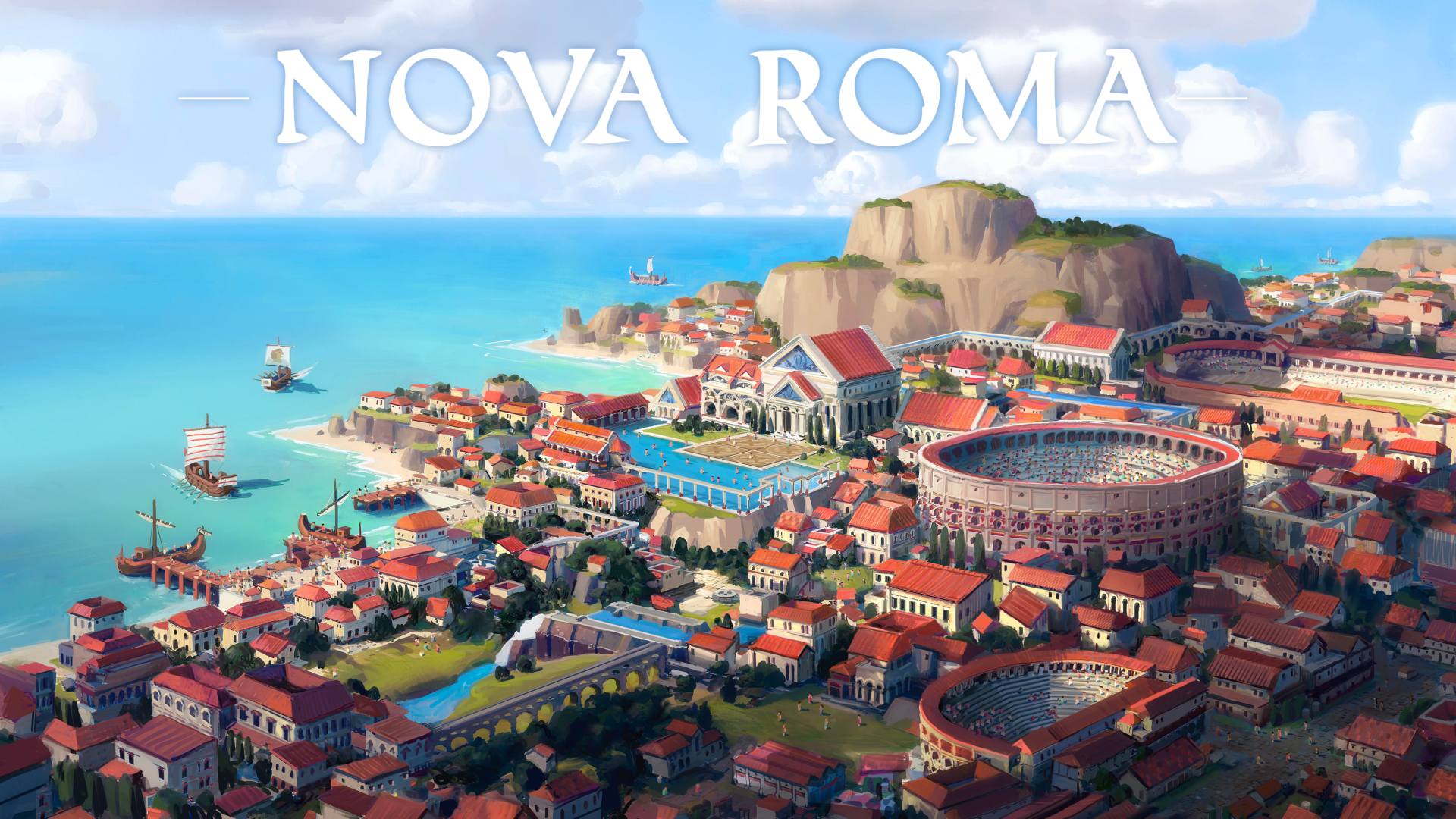
Title: Nova Roma
Developer: Lion Shield Studios
Publisher: Hooded Horse
Release Date: March 26th, 2026
Platforms: PC via Steam
There are two types of “promising” early access games. One type feels like the seed of a good idea, which you are excited to watch sprout into a full-fledged experience. The other is the type of game which feels good and fully featured out the gate, leaving you to think “wow, I can’t wait to see how much better this already-excellent game can become.” Nova Roma is very much the latter.

Developed by the small three-person studio Lion Shield Studios, Nova Roma is a city-builder in which the player seeks to build a brand new city in the style of Rome, which is in decline. They will slowly grow from a small village to a mighty walled city with beautiful aqueducts and a standing army, all while balancing the development of new technology and the happiness of your Nova-Roman citizens. You’ll need that standing army too, as Old Rome will be looking to take a pound of flesh from you at any given opportunity, and raids can come at any time. Will your Nova Roma proliferate and become it’s own Constantinople? Or will it flounder and fail? That is the hook of Nova Roma.
Early Access: This game is currently in early access, and as such, is subject to change. By the time you read this review, some of the information in this review may no longer be accurate.
When In Rome
The game executes the premise fantastically, this is a very entertaining video game. The city-building is satisfying, and will appeals to a broad range of genre fans. If you are a number cruncher, you can obsess over the logistics menu to make sure each dock is delivering the optimal number of goods to each other dock, for the most successful possible growth. If you are more into making your city visually appealing, you can focus on building beautiful aqueducts or reshaping the ground itself. There is also plenty that needs to be reckoned with outside of micro-managing your city, such as Roman attacks, natural disasters, and of course, keeping the gods happy. Bad things happen if you don’t.
Nova Roma is a great time, and while there is certain areas of improvement, I genuinely believe with the right roadmap to get them through early access, Nova Roma may be headed for greatness.
Presentation
Reviewing the presentation of early access games is always a bit of a crapshoot, because many titles prioritize presentation at the very end of their development cycle. This means many early access games look significantly rougher than the final product, utilizing placeholder visuals and audio, with UIs that are more designed for bug testing than playing. Part of the fun is watching these things evolve over time. Nova Roma is different in that regard then, because aside from a few nitpicks, it has excellent presentation right off the bat.
Visually, Nova Roma develops on the blobby Totally Accurate Battle Simulator style, adding a layer of object detail not generally present in games which use such a style, and it adds a lot of character. The buildings are particularly well-done, and certain elements such as the aqueducts are genuinely beautiful. One look at some of the cities constructed by folks online shows the potential these visuals have to make some truly beautiful cities, and it is due to an art style that is simple in areas it can get away with, and high-effort in the parts that matter. I’d never say no to more detail, but what they have now is great.

I also appreciate the visual clarity that Nova Roma offers. For the most part, the UI is well-designed and easy to navigate, with the many buildings sorted into sensible categories, and all important buttons in easy-to-find locations. There are a few nitpicks, the land-molding menu could use some work and I wish that it was easier to determine where water towers can be effectively placed, but overall it is a well-designed UI. I also appreciate how the game lays out its significant amount of information, and I particularly love little features, such as the ability to hover over a house and see exactly where on the map the residents currently are. Small touches like that go a long way.
Nova Roma’s music is lovely. It strikes a perfect chord, and I find the soft Roman-esque music that plays as you toil away at city building to be somewhat entrancing. It goes a long ways towards sucking you into the experience. Likewise the change in tone to something suspenseful, and eventually outright hostile, does a great job of snapping you out of that trance to prepare for battle, or to counter a natural disaster, whatever the emergency may be. Music is not an area I feel like city-builders generally do well, but Nova Roma absolutely hits the mark.
The game does a wonderful job of situating the player in antiquity. The visuals are simple, but also very appealing to the eye, and are distinctly Roman. The music aids in this, providing a soundscape that relaxes when it is time to build, and heightens tension accordingly. Paired with clear visual language and a well-designed UI, the presentation of Nova Roma is impressive for a game in early access.

Gameplay
On the face of it, Nova Roma is about managing your city, and facing the classic chicken-and-egg problem the genre does so well. You need more community members to extract resources faster, but accepting more immigrants increases your resource demand! It is a delightful system, made more complex through added challenges such as having to make sure your villagers live near their workplace, and certain types of buildings causing noise or smells that they won’t like. It has just enough complexity without growing tedious.
Thankfully you have an impressive variety of buildings to manage your population with, alongside a gigantic tech tree to unlock them at your own pace. There is a lot to consider here, from housing placement to aqueduct design, making sure you have a thorough fire-fighting system in place, and paying attention to your military capabilities. Even here, in your choice of building progression, you will run into the classic issue of “too many problems to solve.” Your choice heavily alters your playstyle. Perhaps you put significant focus in certain areas leading to quick growth within them, at the expense of stagnation in the others. Or perhaps you look for a more balanced approach, and deal with the slowness of your growth as a result. There is a ton of different routes you can take as you look to grow your city.
The biggest way in which your choice of neglection will manifest is through the threat system. Always on the horizon, there are impending threats that need to be accounted for in your designs, lest they ravage you. This can come in the form of natural disasters such as torrential downpours, which can flood your lands, drowning villagers and destroying farmlands. Or perhaps the outbreak of fires, which will jump building to building. Of course there is always the threat of invasion by the Romans, who will sack and pillage until they’ve had their fill.

You have to give attention to precautionary measures to avoid these, such as dam systems to deal with floods, thorough fire-fighting services to manage fires, and a worthy army paired with city walls to repel invaders. But all of this is on top of managing the growth of your city, and once again, you can’t prepare for everything. For my playthrough I chose to slack on my military while focusing on making my city natural disaster-proof, and while I managed to fend off early-game raids with the default militia, I was absolutely devastated by late-game raids. Balance is important.
While having to balance wellbeing, growth, expansion, and preparedness for disaster seems complicated enough, the entire thing is further complicated by the introduction of the Roman gods. They expect worship, you see, through the construction of temples and donations in their name. If you keep a god happy, they will provide you with fantastic benefits that will greatly aid you. If you neglect the gods for too long though, they will grow angry. If their anger is not soothed, the gods themselves will punish you and bring about disasters upon your city.
The thing is, you don’t simply have to worry about the happiness of the god you worship. After a while dedicating to one god, the others will grow jealous and begin to demand tribute as well. Build a shiny new bigger temple for one god, and the others will expect the same in due time. You need to manage the temper of the gods, not simply to maintain the benefits they provide, to to avoid invoking their wrath. Yet another thing to manage.
I do feel like the god system is slightly underbaked. For the most part you can ignore them, just build a token temple or make donations when they begin to anger, and move on. If you focus on making money, you can basically ignore the system outright and pay the gods off, with the amount required never seeming that dramatic. I would love to see either the punishment for ignoring a god be more severe, or the process of satisfying them be more difficult. As of now, the gods feel like a bit tacked-on.

The gameplay of Nova Roma, as you’ve come to understand, has a tremendous amount of systems to keep in mind, and decisions to be made. You have to manage happiness, resource extraction, worker placement, natural disasters, a giant tech tree, keeping the gods happy, and more. It can be a lot to think about, and this is the point where many city-builders buckle under their own weight.
I am very happy to report that Nova Roma does not, though. Despite the sheer number of systems, I found it to be a rather straightforward game, in large part because the systems are very logical and everything ties into one another. When you learn about city management, you are also learning about building placement and disaster preparedness, because they are so tightly wound. There is a lot to it, but the entire system runs very gracefully. The only real issue with Nova Roma as it stands is a lack of content. I built a mighty city with the tech tree fully unlocked across two playthroughs, which left me with not much else to do aside from starting a new city. This is to be expected with an early access title, however.
Final Score
Overall, I am very impressed with Nova Roma. Lion Shield Studios might have something special on their hands with this one. It has reinvigorated my love of city builders, and this is done through a strong Roman theming that is aided with visuals that are simple and clean, yet very pleasing to the eye, pared with some excellent music. This is in support of gameplay that is robust-yet-simple, and does a truly masterful job of the central “three problems and only enough for two solutions” crux of the city-builder genre. While the game is ambitious, especially for an early access title, it certainly does not crumble under that ambition. Nova Roma is absolutely worth your time, and I am keen to follow the life cycle of this game, through to the 1.0 full release.
If they can capitalize on what they’ve started with this early access preview, the full release of Nova Roma will be something to write home about. It is also dang fun to play in the meantime.
Featured Image: Lion Shield Studios

Leave a Reply