
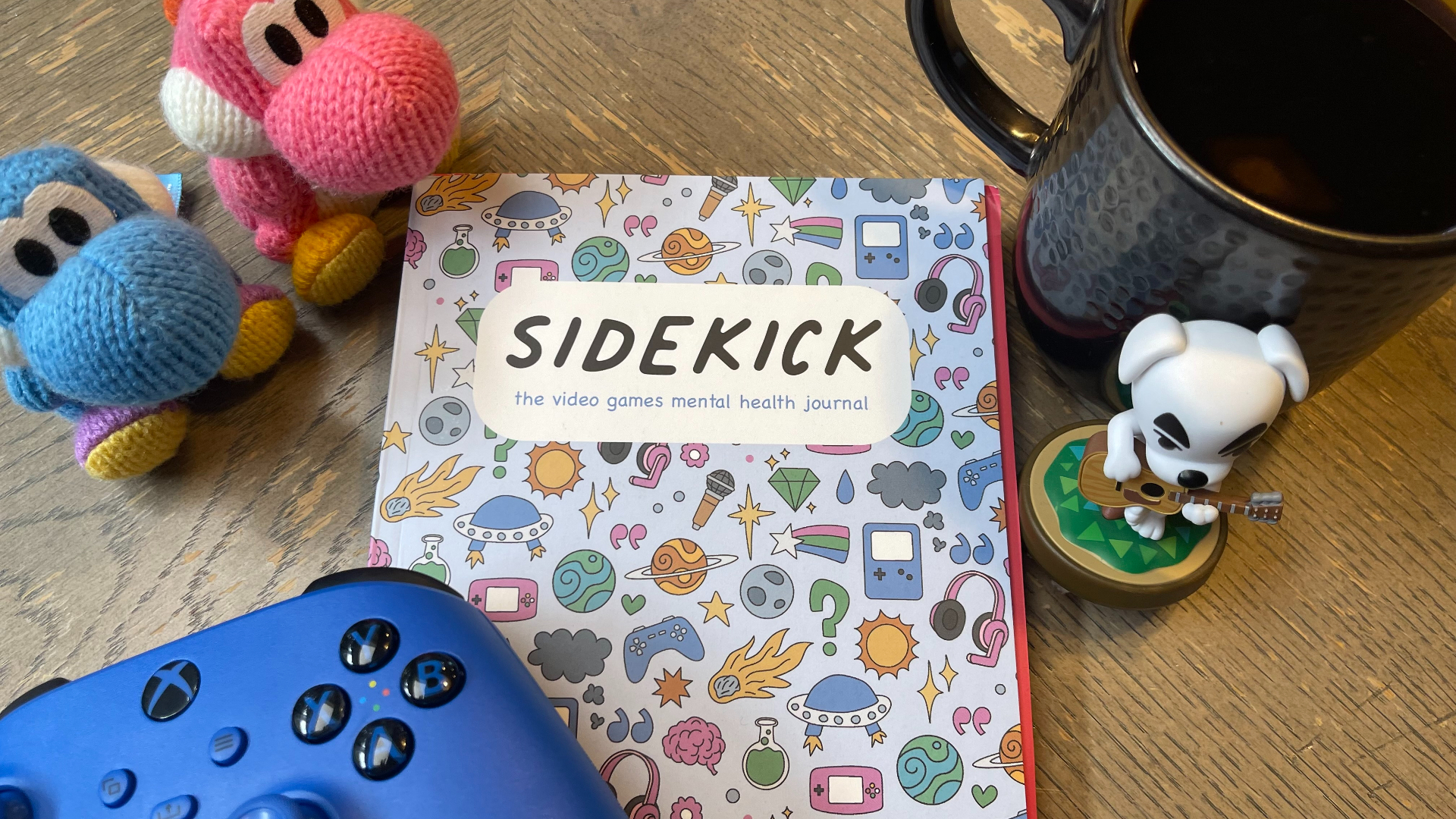
Title: Sidekick: The Video Games and Mental Health Journal
Authors: Sky Tunley-Stainton, Harry Stainer, and Rosie Taylor
Illustrators: Tristan McGuire and Megan Dobbyn
Editor: Sydney Bollinger Design: Eryk Sawicki
Publisher: Peregrine Coast Press
Release Date: May 2023
Price: Hardback only– US $20.00 / CA $27.00 / UK £15.00
We’ve come a long way in recognizing the importance of mental health and caring for oneself. After decades of research, we know that simply “toughing it out” or refusing to feel one’s emotions won’t lead to positive health outcomes. While the scientific and medical communities may hold this knowledge, many people still feel lost regarding how to face mental health struggles; indeed, access to therapy, treatment, and research-based self-care are still out of reach for too many people.
In a similar development arc, the world of video games has transformed from fringe interest to mainstream entertainment, occupying a parallel span of time. As more people enjoy this art medium, many of the old tropes and stereotypes are dropping away, replaced with an understanding that video games are for everyone, and that this medium can teach us so much about our own humanity, dreams, and desires.
Games such as The Legend of Zelda: Breath of the Wild and Animal Crossing have been well documented in the way people felt uplifted during the pandemic by exploring their zen worlds. Nevertheless, dedicated gamers remain at times difficult to reach in the struggle to improve mental health outcomes. There’s much speculation about this from experts, with theories about the causes ranging from the isolated nature of many gaming experiences to the toxic behavior in many online games.
This year, the mental health advocacy organization Safe In Our World teamed up with Peregrine Coast Press to release a brand new book focusing on developing better self-care in the gaming community and positive mental health outcomes.
About Safe in Our World

The main goals of Safe In Our World are to “create and foster worldwide mental health awareness within the video game industry; to eliminate the stigma surrounding mental health, to make it a natural topic of discussion, and to promote the dialogue surrounding mental health so people are not afraid to reach out for help if they need it.”
Safe in our world offers the following services:
- Information and services
- Covid-19 and crisis hub
- News articles
- Mental health related games and apps
- Support and training for the games industry
- Hero stories of mental health
- Podcast: Safe Space
- Safer Together Discord: a safe and inclusive community
Safe In Our World hopes to challenge the industry to unite around the commitment to change, believing the world needs to create a refuge for the many people struggling. The organization believes the video game industry in particular has a major impact on people’s lives in a uniquely personal way. To join in this cause or to learn more about what Safe In Our World is doing, use the hashtag #LevelUpMentalHealth. To donate to Safe In Our World, click here.
What is Sidekick?
Sidekick: The Video Games Mental Health Journal, like the name suggests, is a space for gamers to record their thoughts, feelings, and mental health journey in a way that centers a worldview familiar to the community. Resource planning as a “gameplay loop,” mental and behavioral obstacles as “boss fights,” and self-reflection as “character creation,” Sidekick offers gamers the chance to engage in strong therapeutic practices in a way that goes down easy, using the lexicon and ideological framework most comfortable to those who enjoy the gaming experience.
Mental Health Strategies

Sidekick centers traditional mental health practices such as emotional literacy, grounding exercises, journaling, breathing exercises, resource planning, and many others. What makes this book successful is the way in which these skills and practices are packaged together.
Here are a few of my favorites:
- Obstacles as Boss Battles: this activity asks readers to identify a particular challenge they are facing and to reflect on the ways they have struggled to overcome it; but rather than feel defeated, readers are asked to think of it as a boss battle, knowing that every boss has a weakness. The journal lays out a series of “health bars” and encourages readers to plan for the struggle: what power-ups are in their inventory that can assist them, be that medication, human connection, self-care activities, etc. This journal section provides space for users to map out their battle plan.
- A Challenging Day as a Roguelike Adventure: most gamers have played a Roguelike. Whether your favorite is Hades or Returnal, there is an understanding of the simultaneous thrill and frustration these games offer. A fantastic run will often end in defeat, but that end marks the beginning of a new chance, this time with experience and abilities gained. Sidekick encourages readers to conceptualize their own challenges in this manner and even provides a map of a Roguelike level for mapping out the best route through the day.
- Gamer Care Package: this section of the journal asks readers to plan out an emergency gaming care package. Questions for consideration include which games will be played, what snacks and drinks will be there, and what cosy or comforting items will be included.
Reactions to Sidekick

Sidekick: The Video Games Mental Health Journal is an excellent resource for anyone who loves video games and is also looking to improve their mental health. The activities are rooted in sound psychological principles while the tone of the book normalizes challenges and elevates the importance of mental health care.
The first half of the book is filled with small readings, coaching, and activities; the second half leaves space for readers to put these skills into practice, something that is needed and important for a book that labels itself as a journal. One thing I appreciate in particular is that the writing spaces use a dot matrix rather than lined pages. This allows a different slant of mind for users, encouraging both drawing and writing.
Final Score
It’s hard to be too critical of this resource. It delivers on its goals and promises and absolutely creates a space that assists readers in improving their mental health. The activities are clever and well written and refer just enough to video games and characters without feeling forced or gimmicky.
If I have one reservation about the journal it would simply be that I wish more activities were included. I understand the need to leave space for users to write, but I would prefer a two-thirds split rather than a fifty-fifty division between activities and empty pages. That said, Sidekick offers quality over quantity, a preference that will sit well with gamers.
Boss Rush Network gives Sidekick: The Video Games and Mental Health Journal a four-star rating.
Tell us what you think! Will you be purchasing Sidekick: The Video Games and Mental Health Journal? Share your reactions in the comments below or join the conversation on Boss Rush Network’s Discord and Facebook.
Featured Image: Peregrin Coast Press
David Lasby is the Editor-in-Chief for Boss Rush Network. His favorite video games are The Legend of Zelda, Metroid, and the Aliens franchise. You can find him on Twitter to talk all things Nintendo, sci-fi / fantasy, and creative writing.

Leave a Reply