
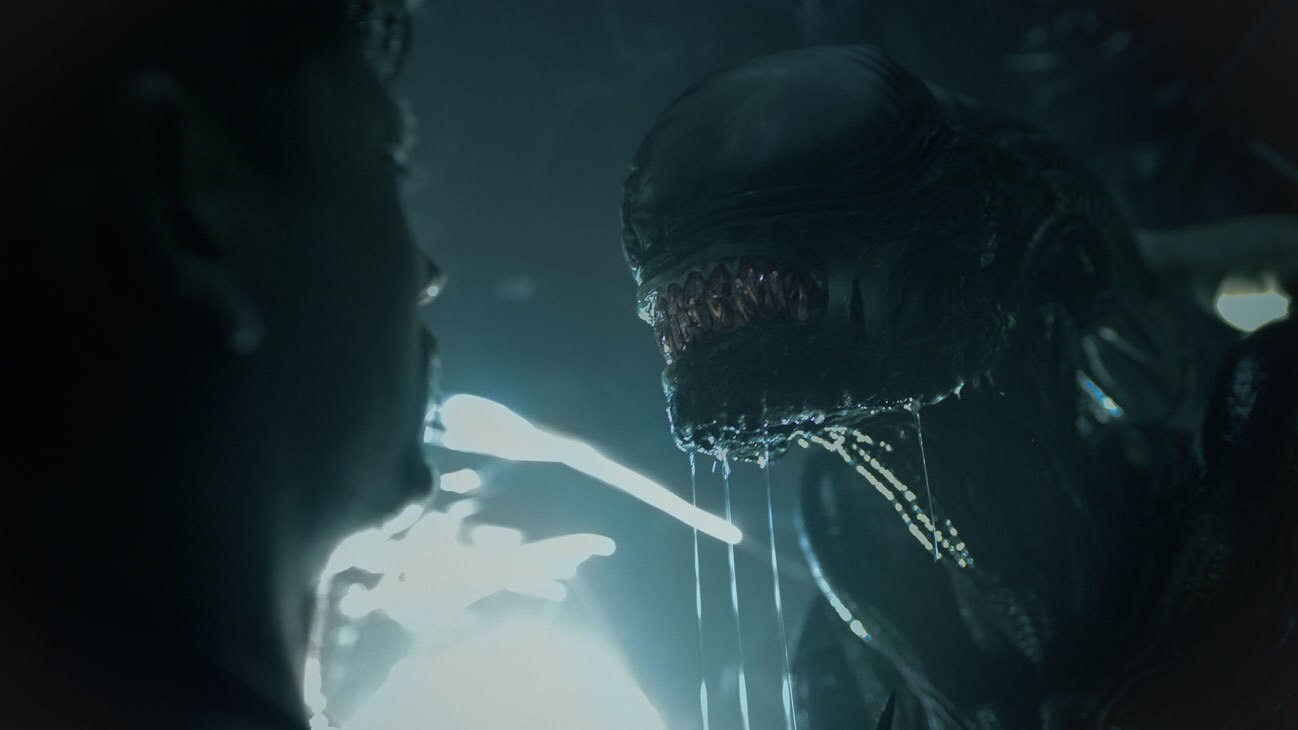
Title: Alien: Romulus
Director: Fede Álvarez
Cinematographer: Galo Olivares
Writers: Fede Álvarez and Rodo Sayagues
Starring: Cailee Spaeny, David Jonsson, Archie Renaux, Isabela Merced, Spike Fearn, Aileen Wu, Daniel Betts, Trevor Newlin, Robert Bobroczkyi
Release Date: August 12, 2024
What makes a good Alien film?
Alien and Aliens are beloved for many reasons: the cinematography that redefined how films are shot, the well-written and reasonable characters, the creature effects that stand (and surpass) the test of time, career-best performances from some of the greatest actors of their generation, and more.
Great films cannot be defined as a whole, only in part. But these are things we should expect an Alien franchise film to attempt and achieve: this is not a series of shlock, but a series with a foundation laid for serious, mostly harder science fiction films with something to say.
Before we take a look at Alien: Romulus, and how well it did against the standard, the corporate maneuvering that brought us here needs addressed.
The critical and commercial reception to Alien: Covenant and The Predator put 20th Century Fox’s further plans for theatrical releases on hold. Instead, they pivoted toward putting more responsibly-budgeted films on streaming. One corporate buy-out later, which saw the mega-corporation added to mega-mega corporation Disney’s holdings, the Dan Trachtenberg’s Predator prequel Prey was a commercial and critical hit, not content to score glowing reviews but standing as an Emmy darling.
Appropriately for its name, Fede Álvarez’s Alien: Romulus was Prey’s twin production. Partly in light of Prey’s response, Alien: Romulus was shifted to theatres to fill out an anemic 2024 release schedule. This was necessary due to studios refusing to pay actors and writers living wages, holding out for months during the 2023 WGA and SAG strikes.
Through produced for streaming, we should not judge Alien: Romulus as a low-budget movie—it is not, as even a glance will tell you. Instead, in a world of monstrously budgeted movies, this is one is budgeted much more closely to Aliens (when adjusted for inflation), and can be judged on the same merits.
Spoiler Warning: This review will discuss the events of Alien: Romulus in depth. Twists, characters, and major scenes are openly explored. You have been warned.
The Filmmaking
Whatever else can be said about the film, it’s made out of the oldest and truest kind of magic: it’s mostly real. The sets are real. The creatures are real. (Most of) the cast is real. Watching the early parts of the film is like letting out a breath you didn’t know you were holding, as physical actors in a physical world come together with all the magic of craft and trade to make a real movie.
Whatever else I have to say, this aspect of the film is perfect. Whatever the film’s reputation becomes, the physical craft behind this film—which reunites and marries the production teams of Alien and Aliens to build magic again, now with decades more experience—is an exception to the movie machine of the 2020s and will outlive all other aspects of this film.
Unfortunately, neither the film itself nor my review can linger entirely in the majesty of the physical sets and creations. The cracks show through, and through those cracks is one of the ugliest trends of this period: a deceased actor dragged back to perform again by CGI.
The digital necromancy of Ash is ugly. It is waxy, it is unnatural, its mouth never moves right, its eyes never truly focus; I could write much more about the artistic failures of his exhumation, but that hardly matters.
What matters are the ethical concerns. It doesn’t matter that his family has given approval. It doesn’t matter if this were, somehow, a thing he had signed-off on prior to his death.
This denied a living actor an open job. This denied an actual human being a chance to perform in a paid, facing role that would provide them residuals for decades, all in the name of putting a face on screen that you recognize. Would you know the bulk of the work behind this Ash was done by Daniel Betts, unless I told you? (There are conflicting statements that Ash’s voice was provided by generative AI. This originates in a report from the LA Times, but the information was provided without a quote. If this is true, this Frankenstein-like portrayal of Holm grows from unethical to despicable.)
But let us pretend that, for some reason, this android must be one we recognize. There is no narrative reason within the film for it to be another Ash model. It could be anyone. The characters have no knowledge of Ash, no reason to distrust him, and he portrays none of the “twitchiness” in the real Holm’s performance or as discussed in Aliens. If we must have a recognizable android, and it must, simply must, wear a face we recognize: why not Lance Henriksen, why not Winona Ryder, why not Michael Fassbender?
The digital exhumation of Ian Holm lords over the film, the central antagonist whose screentime rivals and possibly exceeds the xenomorphs. That this substantial part did not go to a living human being is unacceptable.
For most of the film, the cinematography and direction are exceptional. When the film is on a real set, the footage is well-framed, colorful, attractive, and clear. But when the film enters increasingly digital frontiers, as with most of the climax, it becomes murky and unclear, inexplicable, requiring the audience to piece together events in their minds. We had to discuss the precise sequence of events in the elevator shaft, or in the final fight. It devolves into murky sludge, and everything is guesswork.
The Cast & The Characters
David Jonsson does an incredible job playing essentially three different characters: the damaged android Andy, the high-clearance company man loyal only to Weyland-Yutani, and the restored, fully-functional Andy. Each has different mannerisms, different ways of speaking and standing, an entirely different mien which betrays his thoughts and condition. Jonsson’s performance would, much like Sigourney Weaver’s in Aliens, be Oscar-worthy…if he was the lead.
Instead, Andy is a supporting character often shuffled to the background. He misses major scene after major scene—sometimes sent to stand outside, sometimes rebooting, sometimes overwhelmed, sometimes powered down for no clear reason, sometimes nearly mortally wounded. He is the only character who changes, the only one who has a meaningfully portrayed arc, and yet he is eternally only just barely allowed to be part of the plot.
That alone is a tragedy, but it is a tragedy in two parts. The second tragedy is that most of the film snaps into place if he was the protagonist. Most of the cast only has one motivation: escape. It is one note repeated forever: unlike the crew of Alien, which must contend with surprise orders, the bonus situation, emergency repairs, conflicts over leadership, an ever-shifting set of plans and safe places, before finally accepting they must escape…the cast of Alien: Romulus is set on escape from a few minutes into the film and that plan remains in place until the final moments. Any deviations from that goal are momentary.
Andy, instead, is at the center of his own eternally changing situation that the wider film rarely depicts. Will he go with his sister to a better world or be sent back to the surface? His personality is overwritten, then overwritten again. His physical problems, which made up part of his identity, is repaired without his knowledge or consent. He sits at a center of ethical problems, identity concerns, and questions of humanity that tie directly into the situations around him but rarely get the time or focus necessary.
Cailee Spaeny stars as Rain, and she does the best with what she’s given, but too much of what she’s given after the first twenty minutes is route horror movie dialogue. She’s given so few chances to shine. She progressively becomes more like Ripley, but it’s too low-key, too distant from the audience, for it to land. She is given Ripley’s role because this is an Alien film, not because the film has anything to let such a character say or do. The chance to explore her background, and find out what makes her Ripley-like while still her own distinct character, is untapped.
Kay’s motherhood is disappointingly empty, and disappears from the film for long stretches; we never really learn what she thinks, or see her as a character, which is extremely disappointing in comparison to the ways Aliens discussed the topic. Her first scene discussing her pregnancy is interesting, but then the film never dives deeper, never explores the depths she might go to or how she feels about the situation. Isabela Merced, again, does the most she can with what she’s given: but she’s only given a few scenes before she’s resigned to mostly run and scream.
One of the best things about the Alien films, including some of the lesser entries, is that the characters are provided unique characterization, a direction for the actor to go, something that differentiates what could be an anonymous crowd. Most of the cast of Alien: Romulus are given very little to do, and the blunt dialogue they are given does little to make them stand out as unique. Archie Renaux and Spike Fearn do the best with what they are given, but their roles amount to “Nice Cousin” and “Mean Cousin.” Compare that to the layers both the script and Harry Dean Stanton and Yaphet Kotto give Brett and Parker, who easily could’ve become “Nice Engineer” and “Mean Engineer,” but instead become a co-dependent mess of way too easygoing, crafty, stubborn, frustrating, weird—and, despite everything, they are two of the most reliable men on the ship.
The Film’s Shift in Tone
Roughly the first half of the film is a tense, methodical horror film that takes advantage of physical sets and creatures to build heavy atmosphere. When a previous film is referenced in a central way, it’s usually through so many layers of changes that it’s become something new entirely—when facehuggers attack en mass in a room with knee-deep water, it is a reference to the scene in Aliens when Ripley and Newt are locked in. Yet, at a glance, you wouldn’t think about Aliens. The dangers of the scene are changed enough that it becomes something else, something new.
Most horror sequences in this portion aim to provide something new: a stampede of facehuggers, facehuggers wandering around a room in the open that the characters must cross, a chestburster cocooned to complete its transformation into an adult and the scant moments two people have to kill it before it emerges.
The main problem in the first half is that the situation never concretely changes for Rain. While her ultimate goal may shift in location, she is always crossing xenomorph-infested areas of the station to reach her friends’ ship. She may occasionally get a side quest, as when she must retrieve black goo treatments for Ash, but she is always heading toward the same goal without any surprises for the audience.
But in the second half, the film presents sequences of unfettered, unbelievable stupidity one after the other.
After a strangely immobile action scene where Rain, sitting down, dispatches dozens of xenomorphs without moving, she must cross the same area. She does so by rocket jumping via her pulse rifle through zero-g spirals of acid from her kills.
Rain and Andy must climb up an elevator shaft during the same station-wide zero-g. She falls during a ship-wide gravity reset. A xenomorph catches her and daintily lifts Rain in its tail—not stabs, lifts—and sets her back on the ladder. The Xenomorph then goes into a nook to wait for an elevator to pass, then jumps out toward Rain. It stops short and sniffs her, recreating the famous shot from Alien 3 (though without the context of Ripley carrying the new queen, it has no reason to do this). Andy jumps on it from above, shooting it, and announces, “Get away from her, you bitch.”
The final sequence is a formless slurry of scenes from Alien, Aliens, and Alien: Resurrection, down to recreating specific shot after specific shot.
As the film progresses, it becomes increasingly absurd and disjointed, the human drama all but forgotten. By the finale, Andy all but ceases to exist, spending the bulk of the closing scenes powered down or dying. Rain gets nothing to do as a character, simply progressing from action scene to action scene with very little to say. Kay ends up all but absent from the film, none of the tragedy of her death adequately portrayed.
The momentum of the film is lost, and there are few substantial hooks left for the audience. Three separate people walked out of my showing, all in the second half.
Alien: Romulus & the Alien Franchise
The film struggles with exposition. The plots or xenomorph biology from virtually every film are discussed at wearying length. It insists on talking through every fact about xenomorphs, instead of showing and trusting the audience to keep up.
This denies new fans any surprises, and bores old fans by verbally repeating the mechanics and revelations of the previous films. It’s particularly frustrating since Aliens stopped Ripley from explaining the plot to the new characters, and everyone got up to speed off-screen. This has already been handled with much more grace within the same series.
Alien: Romulus puts on an unending parade of visual elements, lines, shots, and wholesale scenes you have watched before.
At first, it lulls you into a sense of security. One of the first shots of the film is a lovingly framed dippy bird from Alien. One of the first lines of dialogue is about Aliens’ cornbread. You would think that this is, if anything, a joke about slavish referencing in modern franchise films. You could think this would be the end of it. You might even take it as a promise that the film will avoid playing that game, and let the film stand on its own merits.
Instead, the film never ceases in asking you to clap for things you might recognize. The following isn’t exhaustive, only representative.
- Familiar dialogue is repeated: “I can’t lie to you about your chances, but you have my sympathies”; “Busy little creatures”; “I prefer Artificial Person, myself” (a sentiment that was implied to be new in Aliens); “Game over, man!”; “Get away from her, you bitch!” (followed by a pause for audience cheers); “The last survivor of the [ship name], signing off…” to conclude the film.
- Famous shots are recreated: Ripley turning her head in the space suit; Ripley, in her underwear, quietly slithering into her spacesuit; the xenomorph in Alien 3 smelling Ripley; Hicks teaching Ripley how to shoot.
- Props that are not a natural part of the world (like the beer from Alien, or the reebok shoes), but are would-be incidental elements lovingly shot to remind you to clap: the save station phone from Alien: Isolation; the power generator handle from the same game; the blue-glow hologram mist from Alien (which makes no sense here); somehow a stun baton like the ones the crew built in Alien are on board the station.
- Distracting Implications: Weyland-Yutani already knows about LV-426; The Narcissus, presumably with an unconscious Ripley aboard, zooms away from the crashing station;
Are you tired of reading this? Imagine watching it. This list doesn’t count narrative ties (Alien’s xenomorph) or conceptual elements (the alien-human hybrid from Alien: Resurrection is replaced with a alien-human-engineer hybrid that behaves similarly, minus the conflict and tragedy).
Alien: Romulus has an almost exactly two-hour runtime. Including dippy bird and the cornbread, that’s 18 references in a non-exhaustive list. From the above alone, there is an average of one distracting reference every six and a half minutes. Incorporate the obvious Blade Runner references, and it becomes one distracting reference every six minutes. It becomes an assault on your attention, as the film constantly asks you to think about movies other than the one you are watching right now.
Let’s circle back on the distracting implications. Some references beg questions that the film is not prepared to answer. According to a screen placed front and center, you’ll find that Weyland-Yutani already knows the xenomorph eggs are on LV-426. Why did they delay collecting the eggs until Aliens, about 50 years later? Why insist on taking Ripley along at all, if they did wait? Why pretend not to believe her? Why only send one company man attached to a squad of marines? In a film that is determined to show it takes all previous Alien films as equal canon, you can’t pretend the message was delayed or unsent: Alien 3 shows that even outdated hardware sends information immediately, and it is received quickly.
When Romulus station falls to its destruction, the Nostromo’s’ escape shuttle, the Narcissus, is seen darting away from the destruction. Why? To what end? What is gained from implying Ripley’s unconscious body was on board? What is so interesting about tying her into this, in an ultimately meaningless fashion?
The reference and easter egg game is bad enough as it is: inexplicable, weak, and begging dozens of questions the film is not prepared to answer. But there is a heavily-promoted tie-in prequel comic coming soon. If these problems are expanded on in some tie-in, they go from bad to insulting. The price of a ticket did not provide a complete story? The audience must pay more, again, to figure out the reasoning and justification for events from a different medium?
It becomes a bad joke about cinematic universes and media tie-ins. Studios are no longer merely patching films, as with the embarrassing and artist-abusing carnival of changes to Across the Spider-Verse, but selling DLC to fix the film.
But more than that, it’s distracting, pulling you away from the film at hand to no justifiable end. Once you begin layering on all of the conceptual references and repeats, the film sags under its own weight. It never becomes its own unique film, something that can be said of even the worst entries in the series.
This is all the more true of the plot, which bends over backwards to answer all lingering questions of the franchise. Remaining mysteries are squashed. You will learn exactly what the black goo from Prometheus is, and how exactly it relates to xenomorphs, and why Weyland-Yutani wants xenomorphs (obtaining bioweapons is not the reason). The alien lifecycle will be fully explained, incorporating all current information, as well as what exactly they are spreading. It’s tiresome. Apart from the kind of meaningless mysteries that a cinematic universe thrives on (“Why was Ripley here between Alien and Aliens?”), the franchise is smaller than ever before. There is little potential to branch out and little left to wonder about.
Speaking of, apart from fodder for a Ripley-led cinematic universe, why is this set between Alien and Aliens? The film constantly chafes under this restriction, breaking the logic of the surrounding movies. Weyland-Yutani knows too much, knows everything, and they have no reason to behave as they did in Aliens. Ripley is, for some reason, darting from place to place when she should be in deep space. Androids, and their culture, are too advanced for this time. Weaponry is seemingly far advanced from Alien, given the pulse rifle and smartgun have now combined into a single weapon powerful enough to wipe out a hive while sitting still. The single xenomorph from Alien, in a weirdly constrained amount of time, created an entire hive on the station with a truly incredible number of xenomorphs present.
Wouldn’t this whole movie work better if it was set after the events of Aliens, with the still-living queen plucked from space by Weyland-Yutani, given they know about, and are interested in, the bioweapons on LV-426?
Final Score
The tragedy of Alien: Romulus is that the technical aspects are not just beautiful, but perfect, and there is an outstanding film often just off-screen. The practical special effects are gorgeous. Álvarez’s direction and Galo Olivares’ cinematography is not only excellent, but shakes off the trends of this era to produce images that are colorful, personal, and clear. David Jonsson’s performance is unforgettable.
But, unfortunately, too much of what made it to screen was the wrong call.
Alien: Romulus is the worst kind of fan film brought to the big screen. It’s not a project that offers an interesting idea that Hollywood would “never” make. That describes Prey, a film that understands Predator, and dared to make a rigorously accurate period film, largely in Commanche and French, which sets the Predator free to hunt in that era. It has things to say. The film was an Emmy darling for many reasons.
Alien: Romulus is the all questions answered, all plot threads linked kind of fan film that smashes previous movies together and denies any lingering mystery. What if the original xenomorph from Alien’s DNA was taken to make a Prometheus Engineer-esque version of the hybrid from Alien Resurrection by another version of Ash on a station that had a xenomorph breakout whose hive combined elements of the cut Alien cocoons and the Aliens hive? What if we knew everything about the black goo from Prometheus? It reaches a point where it’s word salad, concept salad, fanservice salad—an illegible sprawl across the Alien series that loses track of anything it wants to say.
Meaningful comments on corporate control, on youth stolen from the young, on even personal autonomy stolen by corporations are drowned out beneath fanservice.
We are asked to clap for dippy bird, we are asked to clap for cornbread, we are asked to clap for hallways and locks and phones on the wall, we are asked to clap for recreated shots, we are asked to clap for repeated lines, we are asked to clap over and over and over because we recognize it, because we’ve seen it before, because we love the same films the director loves. But we are so rarely asked to see something new, we are so rarely asked to think, we are so rarely asked to really put ourselves in the situation because instead of the fear of the unknown we too often rely on the fear of really loud jumpscares. The moments we could have had something new and something to think about—like Andy’s character, like the miners’ situation, like Kay’s plight, etc.—must step aside for the audience to applaud what they recognize.
Alien: Romulus offers gorgeous sets and props, and it’s often shot with a true eye for the camera. Beautiful shots, often with real color, dominate the first 80% of the film. The physical effects, creatures, puppets, and animatronics are works of art. And yet, the final stretch of the film exists in an almost illegible darkness, often as bad as the famous darkness of Alien vs Predator 2, and the Frankenstein Ian Holm makes it hard to recommend the film.
The digital necromancy of Ian Holm is unacceptable. It makes no difference if the family approved. It makes no difference if it was done with respect. It’s wholly unnecessary, silly, and destructive. A real actor could have had that part, face unobscured, and nothing would be lost. By eschewing the strange waxy non-functional CGI mask, the real presence of a human being would be gained. And if we simply must have something recognizable, the still-living androids from previous films would do what it cannot: provide a convincing, human performance.
If the film was free of the climax’s lack of clarity and free of digital necromancy, it would still be below average due to the second half. The ways the script collapses upon itself—rocket jumping via pulse rifle through zero-g acid spirals, a xenomorph daintily lifting the protagonist in its tail to set her back on a ladder, the entire business with injectable black goo to justify recreating the final climaxes of Alien, Aliens, and Alien: Resurrection all at once in a formless slurry—makes all the genuine good in the first half amount to so much dust.
Alien: Romulus is a tragedy. It could have been a timeless classic. The elements were there. As this was an unqualified box office success, I hope the studio finally learned the lesson that the audience wants real, physical effects—and I hope future Alien films from Álvarez avoid the problems in Romulus.
What should you watch?
The Alien franchise and fandom is in a place of incredible strength, and you are not lacking for a host of recent worthwhile projects: the incredible fan film Alien: Monday, Free League Publishing’s ALIEN The Roleplaying Game, the real-time strategy game Alien: Dark Descent.
But if you have not played it, settle in for Alien: Isolation. It is not only one of the best video games ever made, but also one of the best Alien stories in the entire franchise. It is a true love letter to the series, in much the same way Prey is to Predator. It shows you something new, it asks you to think, it puts you into the terror so thoroughly that even when the xenomorph isn’t present you feel the fear. It has something to say. More than that, it was the inspiration for Álvarez to write Alien: Romulus. Why not play the original?
You can find Alien: Isolation available for regular deep discounts on almost every digital gaming storefront. Turn the lights off, keep an eye on your motion tracker, and remember: In space, no one can hear you scream.
Featured Image: 20th Century Studios
The Boss Rush Podcast – A Podcast About Video Games

The Boss Rush Podcast is the flagship podcast of The Boss Rush Network and Boss Rush Media. Each week, hosts Corey Dirrig, Stephanie Klimov, LeRon Dawkins, and Pat Klein come together with their friends, colleagues, and fellow creators to talk about their week in video games, discuss industry topics, conduct interviews, answer listener questions, and more. New episodes every Monday. Get each episode one week early and more perks over on the Boss Rush Network Patreon page.
This feed also includes Boss Rush Spotlight podcasts and Boss Rush Video Game Book Club. Get both shows early on Patreon.
Email the Show: podcast.bossrush@gmail.com
Listen to The Boss Rush Podcast:
Apple Podcasts | Spotify | Anchor | YouTube
Follow and Connect:
X (Formerly Twitter) | Instagram | Threads | Facebook | LinkedIn
Join Our Community:
Discord | Facebook | LinkedIn

Leave a Reply