
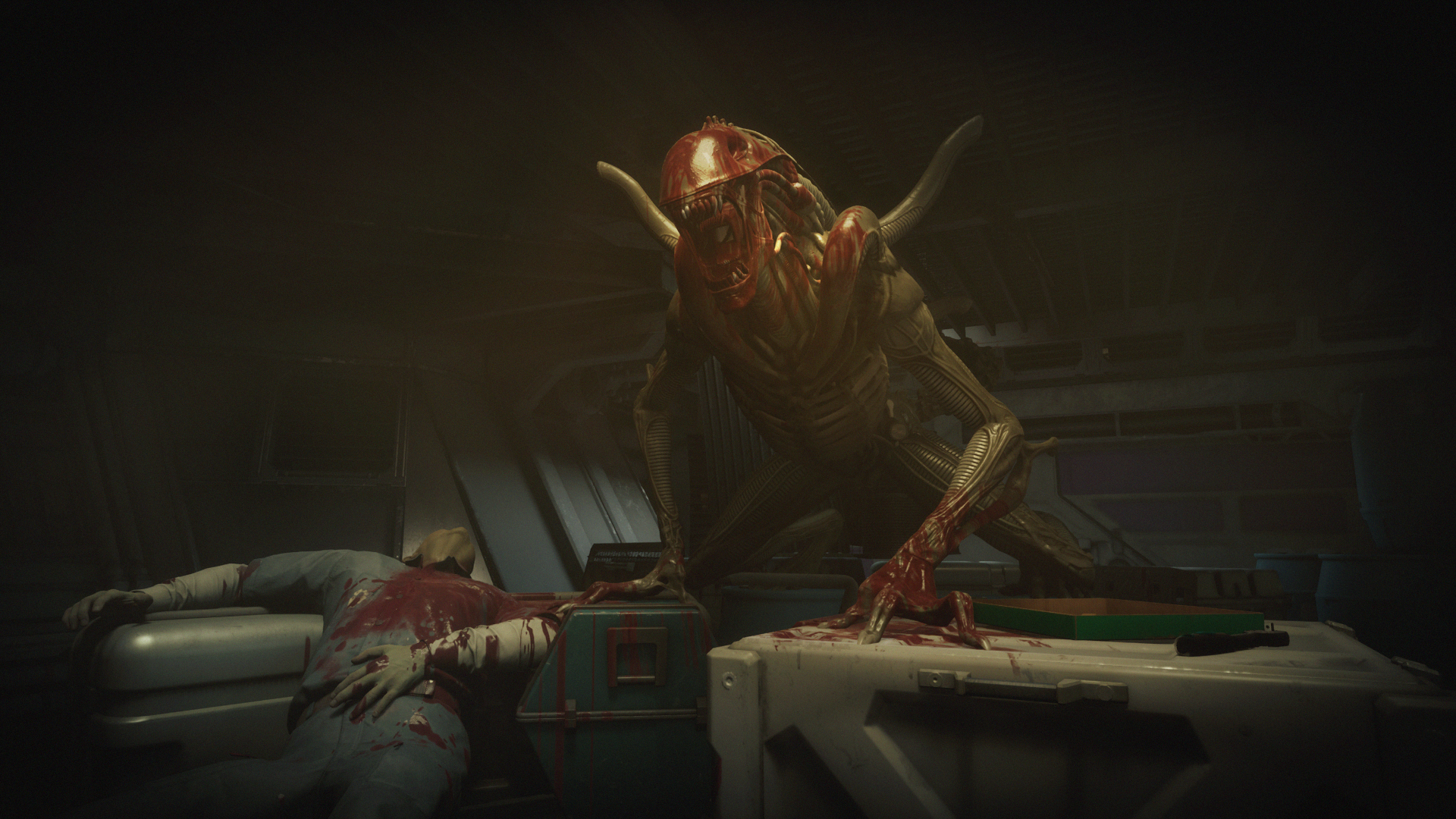
Title: Alien: Rogue Incursion Part One Evolved Edition
Developer: Survios
Publisher: Survios
Release Date: September 30, 2025
Platforms: Steam, Epic Games Store, PlayStation 5 | PS5 PRO, Xbox Series X|S
Reviewed on: Xbox Series X
Price: $29.99 (USD) for the Standard version, $39.99 for the Deluxe version
Earlier this year, I reviewed the Meta Quest 3 version of Alien: Rogue Incursion Part One and wrote extensively about how that VR experience was a dream fulfilled for this lifelong Alien fanatic and gamer. Never did I imagine that a flat-screen / console version of the game could come anywhere close to that pinnacle experience of playing in a fully realized virtual environment on a Xenomorph-infested colony. So when I say that I COULD NOT WAIT to write this review—it means something.
Alien: Rogue Incursion Part One Evolved Edition is, simply put, the superior version of this game; and keep in mind, the VR version is already on my top-five list of greatest Alien video games. Somehow, Survios accomplished the rare feat of taking a hit VR game and making it shine on flat-screen, without losing any of the atmospheric storytelling and utter dread of its virtual reality counterpart.
Alien fans and console gamers alike are in for a treat with this one, and I suspect people will be talking about this game for a very long time.
Check out the launch trailer, as well as the rest of my review below!
Synopsis
Long-time Alien fans and consumers of the Alien Expanded Universe will appreciate that Alex White wrote the story for Alien: Rogue Incursion. White is the celebrated author of Alien: The Cold Forge and Alien: Into Charybdis, both celebrated novels from publisher Titan Books. To read more of our coverage of the expanded universe, click here.
Spoiler-free synopsis from Survios:
“Zula’s Fight Begins Here: Part One of this gripping two-part story thrusts you into the violent world of Alien, where you will uncover the secrets lurking within the GES (Gemini Exoplanet Solutions) facility on LV-354, the enigmatic planet Purdan. This installment stands alone as a complete story, yet leaves you hanging on a thrilling cliffhanger, eager to dive deeper into Zula’s unfolding story in Part Two, where she will face new challenges and deadlier enemies.”
Detailed synopsis with mild spoilers:
Former Colonial Marine Colonel Zula Hendricks receives a distress call from the planet Purdan, where a secret research facility called Castor’s Cradle is being operated by Gemini Exoplanet Solutions, the same corporation featured in Alien: Isolation. This Weyland-Yutani competitor is conducting highly dangerous and unethical research with Xenomorph specimens, and Zula’s former squad-mate Benjamin Carver, who is now head of security at Castor’s Cradle, has key information and is requesting extraction.
Upon seeking permission to land on Purdan, Zula and Davis 01 (her long-time synthetic companion) are shot down by the automated defense systems, only to discover upon surviving the crash that Castor’s Cradle is a ghost town with a full Xenomorph infestation.
Zula Hendricks must survive long enough to find Carver and escape with the incriminating data, but many dark discoveries and terrifying surprises await.
Gameplay

Image: Survios
While I will say that playing this game in VR is a truly special experience that every gamer and Alien fan should try, I’m happy to report that Survios has done a masterful job of transitioning the game to a more traditional experience. To be frank, the VR edition of the game is terrifying; the need to listen to sounds in the environment, and the ability to complete tasks with one hand while holding a weapon in the other, make that medium perfect for an Alien game. But somehow Survios actually elevated those experiences in the non-VR edition; the impeccable environmental details and the artificial intelligence of the Xenomorph enemies (surpassed only by Alien: Isolation) create an all-time gaming experience.
Indeed, not since Alien: Isolation have I felt this level of dread while playing an Alien game. As many have noted about Creative Assembly’s 2014 masterpiece, the foreboding sense of danger and terror build to nearly unbearable heights as gamers progress deeper into that game. That sense of dread captured so masterfully what the original two films accomplished under the hands of Ridley Scott and James Cameron. I’m here to tell you that Survios has done the impossible and matched that level of game design in Alien: Rogue Incursion Part One Evolved Edition.
Despite having a Pulse Rifle, Shotgun, and high-powered Revolver, I never felt comfortable, safe, or even in control of the situations I faced in this game. The Evolved Edition pulls this off by a cacophony of elements, each finely tuned to create dread for the player. The game’s visuals and sound design often deprive the player of core senses like sight and hearing (I highly recommend turning the brightness down to the recommended levels, as it truly captures the intended experience); as players make their way down the corridors of Castor’s Cradle, there is the constant sense that something awful happened here, just moments before you arrived. Bodies are torn apart, their entrails and blood dragged across floorboards and into ventilation shafts; lights rarely work, instead flickering or shutting off entirely; even Zula’s flashlight only grants enough illumination to see a small distance ahead.
Beyond the outstanding use of lighting in this game, the developers keep ammo running low for players, despite the frequent caches scattered around Castor’s Cradle. The Xenomorphs are hard to kill, and players will quickly burn through ammo trying to take them down, causing them to think carefully about which weapon they will use and the consequences of that choice. As the game progresses, players will see their ammo counters approaching zero, forcing them to make hard decisions about staying to fight or risking a flight to a Panic Room.
But without a doubt, the crowning achievement of Evolved Edition is the massively improved artificial intelligence behind the Xenomorphs. In the VR edition of the game, I’d rarely use my Motion Tracker, instead simply relying on my hearing to alert me to the presence of an alien. However, that won’t cut it in this version of the game; even with the Motion Tracker in use (something I rarely put away in my Xbox playthrough), the Xenomorphs are too fast and too clever to escape. Hyper-vigilance is a MUST, and even then you have to be calm under pressure and make your shots count.
The Xenomorphs’ significantly improved AI allows them to hunt and stalk the player more effectively. They have better awareness of the environment they are in, and will react to how the player behaves (similar to the Xenomorph in Alien: Isolation). Whereas the Xenomorphs in the Meta Quest 3 version were predictable and routine (to the point where I never felt too stressed dispatching them), these Xenos are terrifying. For example, one go-to strategy I’ve used throughout my playthroughs on VR (and early in this version) was to place the proximity grenades behind me when working on a computer terminal or rewiring a circuit box; the explosion would kill the first attacker and alert me to others in the area. But as my playthrough progressed, the Xenomorphs adapted to my strategy and changed their attack patterns. They would crawl horizontally on the walls to bypass the cone of reactivity for the grenades and then rush at me once safely on the other side, rendering my trap completely useless; and this didn’t happen just once, they remembered my traps for the rest of my playthrough.
Another instance of Xenomorph intelligence came when I locked myself in a technology lab. The room was inside a two-story structure, with a balcony on the second floor overlooking the lab. I was on the ground floor and locked a pressure door behind me as an alien stalked me through the facility. Rather than accepting defeat, the Xenomorph worked its way down the hall, up the flight of stairs, back down the hall on the second floor and attacked me by leaping down from the balcony. The Xenomorphs in the Evolved Edition of the game are much more aware of their surroundings and use them well in their hunt.

Additionally, Xenomorphs would attack in pairs or even groups of three and react to the movements of their hive-mates. If one came at me straight on, the other would crawl on the walls and the third would seemingly disappear altogether, only to drop from the ventilation shaft above me or pop out of the crawlspace behind me. If I shot the first attacker dead, the others would adapt and change tactics. No two kills were alike, and I never felt like I was safe. And that’s just the story inside buildings—getting attacked outside is a near death sentence, as the increasingly bad storm makes visibility nearly zero.
I believe once Evolved Edition has been out for gamers to play all the way through, people will talk about the game as being one of the must-play, iconic Alien gaming experiences. The improvements to the game reflect criticisms of the VR edition and show that Survios is committed to making something special.
Combat
One thing I was very curious to see with the Evolved Edition of Alien: Rogue Incursion Part One was how combat would feel. Being a game initially designed for VR presents significant challenges for the development team. How would they make combat, and in particular the aiming and changing of weapons, feel immersive? Well, it isn’t immersive in the same way as the VR experience (obviously), but it is unique in its own right and complements the horror-shooter genre of the game.
First (and similar to VR), player will notice there is very little user interface on the screen. Aiming weapons requires looking down the iron sights of the weapon. This requires focus, something that’s difficult to maintain when three Xenomorphs and a Facehugger are barreling toward you. In VR, though, this motion feels somewhat natural, just like holding an object in your hands. Aiming in the Evolved Edition is harder, less natural; but it’s a perfect fit for the genre. (To be fair, it’s no different than the traditional combat controls for most first-person shooters, minus the UI.) The slower, more-demanding tasks of aiming and reloading feel realistic, less like a video game. At the risk of making too many comparisons to Alien: Isolation, it feels an awful lot like Amanda Ripley’s movements in that game. I think players will find themselves constantly comparing the two, and I believe the game invites this comparison, a few times very directly.
The VR version of the game allows players to switch between weapons by grabbing different parts of the body where they are stored. This is both challenging during combat and incredibly fun. The Xbox version of the game allows players to swap between the main weapon and the revolver by tapping the right bumper (RB). This is okay, but I wish there was a way to customize which weapons it switches between or that there was some other way to access all three weapons (the quick select menu was awkward for me, accessed by holding RB down while positioning the stick toward the desired weapon). Overall, these were minor concerns for me and did not negatively impact my experience of the game.
Puzzles and Exploration

As players explore Castor’s Cradle, they will encounter work stations that contain control panels and emails. These work stations appear nearly identical to those in Alien: Isolation and fans will likely swell with nostalgia. However, much like the source material, players can be killed by Xenomorphs while working at these stations. The added complexity of VR gaming, however, is that operating these work stations requires physical movement; the console-based game is nearly shot-for-shot like the controls in Alien: Isolation, with limited to no visibility outside of the computer screen.
Certain rooms will be unavailable upon the first traversal as security clearance, power-failure, and physical obstructions restrict entry. This incentivizes players to return to previous areas, particularly if they desire to complete every detail of the story or collect all items.
The puzzles in Alien: Rogue Incursion are wonderfully varied and feel natural to the world of Alien. These range from rewiring utility boxes (you’ll feel just like Hudson!), to collecting data drives, energy cells, or encrypted data that allows Davis 01 to hack doors. My personal favorite of these was the rewiring of utility boxes with the CC34 Insulated Clamp. These puzzles are often presented to players during extremely tense moments, such as squatting in an air duct with Xenomorphs attacking or the Motion Tracker pinging. Taking the time to figure out which wire needs to get connected to specific locations in order to open a desired door or allow power to a specific workstation felt excruciating in the best possible way.
Always, players will be on the lookout for Panic Rooms—key locations scattered throughout Castor’s Cradle where players can lock themselves in a safe room, protected from Xenomorph attacks while they save, reload weapons, or study the map. Just don’t forget to close the door behind you.
I also thoroughly enjoyed using the ME2 Hand Torch, which allows players to cut through welded doors or break into storage lockers that have been sealed tight. My only critique of Survios’ use of the tool in game is that players don’t get to use the ME2 Hand Torch to seal doors up, only to break through. Imagine the added stress of having to seal yourself into the safe room or facing the prospect that a Xeno will pry its way in. But perhaps that will come with Part 2 of the game, which is set to release at an unspecified time in the future.
The Evolved Edition adds some devious new traps for players. Random lockers or security boxes will contain Facehuggers that will pop out at the player upon opening. This deepens the tension players already feel between a desire to explore and the need to conserve ammo and medical supplies. Entering certain hard-to-access rooms will often trigger Xenomorph attacks from three to five aliens, much greater numbers than the VR edition.
Story Analysis (WARNING: MAJOR SPOILERS)

Warning: this section contains MAJOR spoilers for the game. If you do not wish to read spoilers, please skip down to the next section labeled “Music and Voice Content.”
Simply put, the story in Alien: Rogue Incursion is spectacular. Survios made a wise decision in putting Alex White in charge of the story and in working with Disney and 20th Century Studios to ensure the game blended seamlessly with the Alien Expanded Universe.
Much of the narrative is told through environmental storytelling via investigation of Castor’s Cradle and through emails and audio recordings; however there are some damn compelling cutscenes.
The first act of the game focuses on Zula and Davis 01’s exploration of Castor’s Cradle and on their attempt to locate Benjamin Carver while repairing their damaged ship. The first act comes to a dramatic close when Zula and Davis must take a stand in the Mess Hall, which has become a slaughter house for the crew of Castor’s Cradle. Despite heroic efforts from Zula, Davis 01, (and the player!), the Xenomorphs win this battle. Davis is damaged and Zula is taken to the hive and cocooned in the wall.
This first act gives players a sense of scope in terms of the situation and damage of Castor’s Cradle. It’s a full-blown infestation, just like LV-426. You feel powerful as you cut down wave after wave of Xenos, and when you’re finally taken down, you may incorrectly believe you simply died. It actually comes as a great shock when you wake up cocooned inside the hive.
The second act of the game begins with Zula waking up as Ovomorphs release Facehuggers, one at a time. This is gut-wrenching and brutal. Players have a fully loaded (six rounds) revolver in their hand despite being cocooned. However, there are seven Ovomorphs; even if players perfectly aim and kill each approaching Facehugger, they will find themselves one round short. Zula is impregnated with a Chestburster.
During her time unconscious, she is visited by visions and dreams of Benjamin Carver, the Colonial Marine who carried her from the battlefield many years ago when she was critically injured. His words that this is their “worst nightmare” and that there will be “no glorious death” serve to reinforce the bleakness of the situation and ultimately make Zula’s grit and determination all the more inspiring when she refuses to go down without a fight.
Players must use a fallen ME2 Hand Torch to cut their way out of the cocoon; however, the nest guards will not allow Zula to leave and will attack her if she gets too close. Players must work their way over to the irreparably damaged body of Davis 01, who came looking for Zula in the hive, only to be destroyed by the Xenomorphs. Zula refuses to leave him there to die alone, so he orders her to cut off his head and take him with her as she escapes the nest, directing her to his fallen shotgun.

This section of the story is visceral and moving. Survios does an excellent job of highlighting the best qualities of Zula Hendricks while covering new ground—not an easy task when dealing with an already established character that has extensive lore. The relationship between Zula and Davis is beautifully rendered and fits well with other pieces of canon such as the comics or even the recently released Alien: Seventh Circle.
The second act of the game focuses on Zula’s plan to “carve her name” into the foundations of Purdan as she attempts to go down fighting. During this stretch of the game, she comes to terms with her own death and reflects on her relationships with Davis 01 and Amanda Ripley.
During this section of the game, players can access employee emails and audio recordings detailing the cruelty and heartless greed of Gemini Exoplanet Solutions. One particularly disturbing email recounts how the corporation purchased lobotomized convicts and used them to grow Xenomorphs via Facehuggers. One employee recalls how the people cried and whimpered despite being unable to speak as they underwent experimentation.
As this section comes to a close, Zula is sprayed with some kind of medical compound that appears to kills the Chestburster inside of her, though players and Zula don’t know it at that point in the game. The second act comes to a powerful conclusion as Zula battles a 60-second onslaught of Xenos as she attempts to get a moving communication out to Amanda Ripley, warning her of what they found and about the truth regarding Gemini Exoplanet Solutions.
I absolutely loved this moment and honestly teared up listening to her words to Amanda while simultaneously feeling like the ultimate badass mowing down Xenomorph after Xenomorph. Well done Survios and Alex White.
The third act of the game revolves around Zula’s path back to her ship to explode it like a bomb, taking out the whole of Castor’s Cradle. However, the synthetic staff of the facility have now woken up (many of whom look like off-brand Working Joes—love it!). In order to carry out her plan, Zula must make multiple trips to the medical facility located deep within Castor’s Cradle.
This part of the game is incredible. OF COURSE there’s a creepy medical facility that is without power and full of danger. (San Cristobal Medical Facility, anyone?) It is during one of these trips that Zula becomes aware of the possibility to remove the Chestburster through the surgery operation center.
In a dramatic moment, Zula is awake while strapped into the surgery unit, having the Chestburster removed (the first-person POV is perfect for this); in a terrifying twist, a fully grown Praetorian Xenomorph obliterates the medical synthetic helping with the surgery and then stares down into the operating theater at the player, making clear its intention to kill you next. Only problem? You haven’t been sewn shut yet and still have a gaping hole in your chest.
Zula just barely makes it out of the operation theater with her body stitched close before having to do battle with the Praetorian, whose armor plating makes it immune to Pulse Rifle fire or shotgun blasts. Players must trap the creature in the operating theater and use surgical lasers to cut through its armor before making it vulnerable to exploding pressurized pipes and eventually weapons fire.
The battle is claustrophobic and exhilarating in all the ways an epic conclusion to an Alien adventure should be. Seeing that Praetorian finally fall to the ground dead was a thrill.
The game ends with Zula taking an elevator down to a secret sub-basement to ostensibly meet Benjamin Carver; however, when the elevator doors open, it is a bizarrely malfunctioning synthetic that is using his voice. It carries a weapon and begins to move toward you in a disturbing manner, before letting out a shrill Xenomorph cry. Then the credits roll.
Talk about a cliffhanger!
I really enjoyed the final act of Alien: Rogue Incursion. The game’s conclusion feels like a worthy climax that requires players to use all the skills they learned along their journey. Obviously, it’s hard to wait the many long months before Part 2 releases, but I appreciate what Survios has done with Part 1, and I’m more than willing to give them the time they need to give us a quality conclusion to the story they so skillfully began.
Music and Voice Content

The sound design and voice acting in Alien: Rogue Incursion is superb.
The spatial audio design allows for true immersion and complements the tension in the game. Players will hear Xenomorphs before they see them, as the Perfect Organism crawls inside air ducts, scales walls, or drops from the ceiling. If possible, I highly recommend playing the game with a good surround sound system.
Zula Hendricks is voiced by Emmy Award winning actor Andia Winslow and Davis 01 by the talented Robbie Daymond. Both of these actors nail their roles, and as a hardcore Alien fan, it was a treat to experience these characters brought to life with such talent and attention to detail. Particularly moving was the care for Zula communicated through Daymond’s voice during moments of the game where death seemed inevitable. Similarly, Winslow’s steely passion and fire as Hendricks when she sends off an epic off-world communication about her last stand on Purdan. Absolutely badass!
Final Score
The launch version of Evolved Edition does have a few glitches. My fight with the “final boss” had a notable issue of the creature getting stuck a few times, but overall the issue was relatively small. One issue I’d love to see a patch for is allowing players to close lockers after opening them, something that is currently possible in VR; this would improve visibility and allow players to reach into adjoining lockers much easier. One glitch specific to the Xbox version of the game is that force feedback is on the triggers when it is intended to be on the controller.
Overall, these minor glitches did not impact my enjoyment of the game. The atmosphere, dread, and heart-pounding action make this game a personal favorite. The VR and console experiences each offer something unique–I’ll always love the immersion of the VR edition, but the intelligence of the Xenomorphs in the Evolved Edition is something I’ve always wanted from an Alien game. I enjoyed the challenge of having to outsmart the Perfect Organism as I fought my way through Castor’s Cradle.


While I’m disappointed that I have to wait a while for Part 2 of Alien: Rogue Incursion, I more than got my money’s worth from this game and can’t wait for the rest of the story. This game rates five out of five stars for me, and I look forward to hearing from the community about how they enjoy the game.
Tell us what you think! Will you be playing Alien: Rogue Incursion Evolved Edition? Share your reactions in the comments below or join the conversation on Boss Rush Network’s Discord, X, and Facebook.
Featured Image: Survios
David Lasby is the Editor-in-Chief for Boss Rush Network. His favorite video games are The Legend of Zelda, Metroid, and the Alien franchise. You can find him on X to talk all things Nintendo, sci-fi / fantasy, and creative writing.

Leave a Reply