
GAME REVIEW: Sensei! I Like You So Much!
Developer: LaoO Studio
Publisher: Infini Fun, Erabit
Release Date: August 5, 2025
Reviewed On: PC
Price: $16.99
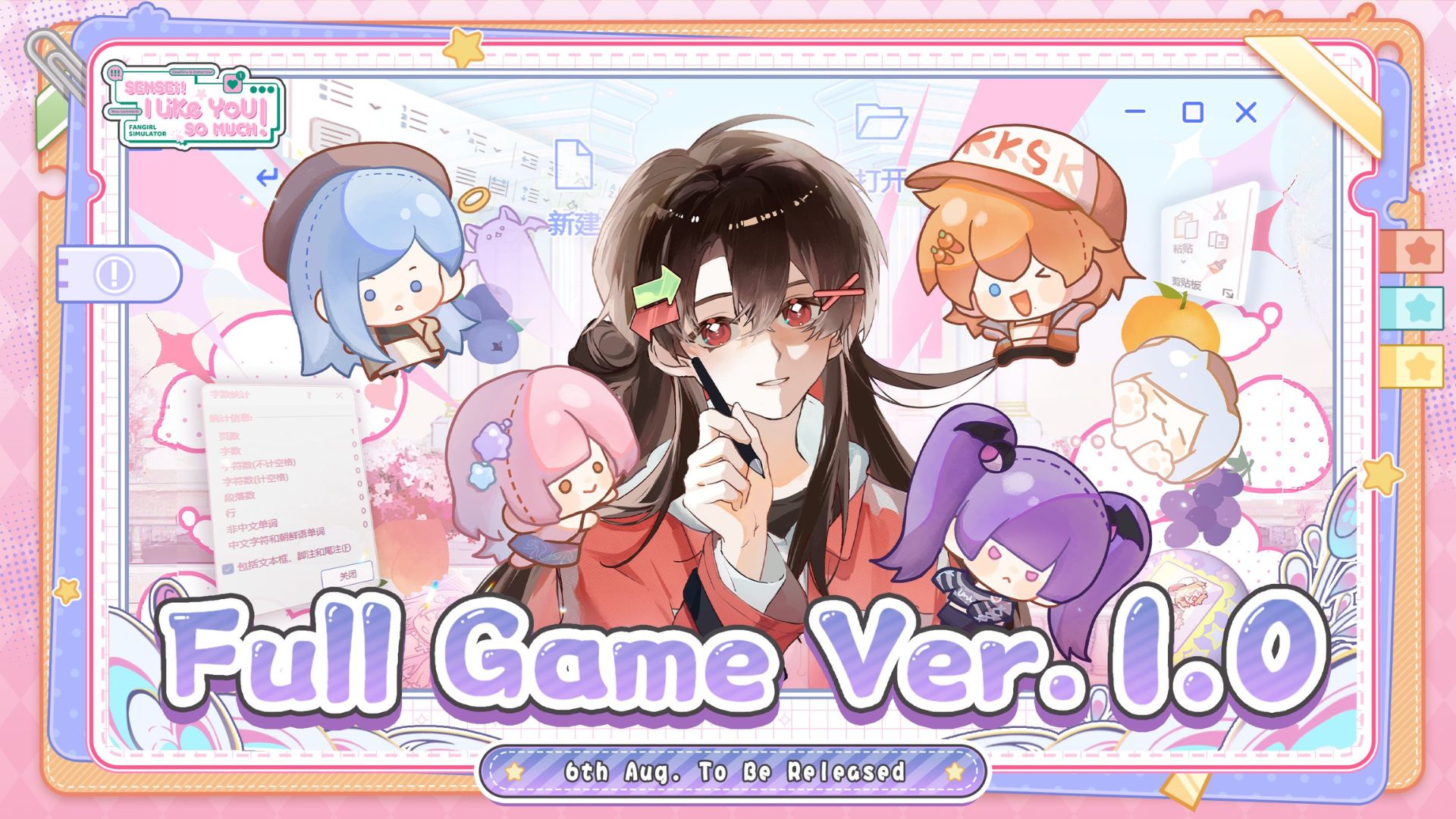
Sensei! I Like You So Much! is a role-playing simulator. Players are a fanfiction (fanfic) writer whose alias has been outed by a fellow classmate. Bolstered by the classmate’s confidence in their writing, players strive forward with posting their fanfiction online and taking a larger part in the fandom community. With 100 days until the big convention, players must write fanfiction and gain a fan base to ensure a successful convention stand.
Story

The story itself is nice, and that’s really it. I enjoyed each character, finding their intricacies and personalities a delight to learn about. Their dynamics with each other felt real as if I was watching a group of friends hanging out. But, when it came to the main character, that story ran dry. It became awkward between the characters and the player, almost stilted in a way. Despite liking the characters, the bond I felt with them didn’t change or really improve in the duration of the story. In fact, I was a much bigger fan of seeing the whole group dynamic than seeing the development between the main character and one of their friends which is a main part of the story.
Even when building rapport with the characters to the highest level, thus unlocking more interactions and story bits about them, I didn’t feel that much of a connection. The story, to me, felt representative of how one common hobby can bring many different kinds of people together in their love for it. I hoped to see how this commonality could help deepen their friendships and allow their relationship to branch outside of this hobby. A person’s hobby is not their main character trait, even if they really love it. I had wanted to see these characters and their efforts outside of the fandom but it felt rather lacking.
As someone who also has written fanfiction, reads them, and taken part in fandom communities, I’ve never solely dedicated myself entirely to one fandom nor to the point that it became the sole part of my personality. It’s a facet of me more than anything, and I couldn’t see this same thing reflected in the characters of the game. Perhaps because it hits closer to home, since I am part of the community the game features, I am harsher with its portrayal, but it feels like an isolated view of the fandom and its culture.
To me, it felt like more attention was brought to the additive features of the game like decorating and creating than the actual game’s story itself. As a role-playing game, the weakness of its story feels self-defeating. If there isn’t a story present for players to role-play in, what makes it a role-playing game?
Gameplay
The gameplay itself is repetitive. It’s a good and bad thing. Players go around to different locations that inspire ideas for their writing under certain tags like fantasy or angst. Based off these ideas, they go through an automatic prompt, choosing decisions in the story that decide its final tags to create a fanfic. I actually love this part of the game. It made the repetition a bit different, and I enjoyed seeing what ideas the developers included.

Aside from this gameplay mode, there were additional decorating modes and mini games. Players could work as a cashier, selling items at the convention or working at the mall. They could browse the online store, looking for merchandise (merch) or furniture to decorate their rooms. There was a gacha to get merch in capsules.
Players are free to create badges and other things, decorating it with whatever merch they received to have unique articles. In fact, the characters themselves being shipped for the fandom are completely customizable for players to create from scratch. I spent a lot of time on this as well, even trying to create characters from anime to include in the game.

The problem came when with its replayability. Doing all of this the first time around was fun. It felt like I had done a long and meaningful journey, exploring everything I could do to get to the end goal. But, I couldn’t focus on building rapport for a single character, missing story events and interactions, so I went back. It got a lot harder in keeping my attention.
The gameplay felt slow, felt like all I was doing was clicking a few buttons and moving on to the next day. Most of the additional content outside of the writing is optional and not needed in order to complete the main story, so I ignored a lot of it. The main gameplay of writing fanfiction became less entertaining, trying to quickly get through it to move forward. It’s a problem many simulation games have, but with how many additional features were included, the repetition of it should have been somewhat negated. But none of it kept my attention enough that I felt like I wanted to do it again in my next playthrough, so I didn’t.
Representation of the Fandom Community
As I said earlier, I’m a part of the fandom community. I follow artists and writers of different fandoms, contributing my own work online, and have visited conventions. Because of this, I’m really conflicted with the overall representation of the fandom community. It’s a great place and also a horrible one. Sensei! I Like You So Much! does well in showing how the fandom can be very welcoming and toxic to fans.
I also enjoyed that there were representations to different aspects of this community. It wasn’t solely about fanfiction writers but also readers, artists, and live meet ups. It encompassed how fans can contribute to their hobby in different ways. Most times, these things are simply a way for fans to show further appreciation outside of liking the media. It’s not necessary, but it’s a way to show their love for the media. But then, there were other issues.
The part of the main gameplay that really got me was that, in order to participate in conventions, players bind the fanfiction into books. Then, it’s sold at the convention. That is a big problem. It’s been a long-standing problem in the fanfiction community of works being stolen and then hidden behind paywalls or others printing and binding fanfiction to sell. None of the fanfics are original content; it uses characters and story elements from real pieces of media. These assets are not owned by the fanfic writer. It’s similar to how people sell Disney merch with the logo and everything but aren’t an official retailer for Disney. It’s easy to get into legal and monetary trouble doing it.
The game promoting this happening, even at a convention, is a big red flag. Anyone who is a fanfiction writer usually knows and understands this. It’s not only limited to fanfiction but also fan art as well. There are gray areas and loop holes, but a good rule of thumb is to not sell it at all, instead giving public access to view the work.
Another problem I had with the representation was that it felt elementary. Although it did delve into some different aspects of the community, the showing itself was surface-level. There wasn’t much about the fans and their struggles about reposting or stolen work. A lot of the ideas and fanfictions in the game were AUs or Alternate Universes. Most of the time, when an AU tag appears, most people’s thoughts, even fans, go to putting characters into an entirely different genre or setting. Although that is a huge part of the tag, a much larger tag that appears in works is Canon Divergence.
I’m as big of a fan as any other reader in seeing characters placed in universes different than their own. A bigger part of me though is a fan of seeing how people felt about the original media itself and its story and where it could have diverged or gone differently. A huge part of the love letter fanfiction presents to the original media is the love for certain characters or wanting to change endings. A great example of this would be Severus Snape from Harry Potter. What could have changed if he didn’t have a fight with Lily? What if he decided to treat Harry differently? What if he knew different things prevalent to the story’s future? These divergences are what many fanfiction writers like to discover and explore. It’s part of why AUs in different settings are so popular as well. What if Severus Snape was born in a world where magic didn’t exist at all? Or a world that coincided or crossovers with a different media? How different would circumstances and people be?
Sensei! I Like You So Much! does briefly dwell on this with how the characters talk about loving how artists and writers portrayed characters well to their canon personalities or reinterpreted them. But it’s such a small mention when it is a main part to how fandoms recreate the original media.
Aside from the tropes themselves, the writing itself feels younger as well. The best way I could put it is that it feels like fanfiction back in the 2010s when the writers and readers were much younger. Including myself, I used to love these tropes that were like a whiplash of drama. Oh, a dramatic reveal here! A secret assassin there! Gasp, they were hiding their true power the whole time! That is still a large part of the fandom, I won’t lie. But, there’s been many gems, hidden and very popular, that have emerged as fandom communities grew larger. There are some deep, truly soul-searching stories that question the original writer’s intent with the universe they created and how they limited its own growth. There are fanfics that make readers question if they judged a character too harshly or too kindly, looking at the different facets of that character in how they acted in the story. Simply put, the game itself lacks the depth in which many writers in fandoms explore in their stories.
Now, many of these problems can stem from how it is simply a game that can include only so much content. I wasn’t expecting perfection or even a great representation of fandoms from the game. I also wasn’t expecting for the game to cross what many in the community consider red lines or to not delve deeper into its own story as a game about fanfiction writing.
Final Score
As a role-playing game, I put the game at 2 out of 5 stars. Like I mentioned, the story itself is weak and lacking in depth. It provides a storyline that feels generic and without an end point. It feels like it fails to meet the typical things I would expect out of a story like a conflict or a climax point. I did still enjoy the characters in the game and getting to know them. The beginning of the story felt great, but as it dragged on, nothing seemed to happen. The biggest conflict I encountered was with one other character and that resolved itself quickly.
As a game itself, it ranks closer to 3 out of 5 stars. The gameplay is there. It can be entertaining and did push me through completing the game in various methods. It suffers from other simulation games in that it can be repetitive and long. I think a big part of what makes a good game is that players enjoy it enough to either want to replay it or reexperience it. Unfortunately, I didn’t feel that way with this game. It doesn’t really challenge players nor does it make the comfy, casual experience that a lot of life simulators tend to have. Because of this, I can’t say it’s a great game in itself.
Overall, I put Sensei! I Like You So Much! at 2.5 stars out of 5. It’s great during its first playthrough in exploring its mechanics and what the game all offers. But the lack of story and its portrayal of the fandom itself made it suffer a lot. For anyone who is new to being part of a fandom, it definitely works as a sort of introduction to how a fandom tends to work and converge. However, for someone who has been in fandoms and their spaces, it feels rudimentary. I was really excited to see the game and what it could offer. But, I ended up disappointed in its portrayals and lacking story.
What are your thoughts about Sensei! I Like You So Much! Would you be willing to try out the game? What parts increased or decreased your interest? Share your thoughts in the comments below or in our Boss Rush Discord!
Featured Image Source: LaoO Studio
Boss Rush Podcast – A Podcast about Video Games

The Boss Rush Podcast is the flagship show of Boss Rush Media and The Boss Rush Network. Each week, hosts Corey Dirrig, LeRon Dawkins, Stephanie Klimov, and Pat Klein, as well as their friends, fellow creators, developers, and industry veterans, share their gaming experiences. They discuss what they’ve been playing, explore rotating segments, debate the Boss Rush Banter topic of the week, answer community write-ins, and more. Patreon subscribers at any tier enjoy exclusive access to the Boss Rush Podcast Patreon Show twice a month along with other perks and extras.
Follow and Connect with Boss Rush Podcast on Social Media
X/Twitter + Bluesky + Instagram + Threads + YouTube
Listen to Boss Rush Podcast on Podcast Services
Apple Podcasts + Spotify + Goodpods + Amazon + More Links
Thank you for supporting Boss Rush Podcast and the Boss Rush Network
Thank you for watching or listening to The Boss Rush Podcast. If you’re watching this episode on YouTube, hit the Subscribe button, Like the video, and hit the notification bell so you don’t miss an episode! If you’re listening on Apple Podcasts or Spotify, consider leaving us a rating and a review as it helps with discoverability and growth. Support Boss Rush on Patreon for exclusive content, early access and audio versions of shows, become a Patreon Producer, and more. Visit our website for all of our content including reviews, news, daily Boss Rush Banter discussion topics, listicles, features, and more. However you support us, it means so much to us. Thank you for your continued support of the Boss Rush Podcast and the Boss Rush Network.

Leave a Reply