

With The Legend of Zelda: Echoes of Wisdom mere weeks away, I’ve delved into many of the previous entries in The Legend of Zelda in which the player can directly control Princess Zelda. Unsurprisingly, with the notable exclusion of The Legend of Zelda: Spirit Tracks, this is exclusive to the realm of spinoffs.
The world of The Legend of Zelda spinoffs is an interesting one. Almost every Nintendo franchise is subject to an extensive number of spinoff games. In some cases, like that of Wario and the WarioWare games, their identity can end up tied closer to the spinoff titles than to their “mainline” series. However The Legend of Zelda has a reputation of remaining relatively untouched by spinoff titles.
In celebration of the impending release date of Echoes of Wisdom, I thought it would be fun to rank the spinoff titles from worst to best. It is worth noting that this ranking is based on their value as video games, not simply as curiosities or amusements. Additionally I’ve selectively chosen games to exclude. I am not including Zelda-flavoured apps with little substance like the DSi’s Too Much Tingle Pack. I am only covering games with independent releases, not spinoff modes within an existing game, such as The Legend of Zelda: Battle Quest minigame within the Wii U’s Nintendo Land, or Tetra’s Trackers within Four Swords Adventures. Lastly, I am not covering the LCD games.
With this preamble out of the way, let’s get started!
11. Zelda’s Adventure
This abhorrent game brings up the bottom of our list.
Game development is incalculably difficult, and I am a firm believer that even the worst games are generally made with love. I don’t believe people set out to make a bad game.
Zelda’s Adventure for the Philips CD-i makes me reconsider that notion.
Zelda’s Adventure was released in 1996 for the ill-fated Philips CD-i console alongside The Wand of Gamelon and The Faces of Evil. I cannot justify lumping the three games together as is traditionally done. The Wand of Gamelon and The Faces of Evil are merely bad games. Zelda’s Adventure is hauntingly, irredeemably bad.
A quest to find anything positive to mention is futile from the start. The controls are so bad that only firsthand experience can quantify the extremity of the issue. The hit detection is laughable. The graphics are revolting, as is the animation. The voice acting is amateurish. The music (of which there is little) is genuinely hard on the ears. Do you love the idea of a dungeon track that starts a new loop every time you enter a new screen, in a Zelda game? Zelda’s Adventure has you covered.
Even the live action cutscenes manage to skip “so bad it’s good” territory, to remain simply bad.
There is nothing redeemable about Zelda’s Adventure, and it deserves its spot in last place. Wikipedia claims it is “regarded as one of the worst video games ever made,” and I do not think that is hyperbole.

10. The Wand of Gamelon / The Faces of Evil
The Wand of Gamelon and The Faces of Evil were released for the Philips CD-i in 1993, the year I was born. What a foreboding omen.
These are bad games. The controls feel horrendous, the game design is weak, and the plot is nonsensical. Outside of the cutscenes, the graphics are hard on the eyes. I suppose you could say I am not fiending for a Nintendo Switch port of them.
Yet, I believe Animation Magic developed these two games with the intent of making something special, and ran into limitations posed by the bizarre “console” they were developing for. Most of the issues with The Wand of Gamelon and The Faces of Evil can be explained away by the limitations of the CD-i.
That said, unlike Zelda’s Adventure, there is a lot to appreciate with these two games. As a fan of Zelda II: The Adventure of Link, I appreciate the attempt at another side scroller, even if both games are far too clunky to even meet the standards set by the notoriously clunky Zelda II.
I have significant affection for the full-motion video animated cutscenes. Contemporary response to these cutscenes was split between appreciation and revulsion, but a dominating resurgence via the format of the “YouTube Poop” across the 2000’s garnered a retroactive appreciation for their weirdness. Today I think it is finally safe to admit how charming these scenes are, and I don’t think I’m alone. Developer Seedy Eye Software developed their recent release Arzette: The Jewel of Faramore in the style of these two CD-i games, albeit pairing the CD-i-like cutscenes and visuals with competent gameplay.
The Wand of Gamelon and The Faces of Evil are bad games, and you should not play them.
Am I glad they exist? Absolutely.

9. Tingle’s Balloon Fight DS
Tingle’s Balloon Fight DS was released in 2007 during Nintendo’s bizarre (but highly appreciated) stint of mass-releasing Tingle-themed games and apps. It was a Japan-exclusive reward redeemable via Club Nintendo.
This game is really just a Tingle-coloured reskin of Balloon Fight for the Nintendo Entertainment System.
When I call it a reskin, I’m not intending to disparage, I really mean it. The gameplay is just Balloon Fight.
Just like Balloon Fight, your primary objective is to control an airborne Tingle, popping the balloons of other enemies while protecting your own.
Just like Balloon Fight, you’ll play an intermittent balloon-catching minigame.
Just like Balloon Fight, you have the “balloon trip” game mode, an endurance match as you scroll through a long level full of floating hazards.
There is no doubt, Tingle’s Balloon Fight DS is a reskin of Balloon Fight.
This is hardly a negative! The two concepts are a match made in heaven. The gameplay feels completely natural considering the first time we meet Tingle in Majora’s Mask, he’s airborne. Tingle’s Balloon Fight DS might be the most perfect reskin to ever be made.
There is nothing fundamentally wrong with Tingle’s Balloon Fight DS, and that alone places it well ahead of the CD-i games. However as fun as Balloon Fight is, I’ve struggled to engage with it for longer than an hour at most. It is a fun diversion, but it lacks substance compared to the rest of the list.

8. My Nintendo Picross: The Legend of Zelda: Twilight Princess
Alongside the release of The Legend of Zelda: Twilight Princess HD in 2016, came this Twilight Princess-themed Picross entry. It was available to download via the Nintendo 3DS eShop as a reward for the My Nintendo loyalty program. With the closure of the 3DS eShop, codes for it can no longer be redeemed.
The presentation is excellent. The Twilight Princess theme is so fantastic and well integrated that I think any fan would find joy in playing around with it. Everything from the UI to the sound effects and especially the music, are all directly from Twilight Princess, and the whole thing is developed in a masterful way. This is fanservice no doubt, but it is also a well-made product in its own right. I am a notorious disliker of Twilight Princess, and I love My Nintendo Picross: The Legend of Zelda: Twilight Princess.
If you are a total beginner to Picross, don’t stress, as Midna will helpfully (and begrudgingly) teach you how to play. As you puzzle out what squares to fill in and which to leave empty, a picture will gradually reveal itself.
Ultimately, how you feel about Picross will determine if you enjoy this game. Aside from appreciating the Legend of Zelda trappings, Picross is all there is to do. I am a big Picross fan, so there is a lot of appeal for me. I enjoy that compared to Tingle’s Balloon Fight DS, there is something to actually bite into, but later list entries are simply more substantial.

7. BS Zelda
The Satellaview The Legend of Zelda games, colloquially known as “BS Zelda,” are easily the most obscure titles on this list. The technology behind the Satellaview games is supremely cool for the late 90’s. They were transmitted to the Super Famicom for download using the Satellaview satellite peripheral developed by Japanese satellite company St.GIGA. The games were broadcast as like a television program, and could only be played during their broadcast times.
The first title is BS Zelda no Densetsu, which is effectively a 16-bit truncated remake and remix of the very first game in the series, The Legend of Zelda for the Nintendo Entertainment System. Later, Nintendo would broadcast BS Zelda no Densetsu: MAP2, which was the same game, with a map that was again remixed.
The best release was BS Zelda no Densetsu: Inishie no Sekiban, translated to BS The Legend of Zelda: Ancient Stone Tablets. This can be lightly thought of as a remake of A Link to the Past, though the narrative is significantly different and rather fleshed out. It serves as a functional sequel to A Link to the Past.
Aside from their inherently fascinating history, these games are also very good! Both games look and play very nicely with smooth controls and feel up to the standards set by the games they stem from. This is to be expected, considering they were developed internally at Nintendo.
If you would like to know more, the scourge of Zeldatube himself Bread Pirate, has an excellent video on the topic that explains much more of the technology and history behind these fascinating titles.
6. Link’s Crossbow Training
Is this the most controversial entry on this list?
Link’s Crossbow Training gets a bad rap. Famously, it is the result of a failed attempt to develop a true sequel to The Legend of Zelda: Twilight Princess, and it was released during Wii peripheral fatigue. As a result, it faced anger from Twilight Princess fans who felt robbed of a true sequel, as well as apathy and annoyance from those tired of buying hunks of plastic to stick their Wiimote into. Due to this cross-section of frustration, Link’s Crossbow Training is often heralded as the poster child of bad spinoffs.
In truth, it is pretty great.
I think much of the criticism comes from the unacquainted assuming it is a cheap Twilight Princess asset flip, but that is not the case. Much like My Nintendo Picross: The Legend of Zelda: Twilight Princess, this game was built by the main Zelda team with love and care.
The game feels great, the motion controls are fine, and the presentation is excellent. The utilization of the Twilight Princess assets is seamless and tasteful. For example, the fan-favourite western-themed shootout in Hidden Village is converted into a first-person romp, and it almost conveys the intentions of the set piece better than the original game.
I understand and sympathize with the frustration around what was lost to get Link’s Crossbow Training, but detached from that, the game is a whole lot of fun. It is rather short however, and that prevents it from placing above what I consider “full” video games.

5. Freshly Picked Tingle’s Rosy Rupeeland
Freshly Picked Tingle’s Rosy Rupeeland is the title to kick off Nintendo’s utterly strange series of Tingle-related products across the 2000s. It was released in 2006, and received a European release the following year.
Freshly Picked Tingle’s Rosy Rupeeland is about Tingle’s quest to reach the titular Rupeeland, a heaven for the greedy, by feeding rupees to a tower that grows upwards as it is fed.
The gameplay of Rosy Rupeeland is not the highlight, to be sure. The adventure gameplay is fine but not particularly interesting. The combat is simple and uncompelling, but not frustrating or bad. The dungeon crawling and puzzle solving is simplistic and somewhat laborious. The unique bartering mechanic is fairly shallow. Nothing in Rosy Rupeeland is mechanically bad per se, simply uninteresting.
Where Rosy Rupeeland excels, and what makes it a must-play, is its sheer strangeness. From the story to the atmosphere and the audiovisuals, Rosy Rupeeland is hyper-focused on providing a Tingle-accurate eldritch experience that will leave you laughing and cringing in equal amounts. From the hilarious adult-oriented writing, to the abstract and often creepy art style, the game never relents on its absurdity.
Many Zelda spinoffs feel mostly like time wasters, and Freshly Picked Tingle’s Rosy Rupeeland is the first entry in this list to feel like a full video game. It is well worth your time to experience the absolute insanity it has in store for you. However it does fall short in the gameplay department, and every game from this point onward is excellent in that regard.

4. Ripened Tingle’s Balloon Trip of Love
The sequel to Freshly Picked Tingle’s Rosy Rupeeland released in 2009, and Ripened Tingle’s Balloon Trip of Love is by my estimations, a significantly better game.
This entry sees Tingle leave avaricious desire for money behind and instead embrace a new cardinal sin: Lust. The pseudo-traditional Zelda-like structure of Freshly Picked Tingle’s Rosy Rupeeland is left behind, and the focus is entirely on between point-and-click adventuring. Balloon Trip of Love is a game about wooing ladies.
This is a massive improvement, as the action elements of Rosy Rupeeland felt forced and obligatory. The adventure game aspects were the strong suit of the game, and Balloon Trip of Love is the better game for focusing on it entirely. Well, almost entirely, as Tingle also spends significant time talking up the many eligible ladies in his quest to find love, in an often hilarious dialogue-based relationship building minigame.
Balloon Trip of Love is even more bizarre than Rosy Rupeeland, and the writing remains just as clever. The visuals become even more wild, as the move to the adventure game format allows for frequent experimentation with perspective and visual style. Playing Balloon Trip of Love is at times akin to a hallucination, and one absolutely everybody should experience.
That said, while I think Balloon Trip of Love is a very good game that really has no major flaws, the top three in this list are simply bigger and better in the ways that matter. But they certainly aren’t weirder.

3. Hyrule Warriors: Age of Calamity
Released in 2020, Hyrule Warriors: Age of Calamity is a spinoff of The Legend of Zelda: Breath of the Wild telling the events of the titular Calamity, featuring hack-n’-slash gameplay found in the Dynasty Warriors series.
Much like Link’s Crossbow Training, I think Age of Calamity is retroactively demonized for controversy around the game. The alternate storyline twist that occurs left many fans feeling as though the marketing for the game had lied to them by promising a retelling of the Calamity, and instead offering a what-if scenario. This frustration often led them to dismiss the game itself. Which is highly unfortunate because from both a narrative and mechanical point of view, Hyrule Warriors: Age of Calamity is excellent.
It is a strong mechanical improvement over Hyrule Warriors: Definitive Edition. While most characters in the previous title felt somewhat simple, lending to it’s mindless hack-n-slasher reputation, there existed characters such as Lana who had sophisticated and complex movesets with resource management and variable systems to master. In Age of Calamity, this complexity is the default.
Narratively, Age of Calamity offers the Princess Zelda-led game we’ve always wanted. She is the undoubted protagonist, and develops from a scared teenager to a brave and powerful leader at the charge of armies. In Age of Calamity we are offered a Princess Zelda who takes her fate into her own hands, and experiencing her growth is something I valued long after I finished the game.
I can understand frustration that we didn’t get the true retelling of the Calamity, and that contributes to it getting bronze instead of gold or silver, but I truly value what we got instead.
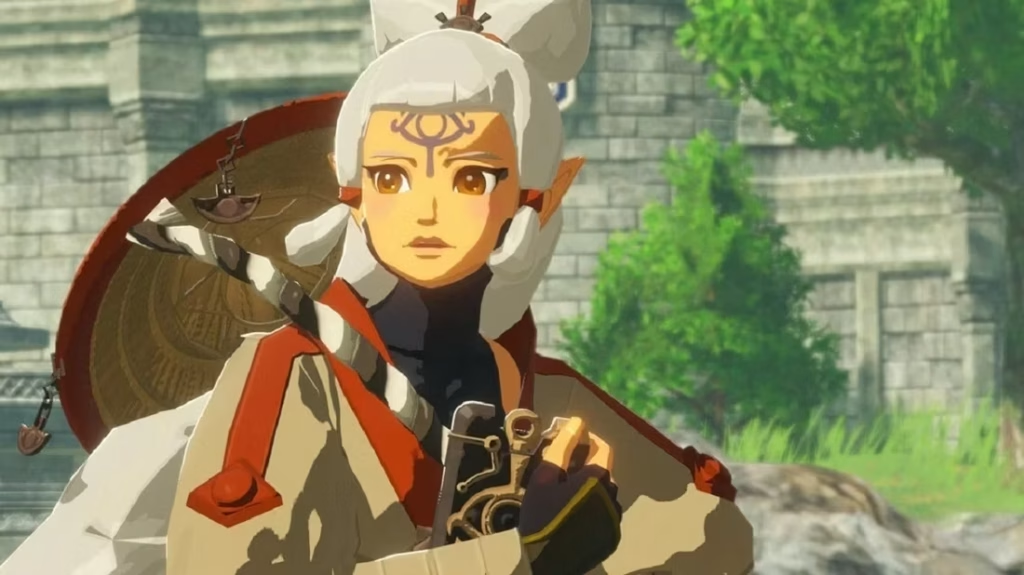
Also, Impa is best girl.
2. Cadence of Hyrule
2019’s Cadence of Hyrule is a unique title in many ways. It is a crossover between The Legend of Zelda and indie darling Crypt of the NecroDancer, developed by Brace Yourself Games. This fusion produces an utterly fantastic experience that feels shockingly like a legitimate top down The Legend of Zelda game, albeit one where you dance and groove your way across Hyrule.
Cadence of Hyrule is not simply a Zelda-flavoured reskin of Crypt of the NecroDancer, akin to Tingle’s Balloon Fight DS. Rather, it is a complete merging of the gameplay styles of both Crypt of the NecroDancer with The Legend of Zelda. You travel the overworld, fight monsters, look for secret caves, and complete dungeons just like The Legend of Zelda. The combat is rhythm-based, the areas are procedurally generated, and the music is bumping, just like Crypt of the Necrodancer. The best features of both franchises are blended into one remarkable game.
It is impossible to not appreciate some facet of Cadence of Hyrule as a Zelda fan. The music, composed by the fantastic dB Soundworks, is incredible. Even the opening, with a smooth, lofi-esque rendition of the title screen theme from Ocarina of Time, is sure to delight.
Many fans skipped the title because of an aversion to rhythm games, but I will always point out that Cadence of Hyrule includes a fixed-beat mode which removes that necessity and facilitates a somewhat more traditional playstyle.
If you have not tried Cadence of Hyrule out, I HIGHLY recommend you do so. It was impossibly close between it and the final entry in this list, and Cadence of Hyrule did not lose out due to any flaws, rather simply due to the herculean efforts of the winner.

1. Hyrule Warriors: Definitive Edition
Released originally for the Wii U in 2014, with 2016 seeing a 3DS port and pseudo-sequel, 2018’s Hyrule Warriors: Definitive Edition is an absolute accomplishment. Containing all the content from the previous releases as well as a bevy of new content, Hyrule Warriors: Definitive Edition is one of the most content-rich games I have ever played. It has modes on top of modes, all of which feel feature complete.
Perhaps one is interested in the main storyline which sees characters from across the franchise come together to face a team-up of notable villains. Or maybe the bulk of their time will be spent in the adventure mode, exploring a number of NES-styled maps to take on battles with unique conditions. This is not even touching on the challenge mode, or story freeplay. Shall we discuss the fairy-raising side game? Or the massive number of alternate weapons and costumes to collect?
The sheer volume of content is complimented by the consistent quality. Koei Techmo put their heart and soul into this game. It is described by the developers as a celebration of Zelda, and that could not be a more apt description. Everything is so thoroughly and lovingly attended to. There is a nearly endless number of references to games across the franchise expertly woven into the game. Have you desired another chance to control Fierce Deity Link? Do you want a personified Volvagia? Have you ever wanted to see what Marin from Link’s Awakening would look like in glorious 3D? Hyrule Warriors has you covered on all fronts.
Musou gameplay is not for everybody and I understand that. I do not begrudge those who don’t enjoy Hyrule Warriors, though I will argue against the assertion that the gameplay is mindless. More importantly, it is so evident that a love for this franchise oozes from every pore of Hyrule Warriors, and I have never before played such a masterful, respectful celebration of a venerated franchise. Hyrule Warriors is an absolute testament to how good a spinoff can, and should, be.

In Closing
While the number of spinoffs in The Legend of Zelda franchise pales in comparison to that of Mario, there is still a surprising number of them considering the anti-spinoff reputation the series has. They surely do range heavily in quality from the spectacular (Cadence of Hyrule) to the shameful (Zelda’s Adventure). More than anything, the sheer variety of gameplay on offer is impressive. From hack-n-slash games to a rhythm music game and even a crossbow shooter, you never quite know what to expect with spinoffs in The Legend of Zelda series.
As we excitedly await for The Legend of Zelda: Echoes of Wisdom, I can’t help but wonder what comes next. Will it be another spinoff? If so, what will be the genre? Perhaps we will get a Hateno-based city management game, or a Stardew Valley-esque life sim based in Kakariko Village. Maybe my dreams will come true, and the Hyrule-based real-time strategy game I’ve imagined in my head for three decades, finally comes to fruition. You never know, because when it comes to spinoffs of The Legend of Zelda, anything is truly possible.
What do you think about my list? Do you disagree with my order? Feel differently about any of the games? Am I too harsh on Zelda’s Adventure? Let us know in the comments down below, or over on the Discord server!
Featured Image: Philips, Nintendo

Leave a Reply