
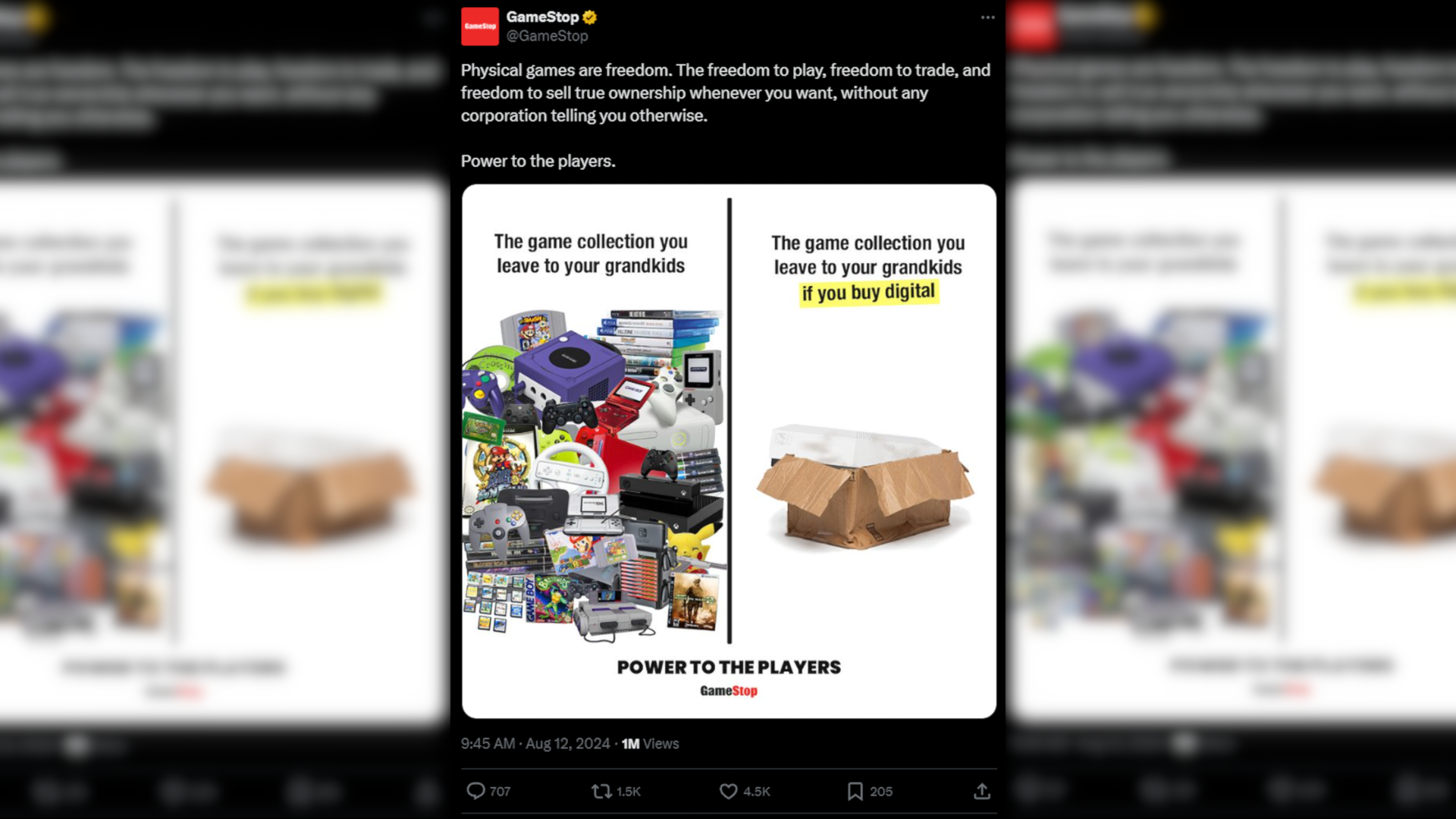
GameStop’s social media team has been having a rough go of it.
The company’s social media presence is generally pretty standard. A quick peruse of their account on social media site formerly known as Twitter, “X,” will reveal that the company largely sticks to posting gaming news, creating memes, and sharing game sales. That is, until recently. As of late, GameStop’s social media team has begun to willingly dip their toes in hot water.

During news of the closure of Microsoft’s digital storefront on the Xbox 360 console in late July, GameStop chimed in with a taunting declaration. Recently, they took another swing with a statement extolling the virtues of buying physical games. It seems like GameStop has launched a crusade for physical media.
The problem is, of course, the idea of GameStop as any sort of authority on physical media collection or preservation. GameStop is responsible for an ever-growing list of anti-consumer behaviour that directly contrasts with their stated concern over physical media. This is not hidden information, and GameStop’s posts have been met with complete derision, with a crowd of replies highlighting the extreme hypocrisy of these kinds of posts coming from a company so culpable in the worsening of the state of physical media preservation and collection.

No doubt, physical media is important.I think this is a point that can be widely agreed upon. However, GameStop is not the company to lead this charge, and there is an ever-growing list of reasons why.
Here are 6 reasons why this is the case.
#6 – Massively Downsizing their Physical Game Selection
There is humour to be found in GameStop’s advocation for physical media, considering how little of it is on their shelf. Step into a GameStop in the early 2000s and you would see wall-to-wall shelves of video games ranging from the modern to the classic.
Nowadays, it is a different story. The vast majority of your average GameStop is taken up with video game merchandise. Be it t-shirts, figurines, mugs, or the all-too-ubiquitous Funko Pop, the actual physical games for sale at GameStop tend to be relegated to small shelves, often in the back corners of the store. It is a sad state of affairs.

It is difficult to take GameStop’s physical media advocacy seriously when they barely sell any.
#5 – Abandoning Retro Game Sales
Directly contributing to this issue is GameStop’s decision to abandon the sale of retro games. True, their website still sells games from previous generations. Some storefronts also choose to either stock used games or have “retro shelves” behind the counter. However, the glorious days of the retro game bins and shelves are a distant memory. For the majority of GameStop stores, it is now only small amounts of games from the current generation consoles, and perhaps a small display for the previous generation.
GameStop claims that you should care about your retro games collection, but relegates their own retro games to the shadows.
#4 – GameStop Destroys Unsold Games
Nothing better exemplifies GameStop’s unseriousness towards games preservation, than how they treat excess stock. The concept of “GameStop dumpster diving” has been in circulation for decades, and while the veracity of any individual claim is up for debate, one fact remains clear. GameStop throws away a lot of stuff. To make matters worse, many GameStops are in the routine of destroying the merchandise before they throw it away, to ensure it cannot be salvaged. As IGN reports, this comes via their “Field Destroy” policy.

When GameStop highlights how physical media is better for the longevity it provides, it is hard not to think about the untold number of games they have thrown away or destroyed.
#3 – Shut Down their Physical Magazine
Still considered recent news at the time of publishing this article, GameStop ended the beloved and long-running Game Informer magazine. After an incredible 33 years of production, Game Informer was unceremoniously ended with an out-of-nowhere update and a delisting of both the magazine and the Game Informer digital archives. What a loss. Game Informer is one of the most beloved publications in the business, and the sheer love shown by those in the games industry after the closure is proof of this. Evidently not even some of of the staff were aware of the closure until it happened. Not a great look.

Perhaps closing the archives was another attempt by GameStop to punish us for not buying the physical magazines while we could.
#2 – Abusive Exclusivity Practices
GameStop is famous for sketchy exclusivity practices. Largely being the progenitor of store-exclusive DLC, and this habit has absolutely extended to their physical inventory too. The release of Xenoblade Chronicles is perhaps the most notable. After an extensive fan-campaign to bring the game to North America, Nintendo struck a deal to exclusively sell the game through GameStop. After initial sales were made, GameStop began selling used copies of Xenoblade Chronicles for $90. Yikes. Additionally, they allegedly opened sealed copies of the game for the sole purpose of being able to sell them as used. If the game was available through another retailer, this price abuse would not be possible, but their exclusivity to the game allowed them to fluctuate the price as they saw fit.

It is difficult to believe GameStop’s claim to deeply care about your physical media collection, when they have a history of purposefully pricing rare games out of the market.
#1 – Tampering with their Used Games
If there is one thing GameStop loves to do, it is tamper with their physical media. The examples are endless. From opening copies of Xenoblade Chronicles, to breaking the seal on copies of Deus Ex: Human Revolution to remove coupons for a rival service, GameStop is not shy about tearing apart their sealed product. That in addition to their penchant for selling used games as new. You can never really trust whether a product you receive from GameStop will match what they are selling.

Maintaining “complete” copies of physical media is an important aspect of the collecting community, and games that come with all their inserts or are still sealed, are even more valued. Despite claiming to be advocates for physical media, GameStop has no issue cracking their games open and violating their “complete” nature.
In Closing
The cause of physical game preservation is a noble one. We should all be a little more cognizant of the losses that will come with an entirely digital future. However GameStop is not the company to be leading this charge, when you consider the immense damage they themselves have done to the cause of physical game preservation. It doesn’t make sense. It is a bit like a lighter company leading the charge in an anti-smoking campaign. GameStop’s posts come off as tone-deaf and hypocritical, and I truly hope somebody on the social media team realizes this.
Featured Image: GameStop
The Boss Rush Podcast – A Podcast About Video Games

The Boss Rush Podcast is the flagship podcast of Boss Rush Media and The Boss Rush Network. Each week, Corey Dirrig, LeRon Dawkins, Stephanie Klimov, and Pat Klein, as well as their friends, fellow content creators, developers, and industry veterans come together to discuss their week in gaming, including what they’ve been playing, a randomly chosen rotating weekly segment, the Boss Rush Banter of the week, answer community write-ins, and more. Members of The Boss Rush Network’s Patreon will receive the exclusive Pre-Show at any tier along with other perks.
For episode schedules and more information, follow The Boss Rush Podcast on X/Twitter, Instagram, and Threads.
Email the Show:
podcast.bossrush@gmail.com
Listen to The Boss Rush Podcast:
Apple Podcasts | Spotify | Amazon Music | Overcast | Audio Landing Page | YouTube
Join Our Community:
Discord | Facebook | LinkedIn






Leave a Reply to erichagmannCancel reply