
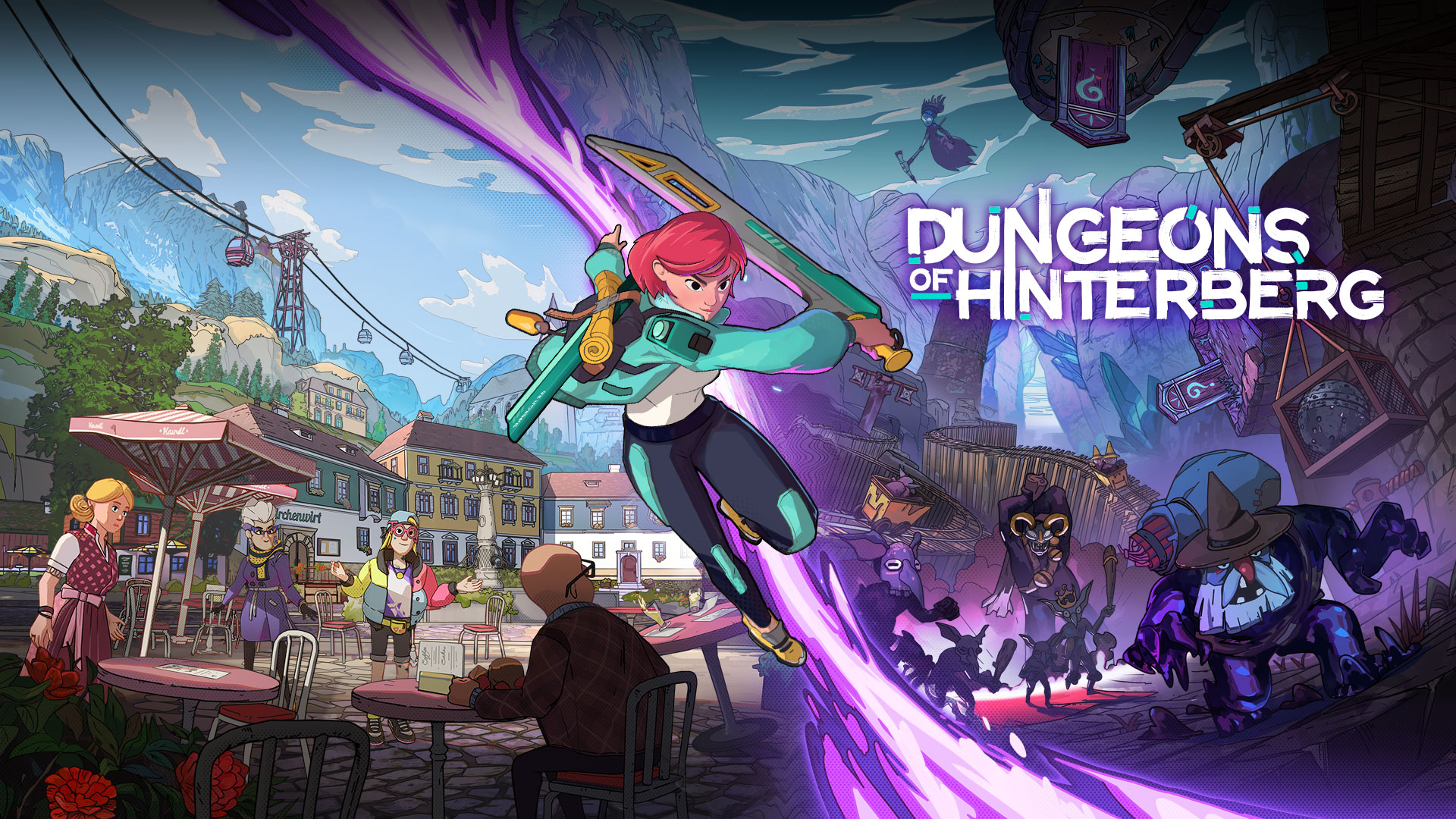
Developer: Microbird Games
Publisher: Curve Games
Release Date: July 18th, 2024
Platforms: Windows, Xbox Series X/S
Reviewed on: Windows through Microsoft Gamepass
Price: $29.99
Welcome to Hinterberg
Time to come clean: I spent most of my life highly suspicious and judgemental of frequent vacationers. Particularly those who visit a relatively stable country, and return with the belief they are transformed. Visiting a war torn or poverty-stricken country and returning a changed person, I can understand. But Paris? Was the Eiffel Tower truly so moving, as to fundamentally transform you? I am deeply skeptical.
I remained this way until shortly after my 30th birthday, when I took my first vacation outside of North America, enjoying a two-week stay in Sweden. I had a truly excellent time. Dare I say it was…transformative? I maintain my skepticism of a trip to Stockholm completely changing a person’s brain chemistry, but there is no doubt I left Sweden different than I came. With more perspective perhaps, a bit wiser about the world, and with a renewed appreciation for cultural differences.
This idea is the heart and soul of Dungeons of Hinterberg. It is a game about going on vacation. Leaving behind the monotony of the daily grind, and experiencing something entirely new. Every vacation comes with its share of difficulties and unexpected problems, and in the process of facing these difficulties head-on, sometimes you can find yourself.
Dungeons of Hinterberg is also a game about hacking and slashing your way through hordes of mythical creatures as you explore magical dungeons, and then spend the evenings hanging out with your friends in the club. Dungeons of Hinterberg is many things. The majority of them are great. It stumbles technically and occasionally in execution, but let me be clear. Dungeons of Hinterberg is absolutely worth your time.

Plot Synopsis
Dungeons of Hinterberg takes place in our modern world, albeit one where the existence of magic has been recently revealed. In a number of locations across Europe, zones of magical influence have been established. Within these zones, people are granted access to magical powers which they use to battle monsters and explore the mysterious dungeons that have popped up all throughout the zones.
Seeing an opportunity, many of the countries impacted began marketing the magic and dungeons as a tourist attraction, inviting all from far and wide to visit and experience them for themselves, Thus the role of the “Slayer” is born, somebody who travels from country to country conquering the dungeons within. Some Slayers do so professionally, others slay as a hobby.
The formerly sleepy Austrian village of Hinterberg is one such location, intensely corporatizing their magic and dungeons to the point that the village’s economic wellbeing relies entirely on the tourism provided by the dungeon-slaying industry. The residents have expectedly mixed reactions. Some long for the quiet days before magic, others see the boom in tourism as a chance to grow the village.
It is amongst Hinterberg’s transformation that our heroine Luisa finds herself. A hobbyist Slayer vacationing from her soul-sucking job as a paralegal, she finds a village that simultaneously embraces and rejects her presence. While Luisa tries to find her place in Hinterberg, it is struck by a number of earthquakes that eventually lead to disasters of a much more serious, and intentional nature. Something is rotten in the village of Hinterberg, and Luisa is determined to unravel this mystery as she strives to conquer all 25 dungeons.
Analysis
Audio and Visuals
No doubt about it, Dungeons of Hinterberg is easy on the eyes. It has that wonderful intersection of a character design and an graphical style that makes for timeless visuals. The characters and monsters are portrayed with simple yet effective cel-shaded visuals. Where Dungeons of Hinterberg really shines is in the environments, which are beautiful as to often be genuinely breathtaking.
The bright colours work perfectly for the diverse ecology of the different areas. From the endless orange of the forest biome to the borderline neon purple water of the swamp, the environments are a total standout. If there is a nitpick to be found, it is in the animations of the characters which can sometimes be a little stilted, especially their PS1-esque walking animation. But this truly is a nitpick, because Dungeons of Hinterberg is one of the most visually pleasing games I have played since The Legend of Zelda: Breath of the Wild.
The music is similarly excellent. I realized I might be in for a treat from the moment the very first music began to play, and it never let up, until the very end. Composed by the duo of David and Marcus Zahradnicek that make up the composer team “Wobblesound,” the music of Dungeons of Hinterburg has this remarkable ability to sound forlorn and melancholic, as well as upbeat and hopeful, at the exact same time.
The Gameplay Loop
“The Legend of Zelda meets Harvest Moon” is a comparison I often see made about Dungeons of Hinterberg due to the split focus on dungeon delving and building relationships. However, I actually don’t think two separate games need to be referenced to convey what Dungeons of Hinterberg is going for. Rather, I think you can just point out that it adheres to a similar gameplay loop as Persona. The gameplay itself is miles different, but in both games you spend half your time adventuring and slaying enemies, and the other half making friends and taking part in social activities together.
Dungeons of Hinterberg’s progression is split into days, and each day further split into morning, afternoon, and night. Every morning, you will choose a zone to explore, one of the areas of wilderness which contain the titular dungeons. You will explore and dungeon delve to your heart’s content, there is no time limit.
Once you complete a dungeon or simply decide to return to town, the day will advance to the afternoon. During the afternoon you spend time in the village of Hinterberg itself, shopping for equipment but more importantly, the afternoon is your chance to get to know the locals. You can spend time with one character per day, deepening your relationship with them. Or perhaps you will spend the day alone watching a movie or visiting the spa, increasing a personal stat instead. The choice is yours.
Once the decision is made, the game advances to evening, where you decide to either go to bed, or entertain yourself with some television or reading, at the expense of a quarter of your maximum health the following morning. Afterward, you fall asleep and an entirely new day begins.
This cycle is at the core of Dungeons of Hinterberg. Dungeon delve in the winter wonderland of Kolmstein in the morning, then grab dinner with business magnate Justin in the evening, and top the night off with some Austrian sitcoms before you go to bed and do it all over again the next day. The story advances on a day-by-day basis, and it makes for a tremendously compelling way to tie the gameplay to the narrative.

The Environment
The bulk of your time is spent exploring the wilderness around Hinterberg, and delving the dungeons you find there. Each morning you decide which location you would like to visit. There are the golden hiking trails around Doberkogel, the autumnal forest of Hinterwald, the winter wonderland of Kolmstein , and the verdant swamps of Brunnelsumpf. Each area is large with plenty of optional areas to explore, treasures to find, and self-contained quests to beat.
More importantly, each location contains access to two magical spells that Luisa can learn. These spells grant practical abilities such as the ability to create and launch a ball and chain, or summon a magical snowboard for quick traversal over snow. These spells function both in combat and outside, and their unique abilities serve as the gimmick that the puzzles are built around, both navigational puzzles in the wilderness, and the dungeon puzzles. The spells can only be used in the location they are learned, and are primarily used to solve puzzles in that location’s dungeons.

The Dungeons
Dotted along the locations are portals that will lead you to one of the many dungeons which make up a third of the game’s title. Some lay proud in the open, others are hidden behind a puzzle or navigational challenge. Dungeons are strictly labelled with a difficulty rating, but any dungeon that can be accessed can also be challenged. This means that there is no order dungeons have to be accomplished in, but there certainly is a recommended order, and attempting a dungeon that is rated significantly above you is likely to be a tough experience.
Each location has a clear biome. Be it Kolmstein’s snow or the murky swamps of Brunnelsumpf, the dungeons within a location take design cues from them. For example Doberkogel features hiking trails to the top of a mountain, and the dungeons are mostly styled after mines, complete with mine shafts to jump down, and puzzles focused on manipulating minecarts. The forest of Hinterwald features a level that takes place entirely in and around a massive ancient tree. While the overarching theme of each set of dungeons is strong and diverse, I do wish the dungeons within each theme had more differences between them.
Progression through a dungeon is straightforward, and anybody with experience with The Legend of Zelda franchise will be immediately at home. The dungeon is split between puzzles that need solving, and enemies that need bashing.
In short, the dungeons are excellent. There are 25 dungeons in all, and they follow a pleasing natural progression in size and complexity, from short ten minute affairs with low complexity in the early game, increasing to much larger endgame dungeons that will take upwards of half an hour with some truly clever puzzles.
Above everything else, the dungeons are good. I’ve wrote before about how I feel Dungeons of Hinterberg to be the perfect replacement for those The Legend of Zelda fans out there who feel a longing for the pre-Breath of the Wild dungeon style, and that feeling was only enhanced as I got to the truly excellent dungeons towards the finale.
The shrines in Breath of the Wild often focused on problems with open-ended solutions that could often be completed simply with unorthodox thinking. This is rewarding in its own right, but it lacks the meticulousness that comes from a puzzle with a simple solution. Dungeons of Hinterberg features the classic single-solution puzzle style. When they design a complex labyrinth of lasers that can be altered with switches, for example, they can focus on making the solution itself complex without worrying about unexpected alternatives. The game sees the return of genre staples like sliding block puzzles and bouncing lasers off mirrors, and I found them all to be sophisticated and enjoyable.
At first, limiting use of magic spells to the location they are learned seems like a limitation. However, it allows the dungeons in that area to be designed entirely with those spells in mind. In the low-level dungeons, you may be solving exceedingly simple logic puzzles with switches and buttons, but this is simply to train you in the use of that spell. When the time comes to take on the high-level dungeons, you will be conquering some truly sophisticated puzzles.
I cannot speak highly enough of the dungeons in this game. While the visuals and thematics never reach the heights of the all time great The Legend of Zelda dungeons, the mechanics within absolutely do.

Combat
When you aren’t navigating the dungeon or solving puzzles, you will be fighting the many monsters that inhabit these dungeons. Combat in Dungeons of Hinterberg begins simple and becomes slightly more complex as you unlock certain abilities further into the game; but even at its most complex, it remains a fairly straightforward affair. The combat is adjacent to the Soulslike genre in the sense that it is based on battling locked-on enemies while rolling out of the way of their attacks, and managing a stamina bar.
Luisa has access to light and heavy melee attacks which naturally take increasing amounts of stamina, in addition to spells which can take up a lot of stamina and can be used in their locale, and devastating special attacks which also take up a lot of stamina and can be anywhere. The combat never really gets more complex than using a technique, hammering with your light and heavy attacks until your stamina recharges for another technique, and rolling or parrying incoming attacks. This is not a flaw. The simplicity of this combat is its strength, because it can remain high energy and frenetic without bogging down in details.
This is an action RPG, and this comes in the form of both Luisa’s stats (HP, MP, Physical and Magical Attack, Physical and Magical Defense) as well as her equipment which is statted and can be improved with crafting, as well as replaced entirely by weapons with better stats. To be honest, the number-crunch aspect of Dungeons of Hinterberg is the game’s weakest area. It feels tacked on and superfluous. The amount you can improve your stats via training and equipment is so minor that it isn’t really possible to have much in the way of build variety.
There is a weapon improvement system, but the improvements are so mild that they were often outpaced by the purchasable weapons in the store, to the point that the system was rather useless. Really, it seems as though the stats system mostly exists as a way to allow the ability to try any dungeon you can reach at any time, since you will naturally be gatekept out of higher level dungeons by enemies that are too strong for you. The busywork involved with weapon upkeep really isn’t fun, and “busywork” feels like a good way to describe the entire RPG system. It takes away from the experience to a mild degree.
The stats feel like they exist only so this can be labeled an action RPG. It just feels lost in the middle of the road between its inspirations. It doesn’t want to commit to a statsless adventure like The Legend of Zelda, but it doesn’t commit to making the stats feel meaningful like Dark Souls. Overall however, I have more positive feelings towards Dungeons of Hinterberg’s combat than I do negatives. The combat is pure and simple frenetic action and while it is probably the weakest of the gameplay pillars, it is not a bad one.

Making Friends
What sets Dungeons of Hinterberg apart from most other Zelda-likes however, and gives it a true identity of its own, is that it is as much a game about socialization as it is about action. That is to say that it isn’t simply a dungeon crawler with a friendship system tacked on, rather, the social systems are of equal importance to the design of Dungeons of Hinterberg as the dungeons are. In this sense, it reminds me of the 2D Zelda-inspired Prodigal developed by Colorgrave Studios. The friendship system is interwoven into nearly every aspect of the game, touching every system. Entire gameplay mechanics may never be experienced depending on whom Luisa does and does not befriend.
Hinterberg is full of characters Luisa can befriend. While there is no limit to the time you spend in Hinterberg, the average playthrough is likely to be around 40 in-game days, which is not even close to enough to reach the maximum level of friendship with all 16 potential friends. I think this gives the game significant replayability. It is possible to put off completing the final dungeon to continue deepening friendships, but I chose to befriend who I could over the natural length of the story, and choose entirely new friends to focus on in my second playthrough.
And what a diverse and compelling lot of characters to choose from! The inhabitants of Hinterberg hail from all walks of life, containing both locals and fellow tourists who fall across the spectrum of gender and age. There are some interesting, complex dynamics at play too. There are characters who Luisa hits it off with immediately, like Alex, the one NPC you are scripted to befriend, or Marina, the ever-optimist with a zillion part time jobs. Yet despite the immediate warmth of these friendships, there are moments of tension and problems to overcome. For example, Marina has trouble asserting boundaries for herself and Luisa has a hard time watching Marina be treated badly by her employer. But asserting too harshly on her behalf will upset Marina as she cares very deeply about her jobs.
However not every friendship is automatic. Julian is a local businessman who is looking to capitalize on the tourism boom to “modernize” Hinterberg, much to the anger of many locals. He and Luisa have fundamental disagreements about, well, just about everything. In fact once you reach the maximum friendship level with Julian, it isn’t really clear if they are actually friends. It is left to the player to interpret.
These sorts of dynamics exist across all 16 friendships. Even a walking stereotype, like the hipster journalist Travis—who hates small towns and has the worlds’ most complicated coffee order—has an extra layer of depth. One of my favourite parts of Dungeons of Hinterberg is that the friendships don’t feel like a checklist. These are complicated people who have a life separate from Luisa, and how she relates to their life varies across the large roster of friendships. You are getting to know these people, not just depositing gifts until you receive the friendship prize.
That said, the friendship prizes are abundant and impressive. The perks unlocked through befriending characters can be significant, and in some cases, such as the local magic weaponsmith Hannah, entire game mechanics can be locked behind the friendship. Not every character has such impactful rewards, but you will likely never feel disappointed for the time put into befriending a character, narratively or mechanically.
Dungeons of Hinterberg has perhaps my favourite friendship system of nearly any game I’ve ever played. While I can’t say I will remember all 16 characters in the long term, I certainly will remember how good it felt to befriend them.
The Story
Dungeons of Hinterberg is a game about being on vacation.
Yes, there is a lot more to it than that. Luisa embraces the life of a Slayer and gains notoriety, attracting attention from other high-ranking Slayers as well as government officials. Some of these people approve of Luisa. Others do not. Luisa begins to find that the corporatization of the dungeons may not have been done with the purest of intentions, as a web of corporate deceit becomes entangled with the inherent danger of unrestrained magic, and she begins to unravel a conspiracy. Dungeons of Hinterberg is about all of this and more.
And yet, it is still a game about being on a vacation. After all, as I sheepishly admitted at the beginning of this review, a vacation can change your life.
The story of Dungeons of Hinterberg is excellent. Luisa’s slow ascent through the rank of the Slayers is satisfying to experience, and the mystery that unravels is compelling and the conclusion does not disappoint. Not to say that any of the twists will leave you aghast, most of it is fairly heavily foreshadowed and there aren’t any truly shocking moments. However the story ends on a note that is exciting, touching, and even a little thought-provoking. Luisa’s vacation deeply changed her as a person, and by the time the credits roll, Hinterberg will have been changed by Luisa.
An idea thoroughly explored is the idea of what it means to be a tourist, and an exploration of the impact that tourism can have on a place, positive and negative. Luisa finds plenty of business owners and other locals who are happy to meet and befriend her, but she meets a number of people who would rather she went home. Becoming a tourist center for a booming new activity is transforming Hinterberg to the very core. Old buildings are being torn down to make way for facilities and hotels. Bars and restaurants that locals could always enjoy are now constantly filled. Even something as simple as a new statue in the village plaza, one that reflects the village’s new status as a Slayer mecca, rubs a number of locals the wrong way.
Yet for as many locals who are against the “modernization” of Hinterberg, there are many who are in full support of it. You have business magnates and political figures who stand to profit from the situation, yes, but also folks who simply felt Hinterberg was falling behind. The impact tourism can have on a community is a nuanced and complex topic, and I felt Dungeons of Hinterberg explored it deftly and with care.
Another theme thoroughly explored is the commercialization of magic. It is telling that you have something as fundamental and earth-shattering as the discovery of magic in our real world, and before scientists can even meaningfully study it, there is an entire tourist industry built up around it. Sure the discovery of magic might offer some real scientific breakthroughs. That is all well and good, but you know what else it offers? Cold hard cash.
Travelers flying from all over the world to experience magic that can conveniently only be experienced locally? The dollar signs print themselves.
Capitalism rots everything it touches, and this is explored in Dungeons of Hinterburg. Something begins to go wrong with magic as earthquakes and natural disasters become more frequent, but rather than stop the money printer, the leadership of Hinterberg simply casts a blind eye over everything and continues to exacerbate the problem. That sounds all too familiar, does it not?
A particularly potent area for me was Dungeons of Hinterberg’s exploration of small town politics. How corrupt, nasty, and enflaming it can be, how it can tear a small community apart as tribalism begins to take form. The mayor of Hinterberg is the one leading the charge in the modernization of Hinterberg, selling out the town to further the pursuit of tourism in every way that can be sold, cutting corners and putting the lives of those in Hinterberg at risk.
But from the getgo Mayor Karin Wagner does not face much opposition because, well, she is the mayor of a small town and everybody knows her. Hinterberg is small enough that many have known Karin their entire life, and place a lot of faith in Karin, believing in her even when things take a questionable turn. In other cases, Mayor Wagner utilizes her authority to browbeat the opposition into submission, such as pulling the permits of business owners, or firing those in positions of influence. I grew up in a small town, we even had our own mayoral corruption scandal and I found all of it to be very on point. Politics can ruin even the most well-meaning of people.
It is one thing to thoroughly explore these themes, but what is more fantastic is how these ideas intersect throughout the runtime of Dungeons of Hinterberg. Being a tourist is to be implicit with the strengthening of capitalism’s stranglehold over both Hinterberg and magic itself, and the game explores this through Luisa coming to terms with how she feels about her own presence in Hinterberg.
Being a tourist who is stuck in the middle of a small town political feud is a central part of the narrative. I cannot elaborate too much without edging into spoiler territory, but suffice it to say that Luisa has strong feelings about how things are run, and the townsfolk as well as Mayor Wagner have strong feelings about her meddling. The combination of small town politics with the commercialization of magic is certainly a recurring theme. Dungeons of Hinterberg is excellent when it combs through these ideas individually, but it is at its best when it is exploring the points they intersect.
The narrative of Dungeons of Hinterberg is strong. It is no Disco Elysium, it didn’t change my fundamental brain chemistry, but I don’t think that is what it was trying to do. I think they wanted to have an above-average story to be paired with their above-average gameplay, and they succeeded. I cared a lot about Luisa, I enjoyed watching her grow as a person. I fell in love with Hinterberg and its many residents and visitors. I was enthralled by the twists and turns of the story, even if they were easy to see coming. I thoroughly appreciate the themes they put so much effort into exploring. I installed Dungeons of Hinterberg expecting to enjoy a fun Zeldalike with hopefully a good enough story to tie it together, and I left feeling like I had experienced something insightful and thought-provoking.

Final Score
Dungeons of Hinterberg is a game about going on vacation, and leaving it a changed person. Luisa reaches Hinterberg as an unconfident mess, and while I won’t spoil her journey, she leaves Hinterberg very much not that. She finds herself on this journey, through the dungeons she conquers, the friends she finds, and the decisions she makes.
I didn’t come home from Sweden a fundamentally changed man, but there is no doubt the trip had an effect on me. When I close my eyes, I can sometimes still see the seas of Gotland and the ancient walls of Visby, or the cramped and beautiful streets of Gamlestaden within Stockholm. When I meet somebody new to Canada, I try to show them the same patience that I was shown by locals as I floundered about the Stockholm metro trying to find my way. Whenever I am frustrated by the hustle and bustle of modern life, I smile at the thought that some places in the world truly do move a bit slower than the rest. I’m not a changed man, but my vacation had an impact on me. My cynicism was deeply unfounded.
I’m glad Luisa did not share this skepticism, and I am glad I got to experience her vacation. Dungeons of Hinterberg is a fantastic game that is entirely worth your time. The blend of dungeon crawling and social aspects is masterfully done, and neither side of the equation feels neglected.The dungeons are clever and diverse, and a total blast to defeat. The combat is simple, snappy, and always enjoyable. Likewise the story is touching and insightful, the cast is well written and interesting, and the social mechanics themselves are refreshing.The game is an audio-visual treat, with particularly excellent music. The only flaw comes in the RPG mechanics which feel like superficial busywork, the game would have been better without. But you cannot go wrong with Dungeons of Hinterberg.
Featured Image: Microbird
Boss Rush Podcast – A Podcast about Video Games

The Boss Rush Podcast – A Podcast about Video Games – is the flagship show of the Boss Rush Network and Boss Rush Media. Each week, hosts Corey Dirrig and LeRon Dawkins are joined by friends, fellow creators, indie developers, and industry veterans to discuss the latest in the world of video games, including news, rumors, new releases, and what they’ve been playing. They also answer listener questions, debate important industry topics and Boss Rush Banter discussion points, and feature a rotating weekly segment. New episodes post every Monday.
Follow and Connect with Boss Rush Podcast on Social Media
X/Twitter + Bluesky + Instagram + Threads + YouTube
Listen to Boss Rush Podcast on Podcast Services
Apple Podcasts + Spotify + Goodpods + Amazon + More Links
Thank you for supporting Boss Rush Podcast and the Boss Rush Network
Thank you for watching or listening to The Boss Rush Podcast. If you’re watching this episode on YouTube, hit the Subscribe button, Like the video, and hit the notification bell so you don’t miss an episode! If you’re listening on Apple Podcasts or Spotify, consider leaving us a rating and a review as it helps with discoverability and growth. Support Boss Rush on Patreon for exclusive content, early access and audio versions of shows, become a Patreon Producer, and more. Visit our website for all of our content including reviews, news, daily Boss Rush Banter discussion topics, listicles, features, and more. However you support us, it means so much to us. Thank you for your continued support of the Boss Rush Podcast and the Boss Rush Network.

Leave a Reply