
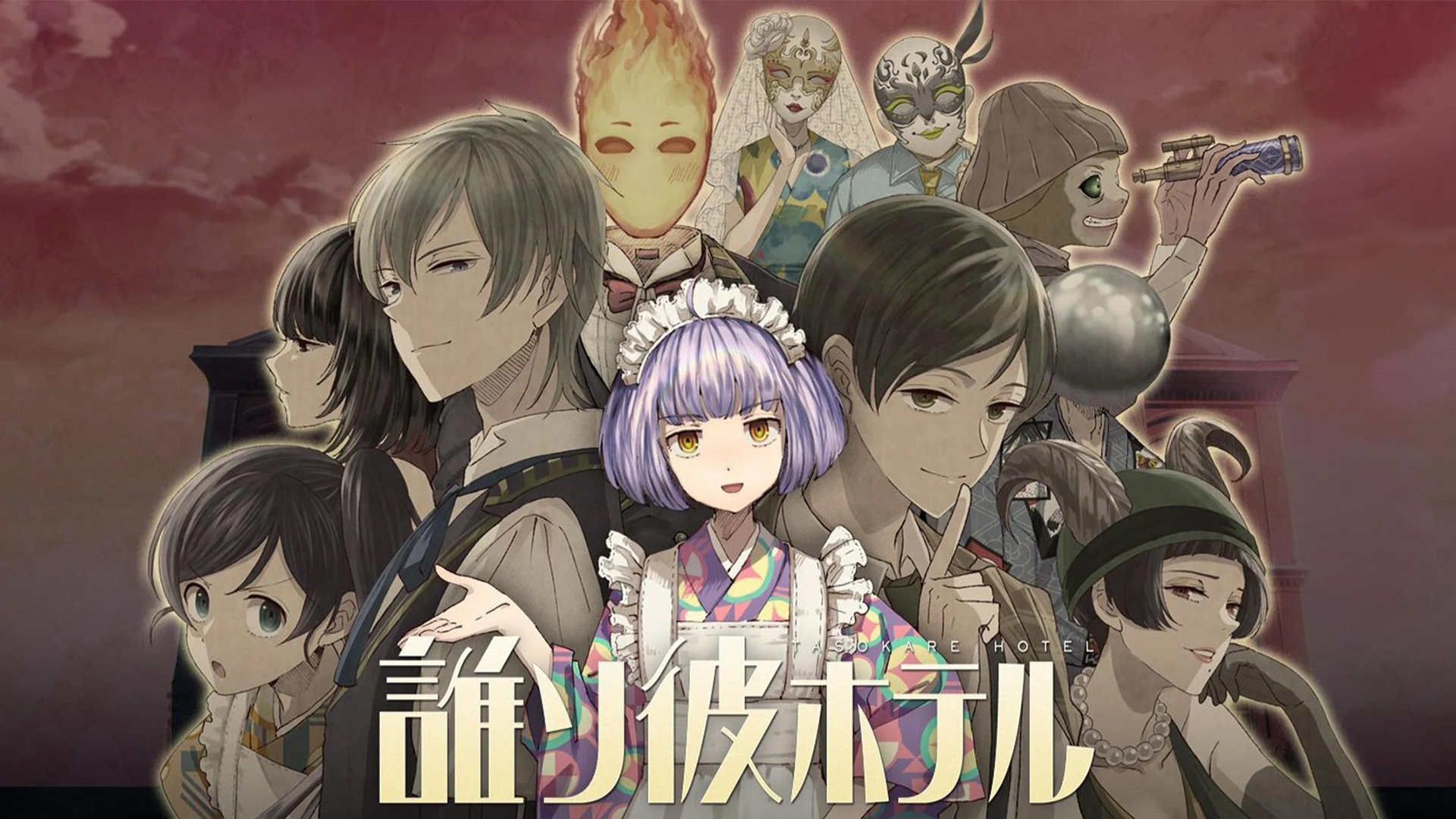
Developer: SEEC
Publisher: SEEC
Release Date: December 19, 2017
Platforms: iOS, Android
Price: Free (includes microtransactions)
Reviewed On: iOS
It’s been just over seven years since SEEC’s Tasokare Hotel was first released in Japan; and while the game has had enough of a following to warrant a remake in 2022 and a sequel currently in the works, it’s been largely under the radar beyond its devoted fanbase. But that’s changed this month, thanks to an anime adaptation of Tasokare Hotel from Studio PRA. With new eyes on the title, it’s time to take a fresh look at this investigative mobile game.
The Story

In Tasokare Hotel, we play as Neko Tsukahara: a somewhat eccentric schoolgirl with an eye for mystery and a love of pop idols. But we don’t know that when we begin. We arrive at the eponymous Tasokare Hotel—a retro hotel in an otherwise blank twilight landscape—with no memory of who we are or how we got there. Fortunately, we’ve come to the right place.
The hotel’s name comes from the Japanese phrase tasokare, which roughly translates to “Who are you?” (This is also allegedly the source of the word for twilight, tasogare—a time of day when it was too dark out to see someone’s face.) This hotel between worlds is a haven for lost souls: people who don’t know if they’re alive or dead. Once they remember who they are, using clues laid out by the hotel in their guest rooms, they can remember the circumstances of their accident, as well as whether they’re alive or dead, and either wake up or move on to the next life.
Despite remembering who she is, Neko can’t recall what happened to her or whether she’s alive. The same is true for Atori, another lost soul who is currently passing the time by working at the hotel. Neko decides to do the same: helping other guests regain their memories as she pieces together her own circumstances. But the arrival of another long-term guest leads to much more dire and immediate worries, and Neko must decide whether she’s willing to risk her soul to save someone else’s.
Gameplay

For the most part, Tasokare Hotel plays out like a visual novel. There are some choices that lead to alternate endings and branching paths, and a few “Quicktime Events” (for lack of a better term), but by and large it resembles a more straightforward version of Ace Attorney.
Outside of the story scenes, there are two main modes of play: exploration and interrogation. In exploration mode, you search the room (sometimes multiple rooms) in the style of a typical “escape room” Flash game. This can involve moving objects around, combining objects, and solving simple puzzles. It’s the least remarkable part of the game, offering a decent enough challenge. The final chapter sinks into some Sierra-level moon logic, but hints are available by viewing ads (or with microtransactions).
Interrogation scenes are mainly a matter of turning the clues you’ve received into answers. Sometimes getting too many wrong will lead to a game over; at other times, putting the clues together slightly askew will take you to an alternate ending. In other words, it’s possible at multiple points to get the wrong end of the stick, send lost souls off with incorrect answers, and still proceed in the game. This is, at least storytelling-wise, much more satisfying than simply being sent to a Game Over for messing up—especially if you enjoy unlocking hidden artwork in visual novels. You can tell if you’ve gone astray using the chapter flowchart, which also lets you double back and explore alternate routes. But there’s a more immediate answer on the title screen, where a dial fills in with the faces of people whose true endings you’ve achieved.
The pacing of the gameplay is artificially slowed in a few ways, the chief way being “tickets.” You automatically get five tickets per day, which translates to playing five scenes per day. (Extra tickets can be gained via gacha, login bonuses, or microtransactions). Completing chapters in a certain amount of time will earn you special artwork and character files, which can also be unlocked with in-game currency (gained in the same ways). In other words, you don’t have to pay to win. But due to the ticket system, progress can feel needlessly choppy—especially since not every scene makes a good cliffhanger.
There is also a room-cleaning mini-game which can earn players more coins and “experience”: another way progress is slowed, as some scenes require a certain amount of EXP to proceed. While the mini-game is a nice idle activity, and also offers up a slew of evolving chibi-Neko sprites, it feels a bit superfluous.
The Aesthetic

Despite being a relatively simple and ultimately short game, Tasokare Hotel has a lot going for it. The story is unique, offering an interesting twist on the classic Holmes and Moriarty rivalry via Neko and Osoto. Each mystery offers several twists and turns, giving players plenty of opportunities to go down incorrect (but interesting) rabbit trails. The character designs are glorious, from the main cast to the faceless guests. And the smooth jazz soundtrack that underscores most scenes is both beautiful and (as players will discover mid-game) appropriate to the hotel’s tragic origins.
The art and concept are the game’s strongest points, and will keep players coming back for more even in the face of relatively standard “escape” puzzles. And because the artwork is so lovely, it feels rewarding to come back, scour through the alternate endings (and yes, play the mini-game to earn more coins), and unlock everything you can.
The sights and sounds of the story make it great, and it’s easy to see why this would be a shoe-in for an anime adaptation. There’s just one problem for anyone outside Japan.
The Translation

I’m not going to mince words: this translation is atrocious. And when a game’s main appeal is its storytelling, that’s a huge problem.
In terms of the puzzles, the translation is basic and straightforward enough that you can complete the game. That is one of the two silver linings here: the game is still playable and navigable. That’s largely because the puzzles are largely visual and don’t require much, if any, linguistic knowledge in any direction. The other silver lining is that this appears to have the earmarks of human error rather than bad machine translation. (Which is more of an ethical silver lining than anything else.)
The minimal attention given to any sort of real localization or tone means much of the characters’ charm (or malice, in some cases) gets lost in the jumble. As beautiful as the art is and as compelling as the storyline is, it falls a bit flat when serious dialogue becomes laughable.
The game is followable, and it’s certainly not the worst translation I’ve seen in my career. But it’s enough that it clashes with an otherwise lovely game.
Final Score
For everything Tasokare Hotel has going for it, it has something pushing against it. A fantastic story is impeded by a subpar translation. Gorgeous art and music hoist up unremarkable puzzles. The whole thing becomes frustrating because of the attempts to force microtransactions and artificially slow gameplay.
The special DLC chapters, which can be purchased after achieving the final chapter’s True End, are fully voiced, and include lots of new art… but they suffer from the same poor translation quality.
In short, Tasokare Hotel is a gorgeous story made mediocre by gamification. It’s still better than average for that gorgeousness. However, unless the Windows remake Tasokare Hotel Re:Newal gets a really solid English translation in the near future, your best bet would likely be to watch the anime adaptation.
Image Source: SEEC


Leave a Reply