
Title: Okami HD
Developer: Clover Studio
Publisher: Capcom
Release Date: Various; August 9th, 2018 on Nintendo Switch
Platforms: PlayStation 4, Xbox One, Nintendo Switch, PC
Reviewed on: Nintendo Switch
Price: $19.99 (USD)
With the announcement of a sequel, I’m sure I’m not the only one looking to play (or replay) Okami HD. As a Legend of Zelda fan, many friends recommended that I try Okami HD, and it’s been sitting on my backlog until now. Now that I’ve rolled credits, I’d like to reflect on this title to see if it still holds up to today’s standards.

Okami was originally released in 2006 for the PlayStation 2 and in 2008 for the Nintendo Wii. Then, the HD remaster came along over the years on various consoles through the Nintendo Switch in 2018. As it stands today, the HD remaster holds a reputable 90 on Metacritic. The fundamentals remain the same from the original to the HD version, with upgrades in graphics and touchscreen abilities.
SYNOPSIS
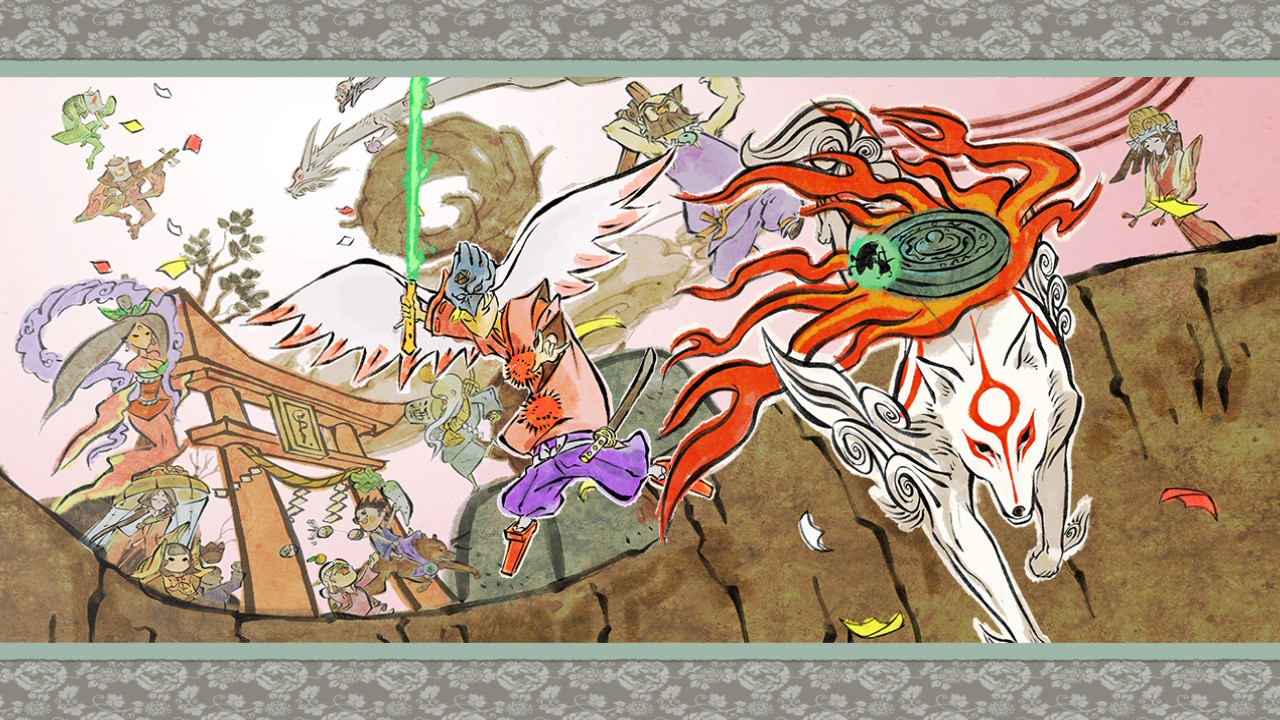
Okami is an action-adventure game in a watercolor, cell-shaded art style where you play as Amaterasu, goddess of the sun and mother of all, who takes form of a white wolf. The story is steeped in Japanese folklore and even takes places in what is a fictional representation of Japan.
Amaterasu is summoned from her deep slumber by a wood sprite named Sakuya because Orochi, an eight-headed demon, has also awakened and is spreading darkness across the land of Nippon. Issun, a bite-sized traveling artist, joins Amaterasu on a journey to restore the land to normal with her Celestial brush. Throughout this journey, you meet mysterious characters with questionable motives like Waka and Priestess Rao. An epic story unfolds as you encounter more demons, a mysterious Ark, and tales of Celestial Gods rumored to have tried to seek refuge on Earth.

ANALYSIS
Gameplay
My friends and colleagues weren’t incorrect that Okami follows a similar structure as the Legend of Zelda series. It is designed in a linear fashion with direction from your companion. You travel from place to place–whether it is a cave or shrine, free it from the darkness oppressing it, and fight a boss or major enemy. During each leg of the journey, you collect more Celestial brush techniques that help you advance.
There are several Celestial brush techniques, each guarded by a god (and inspired by the animals of the Chinese zodiac), including Sunrise, Rejuvenation, Power Slash, Bloom, Water Lily, Vine, Cherry Bomb, Waterspout, Crescent, Galestorm, Inferno, Veil of Mist, Cat Walk, Thunderstorm, and Blizzard. These are executed by pulling up a canvas and drawing their associated symbols. This was fun–and frustrating–on the Nintendo Switch.

I loved the option to use controls or the touch screen; however, the touch screen didn’t seem to always work. There was a particular section where you are careening toward a waterfall, and you must use your Celestial brush to attach several vines to your log. It took me over a dozen times because for some reason, even though I dragged my finger from the lily to the log hook, the Vine technique didn’t work.
These techniques are used to solve puzzles and defeat the diverse enemies in combat. Combat is interesting in Okami, as you are transported to an arena of sorts each time. Most enemies have a weakness, and you can obtain rare Demon Fangs if you play your cards right. You can also collect various weapons, selecting which ones work the best for your play style.

Despite linear nature, there are several side quests that are fun enough to pursue. I thoroughly enjoyed the means of gaining “praise”, such as restoring dead Cherry Blossom trees and feeding animals. These praise points can be used to extend your health bar, ink-bearing capacity, and more. You can also search for all the Stray Beads and help characters dig for treasure.

All in all, Okami has all the trappings of a solid action-adventure game with fun gameplay in the form of the Celestial brush. There are also things that remind me of its age, such as the inverted controls, occasionally frustrating camera angles, and ultra-awkward and perverted comments from Issun to EVERY FEMALE he comes into contact with.

Graphics and Sound
Okami’s art style and sound have stood against the test of time. Cell-shaded art tends to age better than other styles, and Okami is one such game that is gorgeous from top to bottom, front to back. The characters and environment feel alive with its ink-wash painting graphics, and the occasional still paintings are a feast for the eyes.

The music and sound design are very Japanese, which is fitting in Okami, which is very steeped in Japanese lore. The music draws me in and helps me stay immersed even when I’m frustrated with some of the controls.
FINAL SCORE:
Okami HD is a good Zelda-like, although I feel bad saying that. I do believe Okami can stand alone without the association from another franchise, but it is an accurate way to explain this to someone who hasn’t played it before.
Despite its praise and solid foundation, I did get frustrated several times in the game, primarily due to the inverted controls and unreliable touch screen mechanic to execute the Celestial brush techniques. The plot also strung me along for a lot longer than I thought it was going to take, and some of the end-game requirements, such as two digging mini-games and a race that way overstayed its welcome, felt unnecessary.

Source: Capcom
With all that said, I came to appreciate the experience well after I rolled credits. Because of this, I believe Okami HD is a solid gaming experience for those that love action-adventure games and games with a gorgeous art style. It even gave me a few chuckles along the way. Sure, some controls and dialogue are outdated, but the best thing is that I know the sequel is more than capable of improving on those weak points from an almost twenty-year-old game.
Have you played Okami yet? What are your thoughts on how it aged? Please share your thoughts with us on our Boss Rush Facebook Group or our Boss Rush Discord.
The Boss Rush Podcast – A Podcast About Video Games

The Boss Rush Podcast is the flagship podcast of Boss Rush Media and The Boss Rush Network. Each week, hosts Corey Dirrig, LeRon Dawkins, Stephanie Klimov, and Pat Klein, as well as their friends, fellow content creators, developers, and industry veterans come together to discuss their week in gaming, including what they’ve been playing, a randomly chosen rotating weekly segment, the Boss Rush Banter of the week, answer community write-ins, and more. New episodes are released every Thursday. Members of The Boss Rush Network’s Patreon will receive the exclusive Pre-Show at any tier along with other perks.
For episode schedules and more information, follow The Boss Rush Podcast on X/Twitter, Instagram, and Threads.
Email the Show:
podcast.bossrush@gmail.com
Listen to The Boss Rush Podcast:
Apple Podcasts | Spotify | Amazon Music | Overcast | Audio Landing Page | YouTube
Join Our Community:
Discord | Facebook | LinkedIn
Featured Image Source: Capcom

Leave a Reply