
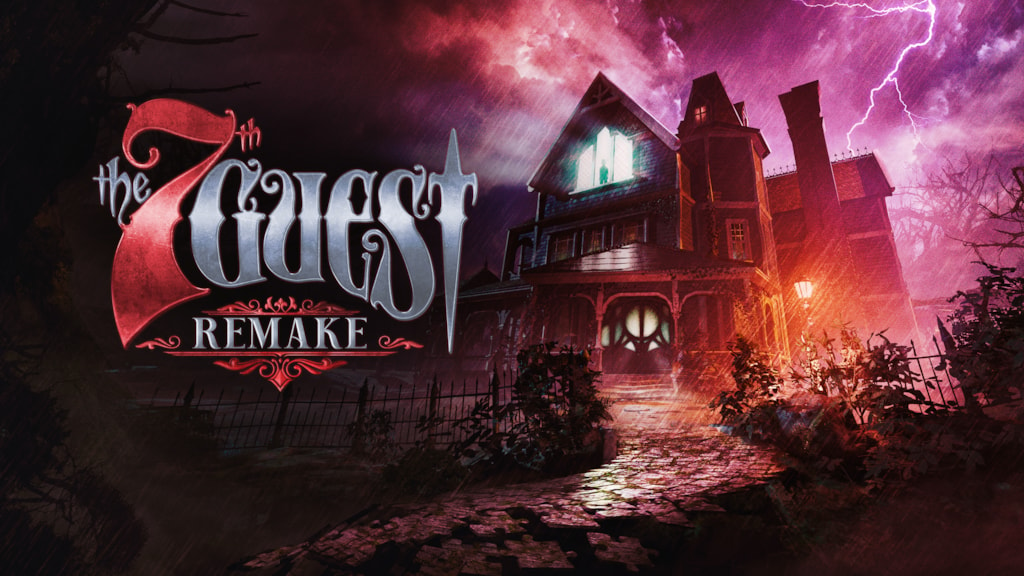
Title: The 7th Guest Remake
Developer: Vertigo Games, Exkee
Publisher: Vertigo Games
Release Date: June 4, 2026
Platform: PS5, Xbox Series X|S, Nintendo Switch, Windows PC via Steam and Epic Games Store
Reviewed on: Windows PC via Steam
Price: $19.99 USD
Several all-time classic games have had the remake treatment in recent years: Silent Hill 2, Final Fantasy VII, Resident Evil 2 & 4, and the upcoming Ocarina of Time being some of the most notable of examples. One remake of a legendary title that shouldn’t go overlooked is the just released The 7th Guest.
The 7th Guest Remake is largely a port of 2023’s The 7th Guest VR, also developed by Vertigo Games. This title kept most of the original game’s experience intact, but delivered a whole new twist on the presentation and gameplay, rebuilding it from the ground up for modern day gamers with fresh graphics and new actors, shifting focus to involve deeper exploration, and redesigning puzzles to be more accessible and fitting for VR control.
The Remake takes things one step further, making the game a breeze to play with a controller in hand, and allowing an even greater amount of players to experience it on modern devices.
Released in 1993, The 7th Guest was a landmark title in video game history. The game is credited, along with Myst which released later in the year, as being one of the first “killer apps” on CD-ROM. The title was the very first graphic adventure game to use 640×320 graphics with 256 colors, making it one of the most impressive games visually for the time. The 7th Guest was also among the first games outside the arcade to use live actors and FMV performances, something that would explode in popularity throughout the mid-nineties. Bill Gates even stated that The 7th Guest set “the new standard in interactive entertainment,” and he wasn’t wrong: directly after release, developers from all over rushed to embrace the format, and they never looked back.
In the game, players control an amnesiac named Ego who arrives one evening at the foreboding Stauf Mansion with no recollection of how they arrived there or why. The brooding estate–which sits dark and vacant on the outskirts of the township of Harley-on-the-Hudson–was built in the 1930s by the sinister Henry Stauf: an eccentric man who made his fortune crafting children’s toys. Sometime after finding success as a toymaker, numerous children who possessed Stauf made dolls came down with a mysterious illness, and eventually died. Enraged, the parents of these children sought out Stauf for revenge, yet he fled into his expansive estate, vanishing into thin air.
Years later, six individuals–all prominent residents of the town–receive strange invites for a soiree at the Stauf Mansion, in which they are promised that they may obtain their heart’s deepest desires. Intrigued, they arrive at the party, only to become trapped inside the manor, and are forced to solve the twisted puzzles that occupy each of the mansion’s 21 rooms. Only by finding the solution to these macabre brainteasers, and making it to morning while still alive, will the guests be granted their wish.
The player character stumbled into the mansion years–possibly decades–later. It becomes quickly apparent that the initial partygoers were not successful in their task, as they’ve all been met with a grizzly fate at the hands of the terrifying toymaker. With the puzzles still unsolved, their souls cannot rest, and thus they haunt these halls, continuously reenacting their final night for all eternity. Ego, the eponymous seventh guest, must work out the solutions to Stauf’s ghastly riddles before daybreak and put an end to the toymaker’s curse, once-and-for-all.
The original game was a point-and-click adventure title, presenting challenging puzzles that defined the genre at the time. In an age without internet guides, gamers were expected to spend grueling hours working out the answers that would eventually bring Stauf to justice.
The world is much different though today, with guides and even video walkthroughs easily accessible within minutes. Video gamers are also much more experienced in these types of dilemmas: The 7th Guest helped pave the way for a wave of similar titles, classics such as Sanitarium, Phantasmagoria, and the aforementioned Myst, as well as a slew of modern titles like The Witness, Erica, and The Cat Lady. Escape rooms too have flourished in popularity over the last decade, an amusement attraction that can trace its roots right back to adventure titles like the original 7th Guest.
The developers at Vertigo Games understand this, and as such have steered away from designing unforgiving puzzles with frustratingly vague mechanics, and instead have opted for increased fun and greater pacing, ensuring players aren’t ever stuck for too long on one activity, and are frequently encountering a new brain teaser to solve.

Rooms within the Stauf Mansion are no longer designed with a single puzzle in mind, but often with several, shorter conundrums to test the player’s mettle. Few of the original game’s puzzles are included in the Remake, and what little that were carried over have been completely remade in both function and difficulty. Some of these new challenges include sliding coffins so that the designated one can be removed from the graveyard; using a seating chart to arrange possessed dolls at a frightening tea party; luring roaches along a path to avoid spiders and get them to their destination; and filling a model of the mansion with figurines of the guests by placing them in the rooms in which they’ve met their demise.
Players who get stuck on a puzzle can access in-game hints with the touch of a button, and if they are still stumped, they can actually purchase solutions with coins that are found while exploring the mansion. This is a wonderful way to satisfy all audiences, and prevents players from leaving the game to hunt for solutions online, or even worse: hitting a dreaded roadblock and then shutting it off in frustration, never to be restarted.
There is a much greater emphasis on exploration in the Remake as well. Being a first-person point-and-click adventure title, the original 7th Guest was largely on rails, and thus players were not able to explore all that much. The Remake however gives you full control, letting you check out every dark nook-and-cranny at your leisure, and even letting you crouch and crawl under tables and other furniture.

To aid you in your investigation, the Remake introduces a special lantern, whose light can cause curious things to appear. For example, shining it onto dead flowers will make them appear in full bloom, or make decayed furniture look good as new, and even ordinary paintings to take on a demonic form. Hints towards puzzles can also be unveiled, with secret messages only becoming visible in the lanterns mystical light.
Collectibles can also be discovered, like the coins used to buy puzzle solutions, and letters and records that give background information. Most all of these are carelessly hidden however, being set out in the open, or perhaps simply within a drawer. There are also dozens of ordinary items that you pick and up and examine up close, but barely any of these serve any real purpose, as they aren’t involved with any puzzles or have any interaction to them. As such, it makes exploring Stauf Mansion much less thrilling, and over all pretty basic.

The graphics are definitely more modernized, and the ghostly effect of the live action actors certainly looks more distinguished and natural, but the overall game is sadly not that impressive. Playing on the highest settings on PC, the game looks to be at least a decade or more old. This is such a shame considering the legacy of the original, and I sorely wanted to be left in awe of the ghastly Stauf Mansion just like players in 1993 were, yet I was underwhelmed with how generic it all looks. Performance wise, the Remake is riddled with clumsy pop-in, especially when entering rooms, though everything else ran smoothly. All of this may be due to the Remake being developed as a VR game first, and unfortunately the technology for VR just isn’t there yet for more realistic graphics and features, at least on a wide scale.
The 7th Guest is perhaps most notable for its cast of characters, and the live actors bringing these spooky ghosts to life, so to speak. You have the sultry Martine Burden, a singer known as much for her flirtatious personality as she is her voice; Brian Dutton, a greedy businessman who will do anything to acquire the wealth that Stauf had; Hamilton Temple, a magician who bills himself on the exotic, but may not be all that he seems; Julia Heine, a cantankerous banker and keeper of secrets; and Edward and Elinor Knox, a married couple who are dissatisfied with both their marriage and their misfortunate lives. This ensemble is the glue that holds the entire game together, and their exploits unfold like watching a cozy whodunnit. The actors don’t take things all-too-seriously in the Remake, and nail the campy nature that gave the original so much of its charm.
Henry Stauf remains a vile nuisance, but he isn’t nearly as frightening as he was in the original. The Stauf in 1993’s 7th Guest had a devilish, wicked nature about him that gave him both presence and actual terror, and I personally consider him to be one of gaming’s top villains. This new Stauf is still good, but he lacks the chilling voice and the Vincent Prince-esque gravitas that made him the stuff of legend.

The original soundtrack for The 7th Guest was composed by the incomparable George “The Fatman” Sangar, who also composed for the games Wing Commander, Maniac Mansion, Zombies Ate My Neighbors, and SimCity 2000, among many others. The soundtrack itself was notable for being mostly a single half-hour suite, crafted so as portions could be inserted into the appropriate scenes to give the game an unpredictable feel.
The Remake is composed by Jonathan van den Wijngaarden (After the Fall, Arizona Sunshine), and it is appropriately moody, but lacks the memorable melodies of the original. Just as with the graphics, the music comes up noticeably short of having the same type of impact that the first game had on its audience.
The 7th Guest Remake is also lacking in the extras department. Most remakes, remasters, or ports of classic games are filled with materials that help celebrate the legacy of the title. There sadly isn’t any of that here. It would have been so wonderful if the game included original concept art, developer commentaries, interviews with the classic team, the 1993 soundtrack, or a mini-documentary that explains why the original is so celebrated. Alas, none of that is included.


Gamers can find a lot of that–and more–in the 2019 25th Anniversary Edition. That version polishes up the original, enhancing the controls and visuals while maintaining the original content, as well as so many extras to satisfy fans old and new. That version is the one I’d recommend for gamers looking for a more authentic experience, or extras that honor the game’s historic legacy.
Still, The 7th Guest Remake is a largely faithful recreation of a classic adventure title that revolutionized the industry in a big way. It may not have nearly the impact of that original game, but what is here is infinitely more accessible, and maintains much of the story, charm, and atmosphere that made that game so worthwhile. Listed at $19.99 and lasting roughly 8 hours, this remake is worth undertaking for both fans of the 1993 game wanting the nostalgia without the dated mechanics, or for adventure fans seeking to solve puzzles with a spooky twist. As an added bonus, it also comes with the VR version, which is a great way to play if you have the hardware. I’d also highly suggest the 25th Anniversary Edition for your library for $10 more, as it does a better job of revering the game that started it all.






Leave a Reply