
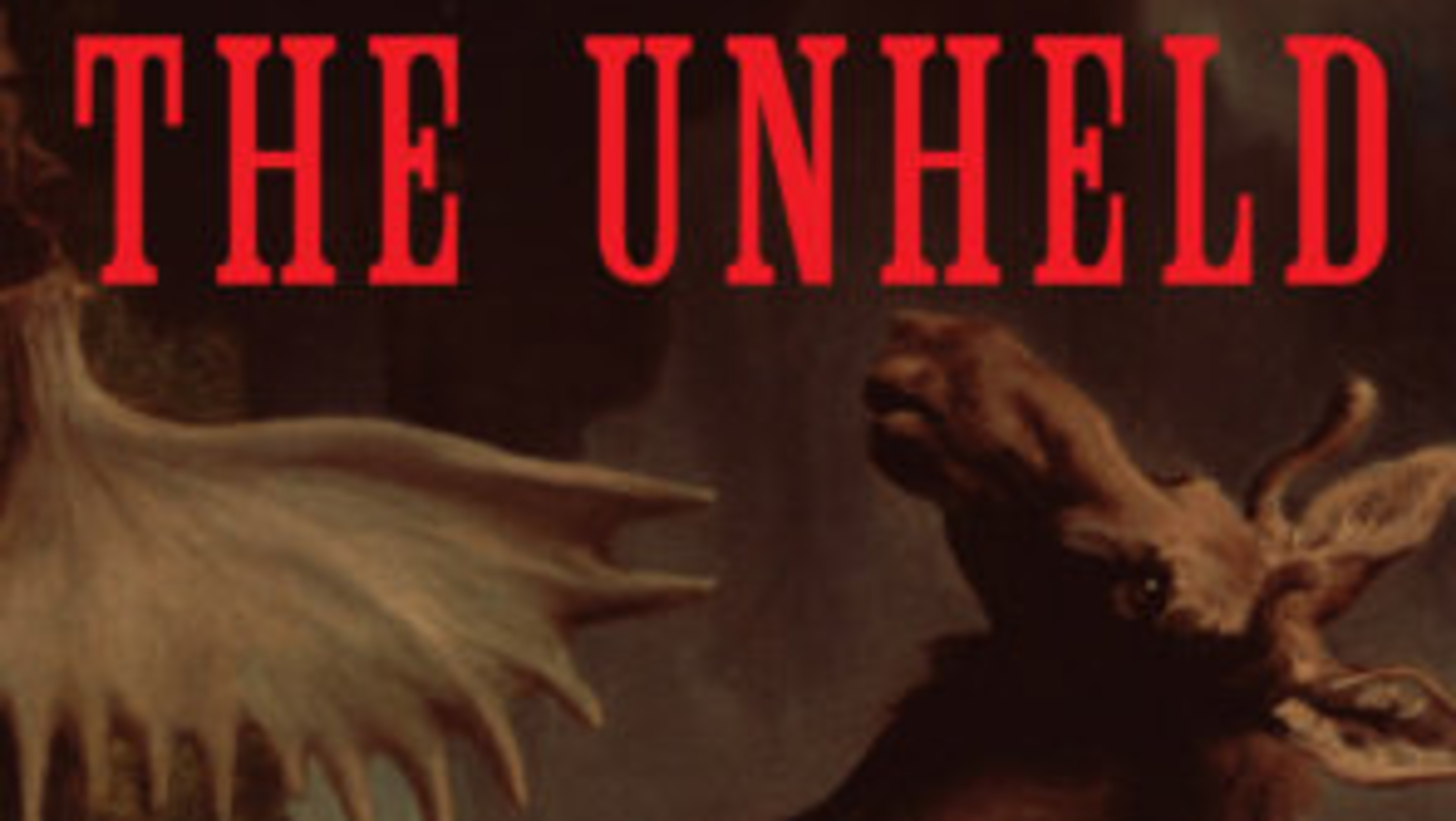
Title: The Unheld
Authors: Luke Larkin
Genre: Horror / Western
Publisher: Hyperion Avenue (an Imprint of Disney Publishing Worldwide)
Release Date: August 25, 2026
Price: Hardcover $27.99 (USD), Paperback–$18.99
Antonio Gramsci, while imprisoned by Benito Mussolini’s fascist regime, once wrote, “The old world is dying, and the new world struggles to be born: now is the time of monsters.” While this is technically a popular paraphrasing of his original statement, the quote beautifully captures the spirit of Luke Larkin’s 2026 debut novel The Unheld.
The western horror novel is set during the era of western colonial expansion into the North American interior. Railroad lines are built, towns established, and indigenous people displaced. Predatory capitalists force vulnerable populations to work at gunpoint, profiting from the cheap or often free labor. It is a world in transition, and cruel men consume and abuse those they can, leaving broken and hurting survivors in their wake. Deep within the backwoods of this monstrous world, a young girl named Charlie sets out to right some very personal wrongs, and in the process discovers a beautiful truth and a reason to live in the new world.
Despite being set in the past, readers will find Luke Larkin’s novel full of relevance to the world today, where courage and clarity are just as needed in our own “time of monsters.”
Synopsis
Publisher Hyperion Avenue describes The Unheld as follows:
“Startling monsters and occult oddities abound in this chilling horror Western as a girl journeys across the haunted Montana Territory to rescue her father from an otherworldly creature.
Charlie’s life is a lonely one. While other twelve-year-olds are in school, she spends her days skinning the animals her mercurial father hunts in the woods just outside their cabin. And the woods and its twisted creatures—an owl with four wings, a boar with two heads, a fox with gills—are becoming stranger by the day.
One night, a nightmarish beast appears and drags Charlie’s father into the wilderness. To find him, she enlists the aid of two unlikely allies also in search of the beast: an Englishman with a connection to a mysterious occult society and a Northern Cheyenne policeman exiled for a crime he didn’t commit. Yet as the trio prepare for the confrontation with the beast, Charlie must decide if her father, a brusque man who has always withheld his affection, is ultimately worth saving.
With its blend of Western grit and supernatural menace, The Unheld is an unsettling and atmospheric horror novel about loneliness, human connection, and how we find each other in a world that seems designed to alienate. With this assured debut, Luke Larkin marks his arrival in the genre and proves the American frontier still harbors untapped stories in its shadows.”

Deep Character Development in a Story All About Connection
While Larkin shines in many aspects of his writing, perhaps most notable is his ability to create deeply complex characters that feel real and relatable to readers. The characters of The Unheld are the misfits, outcasts, and forgotten; yet they carry inside the bright and warm flame of humanity. A young girl with a cruel father; a man who puts his life on hold because he can’t admit a truth that would allow him joy; a person estranged from family, trapped in a prison of regret. These characters, lost on their own, find shelter in each other, united by a common cause. Larkin’s ability to weave the lives of his textured characters together creates a beautiful tapestry upon which the story is told.
Larkin also succeeds in exploring the many sides of this troubled era. His characters represent the European colonizers who believe themselves on varying levels to be doing good in the world, represent the working class families just trying to scrape out a life, and represent the indigenous peoples trying to hold tightly to a way of life slipping from their hands. Somehow all of it comes together to tell not just an intricate account of westward expansion, but the emotional tale beneath it all—the violence of selfishness, greed, and loneliness.
“So Patton said it—Paveameohtse—and it was lost on Charlie, fluttering into the air like a bird spooked from the brush, streaking past her untrained ears and gone too soon. But Charlie liked hearing it. It was like no word she’d ever heard, and really it was multiple words, dancing together” (The Unheld, 208).
A Writer’s Eye for Trauma
Complementing Larkin’s well-developed characters is his rare ability to capture the essence of trauma through his writing. As anyone who has survived trauma or who lives with PTSD will confirm, memory is not linear or continuous. The painful moments from the past often return in fragments, in chunks of memory not bound by the flow of time or logic. These painful remnants unearth regret, grief, longing, and confusion. Larkin’s writing artfully renders these experiences through powerful imagery. As someone still recovering from childhood trauma, I found this writing hit me deeply on an emotional and even spiritual level.
Of particular note is Larkin’s symbolic use of hands throughout the novel. Early on, characters shake hands, hold one another, pass objects, all carefully described by Larkin’s prose in such a way that we understand the individuals through the way they touch the world. However, as the narrative progresses, characters’ hands become disfigured or lost entirely, and animals begin to appear covered in hands, culminating in the terrifying monster made entirely of hands. That the way we touch and connect with one another becomes at once a terrifying symbol of danger and the greatest hope for connection is the perfect literary device for Larkin’s message to readers about the nature of loneliness and the human condition. After all, for a young child, it is the hands of a parent that deliver both the beating and the blessing.
The following section contains MAJOR SPOILERS. If you haven’t read the novel yet and wish to avoid spoilers, please skip down to the section marked “About the Author.”
Hope You Can Read Through Tears
The ending of The Unheld is the culmination of a deeply moving coming of age story. Charlie bravely pushes into a nightmare forest, back to the cabin of her family’s past, now transfigured into a hellish place of flesh and dismembered hands. She has taken this journey because she’s unwilling to let her father die until she’s told him what a “bastard” he is. She knows he was a lousy father and the only solace she may yet find is to tell him off to his face before he dies.
“They walked for a time in silence. The sun rose, but it was neither warm nor bright. Somewhere on the mountain, an autumn wildfire had sparked, and already smoke filled the sky and painted the woods red so that the sun’s soft light was less a welcome companion and more of a warning, an omen, a lighthouse penetrating the smog” (The Unheld, 244).
But at the end of her journey, through a supernatural ability called scrying, she is able to see her father’s life from his own eyes, to live his memories as if they happened to her. It is in this process that Charlie discovers empathy for her father, and ultimately forgiveness—not because he hadn’t wronged her, but because she now understands that he did the best of which he was capable. There’s a beautiful truth here at the end of Larkin’s novel. The trauma done to us may never be undone, but there always exists the possibility of healing, and with that a chance at wisdom. However awful our parents may have been, the truth remains that they were wounded, hurting, and sometimes altogether broken human beings too. This is the wisdom that comes with time.
The way Charlie defeats the creature and comes to peace with her father moved me to tears, and to eventually sitting in silence when I had finished the novel. I knew that the book had offered me not only beauty, but also a truth I could feel in my bones.
About the Author

Based in Missoula, Montana, Larkin is a queer author living and working in Big Sky country. He received his MFA in creative writing from the University of Montana, and his work can be found in places like HAD, Sonora Review, Popshot, Firewords, and elsewhere.
Larkin takes care in the “Author’s Note” at the end of his book to communicate that portions of the novel are written from the perspective of a Northern Cheyenne character living in the late 1800s, “a period of rampant violence and too-often untold injustices directed toward Native peoples…” (The Unheld, 331).In order to accurately tell these parts of the story, Larkin relied heavily upon the histories of John Stands in Timber (transcribed by Margot Liberty). He also credits the work of authenticity reader Adria L. Jawort, a gifted Northern Cheyenne writer and journalist.
For more information, please visit Larkin’s website here.
Final Score
The Unheld, is at its core, is a coming of age story about a child who realizes that her deeply flawed father did the best he could for her, that he failed, and that sometimes at the end of grief lies empathy and forgiveness. The supernatural elements of the story and its ghastly monsters made of hands beautifully blend horror with the equally terrifying truth that to be alone deforms the soul, and that human connection is a need as deep as any biological hunger.
Luke Larkin is an immensely talented writer, and readers will enjoy the well-crafted prose as much as the expertly told story. If you’re looking for a summer read that will transport you out of the world of the familiar while moving the heart and edifying the soul, The Unheld is a must read.
Boss Rush Network is proud to give The Unheld a full five-star rating.
Tell us what you think! Will you be reading The Unheld? Share your reactions in the comments below or join the conversation on Boss Rush Network’s Discord, Facebook, and Twitter.
Featured Image: Disney Publishing Worldwide
David Lasby is the Editor-in-Chief for Boss Rush Network. His favorite video games are The Legend of Zelda, Metroid, and the Aliens franchise. You can find him on Twitter to talk all things Nintendo, sci-fi / fantasy, and creative writing.




Leave a Reply