
Title: Diplomacy is Not an Option
Developer: Door 407
Publisher: Door 407
Release Date: October 4th, 2024
Platform: PC via Steam and Epic Games Store
Reviewed on: PC via Steam
Price: $29.99
Author’s Note: A key was provided for this game by Door 407.
To the Walls!
Diplomacy is Not an Option certainly feels like a real time strategy-lover’s RTS. This addicting and funny title plays like a mix of castle defense mechanics inspired by 2001’s Stronghold, and the genre classics such as Age of Empires. Playing as the king of a small kingdom who will play an outsized role in the resolution of a civil war, defense is the name of the game. You’ll build up your castle walls with archers, siege weapons, and layered defense in order to repel the multitudes of angry hordes that will descend on you. At the same time, you can’t neglect the need for a good offense, as exploring the surrounding areas and defeating the many rebel camps you find is the key to avoiding being overcome during the final waves. The game is hard, and newcomers to the genre are likely to struggle, but those with a fair amount of RTS experience would be doing themselves a disservice by skipping Diplomacy is Not an Option.

Story
In Diplomacy is Not an Option, you’ll play as a king of a minor lord within the larger Kingdom of Samreigna. The kingdom is lacking in tax dollars due to overspending from their opulent king. You’ll be tasked first with whipping the local peasants into shape so they’ll pay their taxes, and then extracting value from the distant lands of Sarranga, to send back to the King of Samreigna. Exploit the poor, and colonize new lands on behalf of your king!
Well… That is one option., anyways. The coolest part of Diplomacy’s narrative is the existence of branching paths which lead not only to entirely different narratives, but entire other factions with unique unit types and mission structure. As an example, early in the game when tasked with destroying rebel forces as to force the peasants to pay their taxes, you’ll be given the option to defect and stand with the rebels instead. From there you’ll play the rest of the campaign against the king, and in support of the rebels. There are two more potential factions you can join as the game advances, and while their identity isn’t a secret to anybody paying attention to marketing, I won’t name them as I personally found organically discovering the options to be a very rewarding experience.
Narrative is generally a secondary concern with RTS games, which is why it is all the more impressive when a game within the genre tries to do something interesting narratively. They don’t always stick the landing, but Diplomacy’s branching narrative system absolutely does.
Presentation
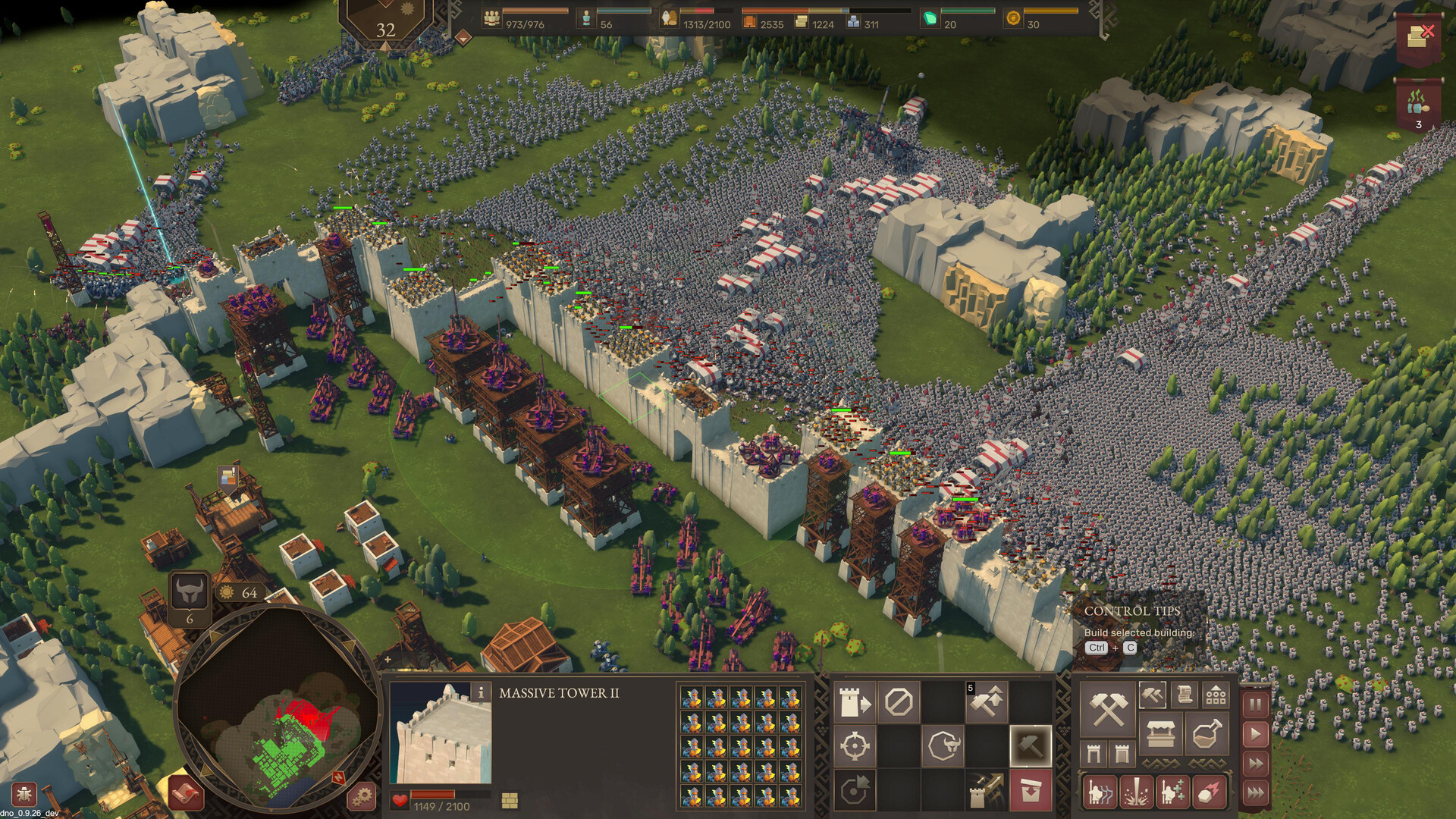
The art style on offer is not particularly complex, but this isn’t a negative. Diplomacy is a simple-looking game, but it sort of has to be. There is a lot to keep track of during sieges, and keeping everything rather plain greatly aids in the readability of the scenario. The art style embraces the low-poly, almost PlayStation 1-esque graphics of many games, similar to the likes of Totally Accurate Battle Simulator or the recently-reviewed Nova Roma, but I think Diplomacy succeeds in modifying this art in a way that feels distinct and unique. I particularly enjoyed the character designs, and I found they were able to impart a lot of personality into the characters both through their design, and how they are animated. Many cutscenes feature minimal, laconic dialogue, and yet leave you with a keen understanding of how the king is feeling through his mannerisms. Diplomacy is Not an Option manages to do a lot with very little.
The environments are equally simple, they almost look like worlds made out of playdough, but I find it to be both an appealing aesthetic, and easy to parse. Part of the gameplay includes picking up caches of supplies hidden throughout the world, and the simplicity of the environment made them easy to find. There is also a lot of variety in both the types of terrain you’ll be exploring, and the types of enemies storming your castle. Many different factions exist, and they all look and behave quite differently, as well as live in unique environments, providing a satisfying amount of variety in enemy and environmental models and design.

Diplomacy is Not an Option certainly isn’t a visual powerhouse, and the art style isn’t winning any awards, but it is perfectly competent for what it is.
Real time strategy games are complicated fare, and generally the less distractions the better, so the fact that Diplomacy is Not an Option doesn’t have a thumping earwormy soundtrack is not a drawback. The score is unassuming, fairly familiar orchestral fare. It fades into the background rather quickly and while none of the music stood out as particularly memorable to me, it is all competent and sets the tone rather well. Most importantly, nothing distracts you from the madness playing out onscreen.
The UI could use some work, too.The menus themselves are laid out competently, and the various icons and resource counts are clear and intuitive. It is when interacting with the UI where things become a bit frustrating. To start with, there is essentially no way to be alerted when buildings are finished, research is completed, or a squad is fully recruited. This is a game in which you are developing your castle while simultaneously exploring, and yet paying too much attention to exploration comes at the cost of allowing your economy to lag behind as you have no possible way to know if a building is finished other than manually clicking over to check. Research is better, as there is a countdown bar as well as a line from your counsellor to inform you the research is complete, and I’m not sure why this couldn’t have also applied to buildings. It is a genuine strike against the game, and while I learned to adapt, I simply wish the same could be done with buildings.
Overall the presentation of Diplomacy is Not an Option is acceptable, but certainly could be improved, especially the UI. It would be nice if more work was done to make it visually easier to keep track of the large number of different timers going at any given time, and make the process of building your city a bit smoother. The game sounds fine though, and while the visuals aren’t spectacular, they don’t need to be, and they have a lot of character as they are. The presentation of Diplomacy is Not an Option is mostly inoffensive.
Gameplay
Diplomacy is Not an Option advertises itself as primarily a siege-based game, but I don’t find that to be completely true. Building a castle and defending it from waves of enemies is certainly a primary element, but it only accounts for 50% of the equation. Exploration is a huge part of the game, and you’ll be putting forth exploring parties as well as going on the offensive against enemy castles just as often. Balancing offense, defense, and economy can be difficult and Diplomacy certainly doesn’t pull any punches, but the road to mastery is very rewarding.
The game is divided into story missions, and each mission has a very basic structure. You start a map with a keep and a handful of soldiers, and are tasked with accomplishing some feat, which ranges from simply surviving a number of days to conquering the enemy’s fort or creating a certain amount of a given research. You accomplish this by building up your castle, allowing you to expand your settled area and safely harvest more resources. While this happens, you will also be exploring the map around you, clearing them of enemy forces. At a set number of nights, you will face an invasion of soldiers, which will need to be repelled, and succeeding grants another period of peace during which you can continue building up, and preparing for the next wave. During the final wave, all enemies on the map that haven’t been eliminated will join in the assault. This is the basics of a given mission, but there is a tremendous amount of variety in the actual execution.
As a siege game, Diplomacy is satisfying. The game gives you a tremendous amount of defensive options, and allows a lot of personalization in how you approach defending your castle. Want multiple walls to fall back to when one is breached? Prefer defense-in-depth with multiple layers of archers and ballistae? Would you rather take an offensive defense with a sortie of troops? All of it is possible, and the wide variety of mission types ensures you’ll need to vary things up. It feels every bit as solid as the castle defense greats such as Stronghold Crusaders, my personal favourite.
One cannot focus entirely on defense though, as every mission has an entire map to explore, which will involve building an exploratory force. The map is dotted with units of enemy factions, all of which will join in the final wave of the enemy’s assault, and so taking them out early provides for a significantly easier final wave. Additionally some mission types will involve playing the invader and taking out an opponent’s castle, which requires finding it to begin with, in often quite large maps. The exploration is enjoyable, though the multitasking required to maximize exploration while also being on top of castle development is difficult, and could be made easier by UI improvements that did a better job of alerting you when construction or unit queues are finished.

Final Score
Though I have my nitpicks, let me state it clearly: Diplomacy is Not an Option is a tremendous game. The real time strategy genre feels like it is in its twilight aside from a handful of big franchises, and Diplomacy feels like proof that there is plenty of new creative ground to explore.
It is visually competent and sounds nice, but the gameplay is truly the star of the show. Diplomacy takes truly excellent castle defense gameplay, mixes it with compelling map exploration, and sandwiches the entire thing in a wave-based mission structure that very naturally creates productive waves and exciting peaks of gameplay. This is fixed in a charming and humorous storyline with a truly impressive depth of choice, as multiple entirely different storylines and even factions can be experienced based on the choices you make.
Best of all, Diplomacy is Not an Option is experiencing tremendous support from its developer, Door 407. It has received timely patches, frequent updates, and is getting its very first piece of DLC, “Fog of War,” towards the end of this year. This review is entirely based on the content as released, but you can guarantee I’ll be checking out everything the game offers in the future, because Diplomacy is Not an Option truly has me hooked.
Featured Image: Door 407




Leave a Reply