
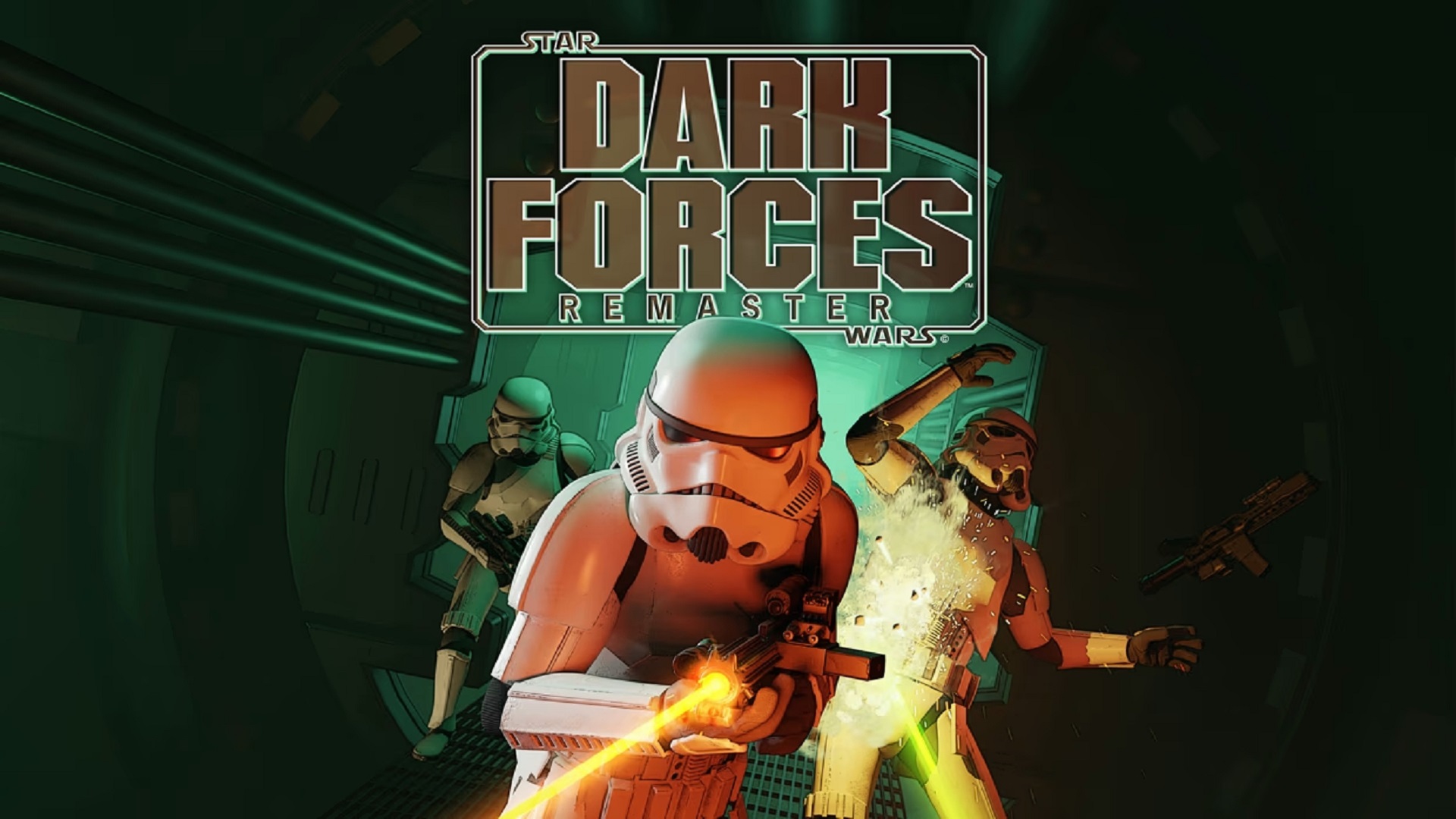
Title: Star Wars: Dark Forces Remaster
Developer: Nightdive Studios; LucasArts
Release Date: February 28, 2024
Reviewed on: PC (via Steam)
Price: $29.99 (Digital)
Nightdive Studios, the developers responsible for the recent remake of System Shock (one of the best games of last year) and a series of loving remasters of 90s shooters, have remastered Star Wars: Dark Forces, one of the finest early first person shooters.
More than a simple doomclone like many games of the time (it was, in fact, developed concurrently with DOOM), the team at LucasArts refined and expanded the genre significantly. Star Wars: Dark Forces was one of the first games of its kind with truly multi-story levels, 3D models, and a fairly fleshed-out, cinematic story.
Star Wars: Dark Forces is an often overlooked technical masterpiece, which until recently was difficult to run on modern hardware. The remaster is an often excellent, and sometimes frustrating, presentation of a classic.

Story
Stop me if you’ve heard this one before. After suffering a grievous defeat, the Empire approves a plan to clandestinely construct Dark Troopers: unstoppable, Terminator-like soldiers nearly immune to conventional weapons. The Rebellion’s only hope is a laconic, western-inspired mercenary with a dark connection to the Imperial figure behind the plot. Locations include a city on the wrong side of the law, an imperial prison, a star destroyer, and innumerable factories.
The first two seasons of The Mandalorian follow Star Wars: Dark Forces closely. While the show has many side-quests, additional steps, and flipped context, it’s familiar to anyone who played the game. (Many of the remaining elements emerge from BioWare and Obsidian’s Knights of the Old Republic games.)
This game also introduced Kyle Katarn, one of the most popular Star Wars characters, albeit sans beard. He would later go on to lead in the Jedi Knight games, but in this first installment he relied on little more than his blasters. Most of his character development would come later; for now, we only follow him from a cash-chasing mercenary to a man who believes in something.
Gameplay
Star Wars: Dark Forces is a largely traditional first person shooter of its era: an emphasis is placed on fast, smooth movement and momentum; battles are intense, against overwhelming odds, as sprite-based enemies have little technical impact; most importantly, this is as much an adventure game as an action game.
This game has a bad reputation as an unendurable keycard hunt, much like many of the shooters of its day. That’s not particularly true: only a few levels have necessary keys and switches far away from where they’re needed, and generally missions are straightforward and only ask for some exploration. Even the sewer level is straightforward (explore each of the four numbered branches at least once). Only two missions are notably obtuse: mission 6 (mostly for the elevator puzzle), and mission 9 (which is a city exploration level through a smuggler’s den, with all that implies). This reputation is due to the game asking to be played in a specific, out of vogue style: it’s not a shooting gallery, it’s an action-adventure game.

To that end, most of the weapons are designed to solve problems and encourage creativity. Rather than the traditional weapon selection (i.e. the machine gun, the shotgun, the room-clearing exotic machine, etc.), each weapon fills an unusual niche and encourages thought. The Imperial Repeater can be used as a SMG with long range, but it can also be used as a shotgun with an unusual, decaying pattern. The mines can be set to explode after a brief delay, or on proximity. The Fusion Cutter is a powerful tracking weapon, but can be used as a horizontal shotgun with little drop-off, but the price you pay is that at range the shots won’t land on your reticle. The closest equivalent of a sniper rifle is a long range concussion blaster that creates an AOE effect on any distant surface. It’s an interesting system that forces you to think outside the box.
The only flaw in the above is the enemy AI. They have simple, direct, and immediate responses and this makes it more difficult to pull off crafty stratagems. It was standard for the time, but it says how interesting and good the rest is for this to feel like a sometimes serious flaw.
It’s also incredible to see a 3D game this early that puts such effort into creating believable, livable spaces. Coruscant feels like a real place. The factories feel reasonable. These aren’t the abstractions of many games of the time, but a representation of a place people could actually be.
Restored Material
Star Wars: Dark Forces Remaster features a small collection of bonus material, largely comprised of concept art, renders, and some design documentation images. There may be physical limitations, particularly if these originated as ancient computer files, but I wish many of these were higher resolution.
But the main draw is the scrapped version of the first level, “The Avenger.” Set on the decks of a Star Destroyer, it was part of a Consumers Electronic Show demo. A few rooms were reincorporated into mission 13, but otherwise this mission was left on the cutting room floor. The developers abandoned it as they believed it was too difficult. While I find the fights against overwhelming odds fun, this is the one level truly guilty of the sins of 1990s keycard hunts. Necessary cards are hidden in easily missed spots. While I wish the sheer high of battling through a more recognizable Star Destroyer had been retained, rejigging to some degree was the right call. It’s a lot of fun, and well worth playing, particularly if you’re familiar with the game.
Technical Issues & Performance
The remaster runs in Nightdive Studios’ KEX Engine, supporting 4k at 120 FPS. Many of the assets were recreated by hand, and the developers promise no AI was used. When elements are no longer usable, this is the approach I want to see. It looks great, and generally runs well. The original presentation of the game is there too, and you can switch to the original presentation with the press of a button. I’m thrilled that this is becoming a standard feature on remasters.


There is one problem: the technical issues.
The development team behind Tomb Raider I-III Remastered Starring Lara Croft went out of their way to preserve oddities, glitches, and unintentional behaviors in the code. Elements like the unintentionally hidden med-packs and Lara’s double scream are part of the legacy of the games, and removing them would not only diminish the value of the remaster but hide the human toll of developing the games at that unimaginably rapid pace. Few, if any, of these elements get in the way of the gameplay and do not represent a total breakdown of the game. I applaud this decision: it preserves that these games are a human work of art.

Star Wars: Dark Forces Remaster preserves all of the glitches and bugs from earlier versions of the game. For example, it is still possible to lose all momentum on ice, leaving you stranded and and forcing to reload the level from the start. This is due to faster-than-expected processors, but has been a problem since release. New (or new to me) problems rear their heads throughout: the ending to mission 12 can simply fail to initiate, possibly due to a problem with v-sync (a known issue since at least The Force Engine). The graphics can tear and smear across the screen. The music timing is sometimes wrong. Several times a level, I dropped frames in a disorienting way. For the most part, this annoying rather than game-breaking, but on the final level this was particularly noticeable.
These should have been fixed. They are not part of the legacy or history of the game, nor do these problems tell us about the developers and their work. The game is simply breaking down due to unforeseen hardware configurations.
Remaster or Source Port?
Star Wars: Dark Forces Remaster was announced not too long after The Force Engine reached 1.0. This project is “essentially a source port designed to run the original game natively on modern systems with quality of life improvements and optional enhancements,” as the developer puts it. The Nightdive and Force Engine teams shared some knowledge, but these are two different projects with different goals.
Which version should you play? It depends on your goals.
Do you want to play Star Wars: Dark Forces as authentically as possible? Do you intend to mod it? The Force Engine is right for you.
Do you want to play Star Wars: Dark Forces with a new coat of paint in a way that behaves a little more like modern games? Are you interested in playing the scrapped Star Destroyer level? Star Wars: Dark Forces Remaster is right for you.
Neither are bad choices, and I have played both. It only depends on what experience you’re looking for.
Final Score
Star Wars: Dark Forces is a technical masterpiece that stands above many of the games of its era, with the old LucasArts sensibility and polish shining even thirty years later. Creative, unique, and exciting, it’s a shame that only two games were produced in this way: this, and the unjustly forgotten Outlaws.
For many players, the remaster will be the preferred way to play: it places emphasis on some of the best or most impressive elements of the original game; it is immediately, easily playable; it features a lost level. But it’s not a flawless remaster: ancient technical issues persist, and new problems emerge to frustrate the player.
The game itself is 4.5 stars. The remaster is 3.5 stars, due to the above issues. The above score reflects a balanced consideration between the game itself and the remastered presentation.
Featured Image: Nightdive Studios
The Boss Rush Podcast – A Podcast About Video Games
The Boss Rush Podcast is the flagship podcast of The Boss Rush Network and Boss Rush Media. Each week, hosts Corey Dirrig, Stephanie Klimov, LeRon Dawkins, and Pat Klein come together with their friends, colleagues, and fellow creators to talk about their week in video games, discuss industry topics, conduct interviews, answer listener questions, and more. New episodes every Monday. Get each episode one week early and more perks over on the Boss Rush Network Patreon page.
This feed also includes Boss Rush Spotlight podcasts and Boss Rush Video Game Book Club. Get both shows early on Patreon.
Email the Show: podcast.bossrush@gmail.com
Listen to The Boss Rush Podcast:
Apple Podcasts | Spotify | Anchor | YouTube
Follow and Connect:
X (Formerly Twitter | Instagram | Threads | Facebook | LinkedIn
Join Our Community:
Discord | Facebook | LinkedIn




Leave a Reply