
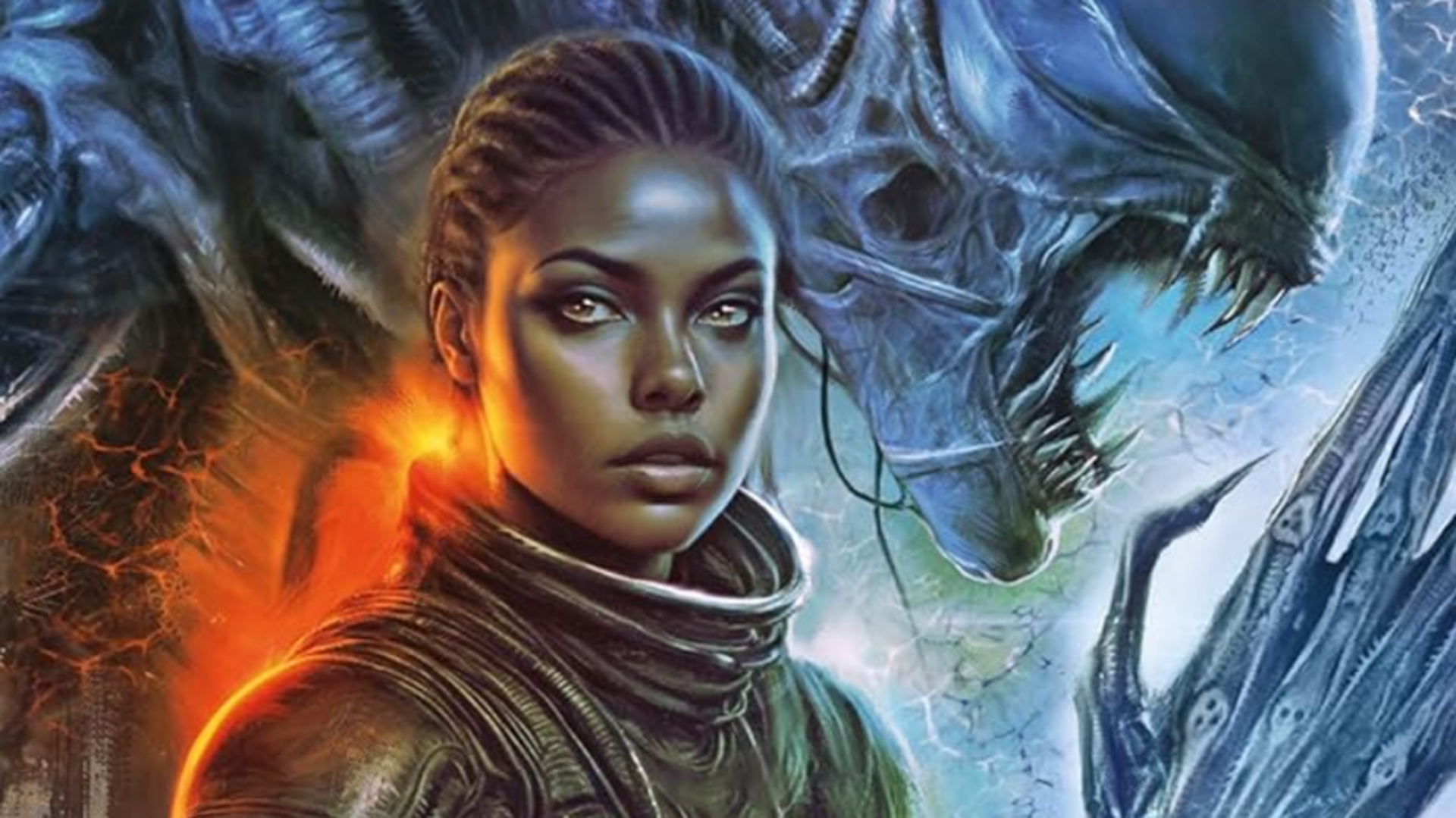
Title: Alien: Seventh Circle
Author: Philippa Ballantine (Story by: Philippa Ballantine and Člara Carija)
Publisher: Titan Books, 20th Century Studios
Release Date: Paperback, January 7, 2025 (Global Release)
Price: $18.99 (USD)
Boss Rush Network was provided an advanced copy of the novel from Titan Books for the purpose of this review. To see our reviews of other Alien novels and coverage of content within the franchise’s narrative universe, click here.
READER WARNING: Some sections (clearly marked) contain MAJOR spoilers. If you wish to read the spoiler-free portions of this review, skip to “Final Score” after reading this section.
Brendan Deneen, in his author’s note at the end of the novel Alien: Uncivil War, astutely observes that since the original film, Alien has always consisted of “three essential elements that have allowed this franchise to grow into multiple movies, comic books, video games, and… novels. These elements are: the Corporation, the Monster, the Android” (374). Good Alien stories always involve some element of these three—great ones masterfully blend these together into a seamless tale of the inhumanity of mankind.
Enter Alien: Seventh Circle. Following up on the thrilling Alien: Inferno’s Fall, Philippa Ballantine’s second expanded-universe novel is a tour de force, bursting with thrilling action, terrifying scenarios, and profound questions about the nature of humanity. As with the first novel, Ballantine teamed up with Alien expert and storyteller Člara Carija. These two are a powerful team, one that fans of the franchise will come to expect top-tier content from going forward.

The novel’s publication also coincides with the release of Alien: Rogue Incursion, the VR game staring Zula Hendricks; the legendary character also plays a significant role in Alien: Seventh Circle, though the novel primarily features Mae Hendricks, the synthetic and daughter of Zula and Davis One.
Plot Synopsis
Publisher Titan Books describes the novel as follows:
“As human colonies are obliterated by the dark pathogen and hideous monstrosities proliferate, a family of scavengers find an amnesiac who may hold the secrets to the forces tearing apart the galaxy.
Life amongst the stars is brutal. Human settlements are being destroyed by a dark pathogen launched from mysterious ships, which turns whole populations into hordes of ravenous monsters. And no one knows what happened to the Jackals, the elite cadre of soldiers hunting down the perpetrators of these atrocities.
When a family of scavengers recover the amnesiac Mae Hendricks amongst the wreckage of an unidentified ship, they bring a world of pain down on themselves and the civilians of Guelph Station. Mae doesn’t know where she is from or her true nature, nor that she is being hunted by vicious adversaries.
Mae’s past could finally reveal the conspiracy, but may well unleash a tide of snarling terrors…”
Alien: Seventh Circle is told through third-person narration; however, synthetic human Mae Hendricks, daughter of human Colonial Marine Zula Hendricks and combat synthetic Davis One, is the reader’s means of perception throughout the story. (If you’re hung up on that last sentence, there’s a very long story arc you can travel to get the backstory, and these two novels are a good place to start: Alien: Colony War and Alien: Inferno’s Fall.)
In short, this is a story about Mae Hendricks and her desire to find her place in the universe. She strives against the forces of greed and cruelty, against corporations, governments, and the increasingly less human forces that pull the levels of power. Mae shines with the light of humanity, a brilliance that transcends wires and circuitry, and in the process makes for a damn good story.
Synthetic, Augmented, and Genetic Humans, Oh My!
The following section includes MAJOR SPOILERS. If you haven’t read the novel yet, we encourage you to bookmark this and return after finishing the novel. You can skip down to the section marked “FINAL SCORE” to read more spoiler-free content.

One area in which Alien: Seventh Circle really shines is in its exploration of artificial intelligence, human augmentation, and the ways in which human beings will likely merge with these technologies as we barrel toward the future. Looking around the world in 2025, it’s not hard to imagine a future where Ballantine’s vision comes to fruition.
In this era of the Alien timeline, wealthy and well-connected human beings have augmented their bodies with synthetic technology, parts that improve physical prowess as well as mental acuity and network connectivity. Those without augmentation due to resource scarcity or free choice are referred to as “genetic humans”.

This aspect of the novel allows Ballantine to ask some profound questions about humanity and the nature of our identity; chief among these is whether our genetics (or programming in the case of synthetics) define us or if there’s some other unchanging essence that makes us who we are. It’s a subtle variation of the nature versus nurture question, but one that needs asking as humanity becomes increasingly enmeshed with technology.
For the humans in the story, this question arises when augmentation replaces so much of the genetic body that readers wonder how much humanity is really left. This is particularly apparent with The Extraktors, a Combine military group working for the UPP (Union of Progressive Peoples). For those unfamiliar, the UPP is a stand-in for the Soviet Union within the Alien Expanded Universe. The Combine (appears in Alien: Inferno’s Fall) is essentially the UPP’s version of Weyland-Yutani.
The Extraktors hunt down “rogue” synthetics who have escaped their initial programming, many of whom are on the run and seek a life of individuality. To better equip themselves for the role (which feels an awful lot like the slave catchers of American history), the Extraktors augment with mechanical body parts and brain implants that allow hacking and connecting to networks.
Leading the Extraktors is Captain Warrae, who grew up in the underclass of the UPP society but has now risen to a position of nearly unchecked power. Readers will notice his cruelty and delight in hurting others and naturally will wonder what is left of his humanity after so much augmentation. Or perhaps these changes simply amplified a rage born in the cruelty of his upbringing.
Mirroring this question of identity is the synthetic Mae Hendricks. Mae’s external body is so human-like that no one (including other synthetics) are able to identify her as anything other than a genetic human. A major plot device in the story is that Mae is suffering from amnesia.
This is certainly a trope within storytelling, but not something typically done with an artificial person; and it provides an interesting counterweight to the human characters that play out this question of identity and true essence. Does Mae retain her essential personhood if she is without her core memories and any knowledge of her past? What governs our actions if not decisions built upon the wisdom of past actions and the code of ethics we choose for ourselves? Despite these crucial elements missing from her internal code, Mae does in fact behave in ways consistent with her identity, suggesting there is some unchanging essence that defines her personhood.
At one point in the story, Mae stumbles upon a group of synthetics who have been “scrubbed,” stripped down to mindless automatons. In another, the readers witness the torture of a synthetic. These scenes feel akin to visiting a slave plantation or seeing people lobotomized from cruel medical experiments—a terror to behold. At this moment, readers feel the personhood of Mae and recognize the authenticity of her humanity, even as a synthetic.
Finally, Ballantine writes a number of beautiful passages in which Mae wonders at the cost of killing humans. The programming for most synthetics prevents them from harming a human, either directly or through failing to take action. (Think Asimov’s first law of robotics.) But Mae is not bound by such laws; instead, the entire notion is flipped on its head. This time, the synthetic wrestles with the moral cost of taking a life and the changes it will cause internally—a beautiful reflection of the humanity Mae seeks.
Philippa Ballantine handles these questions well, exploring our humanity and the role augmentation and artificial intelligence will play in our future. I love that the Alien expanded universe includes authors such as Ballantine and T. R. Napper (Aliens: Bishop); I couldn’t help but swell with pride as a long-time fan of the franchise and also as a writer and literature teacher. Alien has always felt special, a franchise that fans have some ownership in. I feel proud that our stories are asking the big questions.
A New Kind of Control
The following section includes MAJOR SPOILERS. If you haven’t read the novel yet, we encourage you to bookmark this and return after finishing the novel. You can skip down to the section marked “FINAL SCORE” to read more spoiler-free content.
The synthetics aren’t the only one evolving in Alien: Seventh Circle. The iconic Xenomorph progresses and builds upon its reputation as the Perfect Organism. These Xenomorphs are more intelligent than many of their counterparts, a far cry from the mindless bugs portrayed in many video games. But while their cunning and aggression are noteworthy, most intriguing is the way in which the hive communicates and even expands its power.
Ballantine introduces the Kuebiko fungus into the Alien expanded universe; it works like mycelium (a root fungus that allows trees to communicate with one another about danger and threats). Weyland-Yutani’s experiments with the fungus have allowed them to discover that it is possible to control Xenomorphs by infecting the host before the Chestburster emerges.
Searching for ways to control the Xenomorphs is nothing new for Weyland-Yutani; indeed, there’s been several other instances of the company successfully doing so in previous installments in the expanded universe. But Ballantine offers a fantastic twist on this trope: Kuebiko can also be used to control humans and to get them to work together with Xenomorphs. This significantly elevates the narrative tension, and creates dangerous situations wherein the Jackals (Zula Hendricks’ rogue group of fighters from the Colonial Marines, UPP, and Three-World Empire) must overcome the raw power of the Xenomorph backed with the cunning of human intelligence.
I really enjoyed this nuance on otherwise well-trodden ground. The resolution to the novel leaves open the possibility of future appearances of Kuebiko; and honestly, I think it would make for riveting cinema on the big screen if 20th Century Studios chose to include it in future films.
Fast-Paced and Paced Well

Image: Titan Books
The following section includes MINOR SPOILERS. If you haven’t read the novel yet, we encourage you to bookmark this and return after finishing the novel. You can skip down to the section marked “FINAL SCORE” to read more spoiler-free content.
As with most good storytelling, Alien: Seventh Circle relies on overlapping conflict to drive the narrative forward. With the clever plot mechanic of Mae “splinters” (Mae separates her personality core into three combat synthetics), readers are able to experience three separate military operations at once while maintaining Mae as the reader’s means of perception. This created a sense of integration, even as the three conflicts branched out; I found myself somehow worried about the survival of the same character in three different places at once. That’s quite the feat and a unique experience.
It also adds beautiful depth to the central questions of individuality and personhood. Can the Mae splinters individuate and progress towards separate personhood? What happens when they re-integrate into Mae Prime? Again—Ballantine excels with asking the big questions.
Perhaps the best indicator of good storytelling, each segment of the novel had me desperate to keep reading; and when the section would end, I felt a desperate impatience to get back to that story thread as a new one began, only to be just as consumed by the next. As these overlapping conflicts and narrative threads shifted faster, it became impossible to put this novel down.
Final Score
Simply put, Alien: Seventh Circle represents the Alien Expanded Universe at its best—intricate storytelling, “high-budget” set pieces, and profound depth of themes, all of which would be too complicated or too expensive to produce on the big screen. Yet when set within a novel, these elements weave together to create a kick-ass Alien story that lifelong fans and newbies alike are sure to love.
Alien: Seventh Circle also handles Easter eggs and franchise nods better than certain recent films (cough, cough). These one-liners are used sparingly and don’t cause immediate eye-rolls. Delightfully, the novel does include some references to other novels within the expanded universe; fans that have read Alien: The Cold Forge, Alien: Into Charybdis, and Aliens: Bishop will find themselves in a “hey, that’s….” moment. Bravo, Ballantine and Carija!
Ballantine builds upon the recent trend from Titan Books authors of focusing narratives around artificial life and the nature of our humanity; while these ideas have always been a focus on the Alien universe, recent developments in AI have brought these issues to the forefront among many in the artistic and scientific communities.
Now, more than ever, stories exploring the complex challenges raised by artificial intelligence are sorely needed; and Alien: Seventh Circle through Mae Hendricks and the many foils of her character challenge readers to broaden their perspectives, not only about what is possible, but about just what makes “genetic humanity” meaningful (or lacking in such).
If you consider yourself a fan of the Alien franchise or are simply looking for a place to jump in, don’t pass up Alien: Seventh Circle. And Titan Books, if you’re still reading this, PLEASE give Philippa Ballantine and Člara Carija more opportunities to tell stories for this beloved franchise.
Boss Rush Network awards Alien: Seventh Circle a five-star rating.
Tell us what you think! Will you be reading Alien: Seventh Circle? Share your reactions in the comments below or join the conversation on Boss Rush Network’s Discord and Facebook.
Featured Image: Titan Books
David Lasby is the Editor-in-Chief for Boss Rush Network. His favorite video games are The Legend of Zelda, Metroid, and the Aliens franchise. You can find him on Twitter to talk all things Nintendo, sci-fi / fantasy, and creative writing.


Leave a Reply