
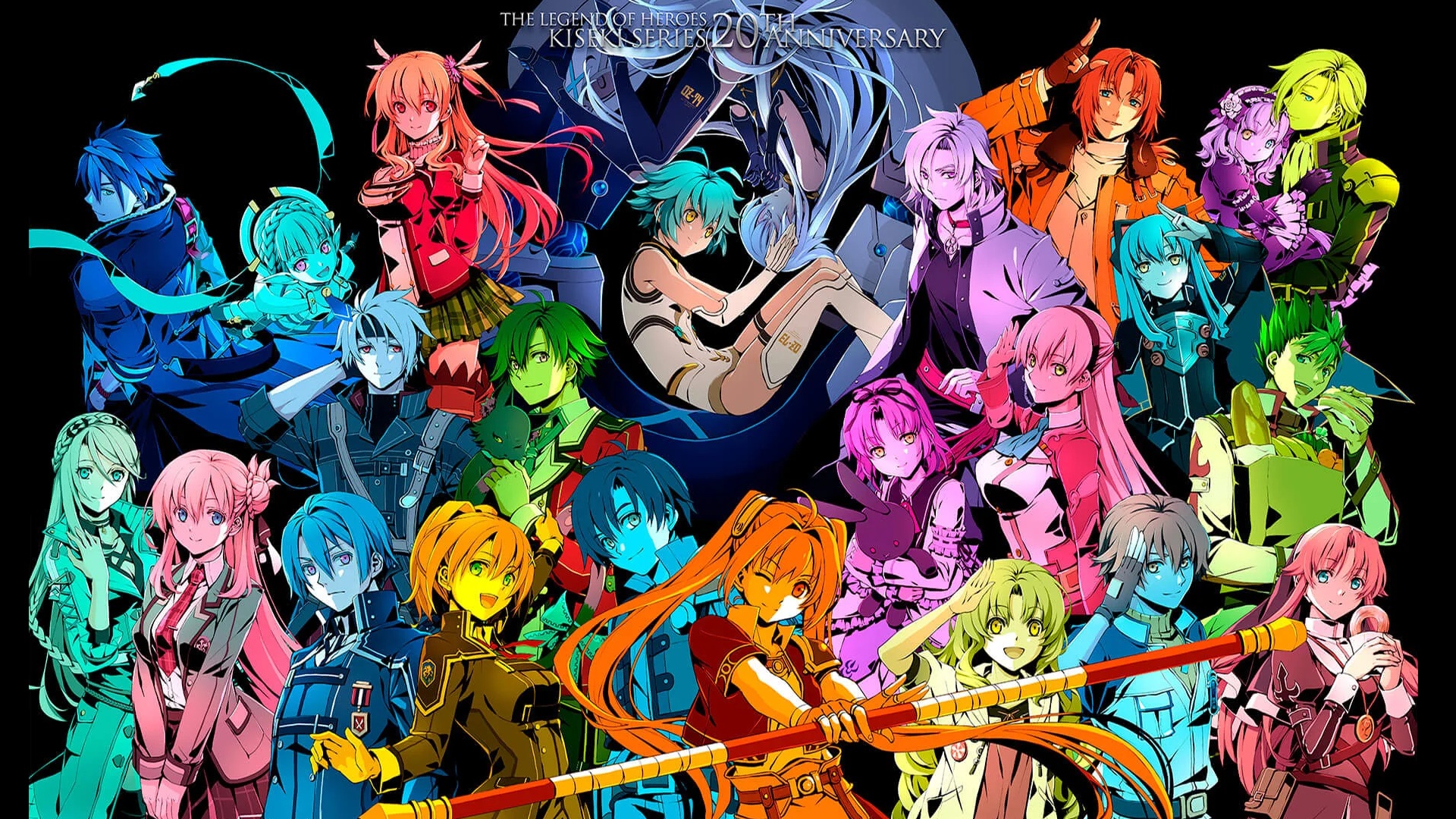
Last month saw the Western release of Trails Through Daybreak 2, the twelfth mainline entry in the long-running Trails series. With the Calvard arc in full swing, there has never been a better time to hop on the Trails trail and immerse yourself in the stories unfolding across the continent of Zemuria. But a series this massive in length and broad in scope can be intimidating to newcomers. So, for anyone who’s curious about this series but has no idea where to begin, this guide is the perfect place to start.
Series Overview: What Am I Getting Into?
The Trails series takes place on the fictional continent of Zemuria, a land with a rich history and a complicated political landscape. The world is amid a sort of magical industrial revolution thanks largely to orbments, a technology that uses magical crystals to power everything from streetlamps to war machines.
Gameplay is pretty standard turn-based RPG fare. You control a four-person party equipped with various magic spells and innate skills (charmingly called Arts and Crafts). Party members and enemies can move freely around the battlefield, adding positioning as an extra complication, and arts take time to cast, forcing you to factor cast time into your tactics. As the series progresses, extra systems get added on top of this base, but the core combat remains basically the same throughout.
What sets the Trails series apart from most other RPG franchises is its story. For most RPG series, each new game features a new setting and story, and the connections to past entries come in the form of recurring creatures, themes, and plot elements. Conversely, all the games in the Trails series are part of a single continuity, with a common setting and history.
Even though the series does progress chronologically, with each arc starting a few months after the previous one ended, the overall narrative isn’t strictly linear. For the most part, it is split up into two-game arcs, each set in a different part of the world. Each arc has its own story to tell, but it will also give you a clearer picture of the broader world. Think of it like the early days of the Marvel Cinematic Universe.
So, with all that being said, which arc should you start with? Just about any arc is a perfectly suitable starting place, with one notable exception. So, check out my elevator pitches for each arc below, start with whichever one sounds the most interesting to you, and if it leaves you wanting more, then go ahead and jump into another!
Liberl Arc

Games: Trails in the Sky, Trails in the Sky SC (Second Chapter)
Start Here If: You enjoy a more traditional JRPG story and setting (especially the SNES Final Fantasy games) or if you just want to play the games in release/chronological order.
The first arc of the series follows Estelle, a spunky young girl on a journey through the Kingdom of Liberl to become a top-rated Bracer (basically a Professional Quest Doer). During her journey, Estelle visits the various cities around Liberl, meets a colorful cast of characters, and solves problems as small as a broken hot spring, and as huge as an attempted coup against the royal family.
The Liberl arc does a great job of getting the player immersed in the world. Even though the games are set in Liberl, we get a small taste of the different countries of Zemuria like Erebonia and Calvard through the characters that Estelle meets on her journey.
Crossbell Arc

Games: Trails From Zero, Trails To Azure
Start Here If: You want a story with a smaller but denser cast and a more modern setting, or if you like buddy cop movies.
This arc is set in the magnificent metropolis of Crossbell, a city that is not only at the forefront of technological innovation, but is also hotly contested territory between the two major superpowers on Zemuria, the Erebonian Empire and the Calvard Republic (both of which we will visit in later arcs).
The story follows the Special Support Section, a small, experimental division of the Crossbell Police Force who, like the Bracers Guild, are essentially Professional Quest-Doers.
The more modern setting gives a different flavor to the many side quests you do, like breaking up gang wars or catching a hacker. The city of Crossbell also becomes a character in its own right, a place that becomes more comfortable and precious as you spend more time with it.
Erebonia Arc

Games: Trails of Cold Steel I-II
Start Here If: You like some light social-sim gameplay in your RPGs à la Persona, or if you want more freedom to experiment with character builds and party composition.
This arc follows Rean Schwarzer, a new student at the prestigious Thors Military Academy of Erebonia. Rean and his classmates find themselves part of a new, experimental class that mixes students of noble and common birth. The resulting tension provides many opportunities for conflict between students of different social status.
The military school setting gives the game a similar flavor to Fire Emblem: Three Houses. Like Three Houses, there’s a large cast of students with colorful personalities and a variety of strengths and weaknesses in combat.
With the cast being larger than previous arcs, the overall character writing isn’t quite as deep, but every student gets at least a few moments to shine, ant the revamped Quartz system (similar to Final Fantasy VII’s materia system) makes it easier to make a viable party out of any combination of characters.
Great War Arc

Games: Trails of Cold Steel III-IV
Start Here If: You just want to hit huge damage numbers and don’t care about the ongoing plot threads getting tied up.
Remember when I said this series is like the MCU? Well, this arc is basically the Avengers: Endgame equivalent. All the characters from all the previous arcs team up to put a stop to a major conspiracy before it erupts into global war.
In case it’s not obvious, this is the one arc that I would not recommend starting with. Narratively and mechanically, it builds directly off from previous arcs, mostly the preceding Erebonia Arc. It’s a satisfying climax, to be sure, but only if you’ve gotten the context from all the previous arcs.
Calvard Arc

Games: Trails Through Daybreak I-II
Start Here If: You liked the hybrid of real-time and turn-based combat seen in Metaphor: ReFantazio, or if you like gritty detective stories.
The most recent arc in the series thematically echoes the Crossbell arc, with protagonist Van Arkride struggling to organize a ragtag group of misfits into a coherent unit while investigating shady dealings in the dark underbelly of the city. The main difference this time around is that Van and his crew don’t have the backing of the police department, so they often have to get more creative with their investigations.
As newer installments in the series, the Daybreak duology benefits from a more modern design approach. The seamless transition between dungeon exploration and battles, along with the option to face easier encounters as real-time hack-and-slash battles, gives the series a much-needed breath of fresh air, mechanically speaking.
It should be noted that at time of writing, the Calvard arc is incomplete in the west. A third game, Kai no Kiseki -Farewell, O Zemuria-, was released in Japan on September 26, 2024, and serves as both a conclusion to the Calvard arc and a setup for what Nihon Falcom has stated to be the final phase of the series. So, if you decide to check out this arc first, you’ll need to either wait for an English release or learn Japanese before you can see it through to the end.
The Odd Ones Out

Games: Trails in the Sky the 3rd, Trails Into Reverie
Technically, both games in this section are parts of previous arcs – Trails in the Sky the 3rd, as you might imagine, comes at the end of the Liberl arc, and Trails Into Reverie finishes up the Great War arc. But I’ve put these games into their own category because of their negligible impact on the overall story of the series.
These games are more like post-game bonus content, tossing a few extra dungeons to the player and letting them build their dream party using practically any named character from their respective arcs. The gameplay is still just as fun as ever, but the narrative contrivances used to explain why and how everyone is in the same place at the same time are pretty flimsy, and the stories end up feeling pretty inconsequential.
Treat these games as the glorified expansion packs that they are, and check them out only if you really want to spend more time dungeon crawling with your favorite party members.
And there you have it, the Trails series in a nutshell! If you’re a series veteran who wants to share how you got into the series, or if you’re a newbie with more questions about the games, head on over to our Discord and let us know what you think of this guide and this series!
Featured Image: Nihon Falcom (via PinBox)
Boss Rush Podcast – A Podcast about Video Games

The Boss Rush Podcast is the flagship show of Boss Rush Media and The Boss Rush Network. Each week, hosts Corey Dirrig, LeRon Dawkins, Stephanie Klimov, and Pat Klein, as well as their friends, fellow creators, developers, and industry veterans, share their gaming experiences. They discuss what they’ve been playing, explore rotating segments, debate the Boss Rush Banter topic of the week, answer community write-ins, and more. Patreon subscribers at any tier enjoy exclusive access to the Boss Rush Podcast Patreon Show twice a month along with other perks and extras.
Follow and Connect with Boss Rush Podcast on Social Media
X/Twitter + Bluesky + Instagram + Threads + YouTube
Listen to Boss Rush Podcast on Podcast Services
Apple Podcasts + Spotify + Goodpods + Amazon + More Links
Thank you for supporting Boss Rush Podcast and the Boss Rush Network
Thank you for watching or listening to The Boss Rush Podcast. If you’re watching this episode on YouTube, hit the Subscribe button, Like the video, and hit the notification bell so you don’t miss an episode! If you’re listening on Apple Podcasts or Spotify, consider leaving us a rating and a review as it helps with discoverability and growth. Support Boss Rush on Patreon for exclusive content, early access and audio versions of shows, become a Patreon Producer, and more. Visit our website for all of our content including reviews, news, daily Boss Rush Banter discussion topics, listicles, features, and more. However you support us, it means so much to us. Thank you for your continued support of the Boss Rush Podcast and the Boss Rush Network.



Leave a Reply