

Pokémon GO exists in an odd space as a part of the world’s largest franchise. It’s part mobile game, part creature collector, part digital pet, and somehow it’s not even pay-to-win. The app exists at a dysfunctional in-between for someone who is looking to get the most out of their experience. If you spend your time collecting Pokémon creatures you can steadily fill out your Pokédex. But pretty quickly you’ll start to run out of storage! In order to upgrade that storage you’ll need 200 of the in-game currency: Pokécoins.
The Problem with Pokécoins:
The singular way you can earn Pokécoins is by putting your Pokémon in a gym, but it’s not so simple! Your Pokémon will need to be a part of the gym for approximately 8 hours in order to earn 50 Pokécoins, which is the maximum you can earn in a single day. That’s a big investment! On top of that, if you’re in an urban area where gyms change over frequently that means you might not be earning the full 50 coins per day.
Conversely, if you live somewhere more rural and are trying to make the most of time you’re in urban or suburban areas—where the app actually has populated gyms—there are two possibilities: your Pokémon gets knocked out of the gym before you can earn the maximum OR your end up with a Pokémon in a gym no one visits—meaning your Pokémon is effectively trapped until someone finally comes along to knock it out and free it from its week long prison sentence. And you still only earn 50 coins for a week’s worth of uptime.
But wait! There’s more! And it’s worse! Having multiple Pokémon in several different gyms to try and get a potentially diverse return means that you’re submitting to the chance that all of them get knocked out rapidly, or within the same short period which still only nets you 50 coins. Say you stash five Pokémon in gyms after leaving work for the day. It’s entirely possible that in the morning all 5 of your Pokémon have been sent back to you and now you’ve hit your daily cap of 50 coins for the next ~24 hours. You’re out of luck for a full day. Your only other option is to pay real money for in-game currency.
Additionally, Pokécoins don’t buy you very much! The in-game shop’s stock is minimal. Nearly everything has a 50+ Pokécoin price attached. In most cases the rewards they grant are minor: faster egg hatching, 1.5x more experience or stardust for 30 minutes. The exceptions to this are for the hardcore players who frequent raids, who are able to purchase raid passes and max mushrooms for dynamax battles. Otherwise the items sum up to being expensive ways to restock on items you can get from playing regularly: Poké balls, healing items, incense and lures.
The Isolation of Playing Solo:
It’s fascinating how much this app looks to reward cooperative play, and seems to almost discourage solo play. Taking on gyms, raids or dynamax battles are all much easier with a group. It’s possible for a solo player to tackle those things, but the difficulty spikes drastically with each tier of power attached. For example, a solo player can easily handle a 1 or 2 star raid or dynamax battle. But 3 stars and above, which tend to hold better rewards, are possible but much harder for a single person to tackle. 4, 5 and 6 stars are nigh impossible for a single person. Part of the issue with this is that most folks who still actively play may not have a legion of friends—or the availability—to tackle these exceptionally rewarding challenges and therefore miss out on the best that Pokémon GO has to offer.
Gyms are spared from this, but only slightly. The way gym battles work requires the Pokémon stored in the gym to be defeated. Depending on the stored gym Pokémon’s current health / Combat Power level they may need to be defeated three separate times. Each time they’re defeated they lose power and progressively get easier. This was likely implemented in order to prevent immediate gym turnover. In cases where just one or two Pokémon are stationed in a gym it’s not a big issue. However, when a gym is filled with its maximum capacity of six Pokémon—all with full health—that boils down to fighting eighteen Pokémon in a row. That’s not only a huge time-sink, but also a big drain on a player’s resources. Once again rewarding party play and discouraging single players from engaging in the only singular option to gain the in game currency. Truly horrible design. The flip side of this issue is that gyms stocked with six Pokémon are less likely to be challenged and the players who left their Pokémon to guard it are also not likely to have their Pokémon return for a long time. The system actively burns both sides; the gym defenders and those who take them on.
The trouble with trading:
Let’s take a look at the friend system, and in specific the trading system! Before digging into the insane cost of that system we have to talk about the elephant in the room: stardust. Stardust is an in game currency that cannot be bought. The few ways to earn stardust are by catching Pokémon, completing in-game missions (few and far between and the rewards are so unbelievably low) and battling online. Stardust is used for a few things, mainly powering up your Pokémon. The cost of powering up your Pokémon to the heights of their Combat Power potential often requires 3,000+ stardust and eventually upward of 6,000 stardust. It’s important to note that catching a Pokémon—one of the fastest and few methods of earning stardust—nets you only 100 stardust per catch. That means powering up one of your strongest team members requires you to put in the effort to catch 60 Pokémon.
Not everyone has the time to commit to that kind of grind! You may not have enough Poké balls to catch that many Pokémon. Earning more Poké Balls requires spinning Pokéstops. These Pokéstops refresh every 5 minutes. Unless you’re traveling a wide area you’re not going to be spinning many Pokéstops. If you’re lucky and able to station near one for a while, you’re still only getting one spin every five minutes. Even then, you could spin a Pokéstop and not even earn a single Poké Ball! So not only is stardust hard to come by, but the effort to earn a high amount is almost a full time job.
Now we can talk about trading. Trading is something that’s always been a core function of the Pokémon series. “Collecting them all” was the name of the game, and to do so you had to have a way to connect to your friends’ game because some Pokémon only evolve via trade, and the separate versions of games have exclusive Pokémon. To trade in Pokémon GO you need to be friends with someone in-game, but also physically within 100 meters of them to be able to trade. There was a short stint where online trading was allowed but that has since been rolled back! The pros for trading are that, like the core games, some Pokémon can evolve in the process. That also allows evolution without the high cost of using 100 or more candies to evolve. BUT there’s a price attached. You also have to pay stardust to trade. This is where it gets fun and complicated and extremely expensive.

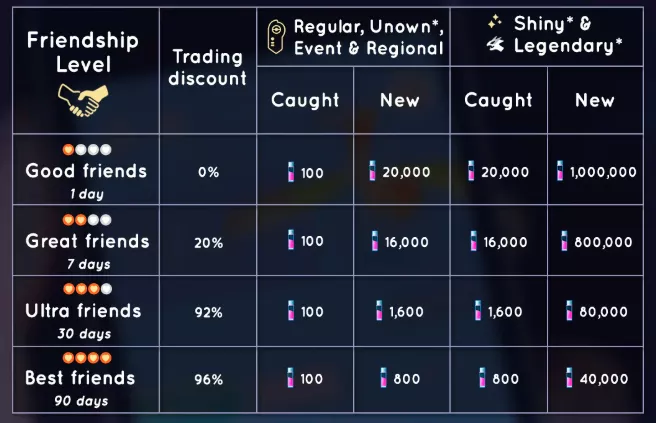
If you are friends with a player you can trade Pokémon nice and easy. But only if you and your partner both have caught each of the Pokémon you’re trading. If only one of you doesn’t have the Pokémon registered the price is 20,000 stardust. That’s 200 Pokémon caught just for 1 trade. You’re better off grinding for the Pokémon alone! Which is ironic because of how much the game seems to despise solo players.
You can increase your friendship with other players by playing together. Sending gifts is the easiest way to check in daily and increase that total. But after a full week of friendship you only get a 20% trading price discount, bringing that 20,000 down to 16,000 (still 160 Pokémon’s worth of stardust!) The big discounts come in after a full month of daily play with someone, cutting all prices by 92%. That’s nearly the best it can be, cutting 16,000 down to just 1,600. And after 90 days of co-op you get a 96% discount bringing the high price to simply 800 stardust.
Now, if you’re trying to trade shiny Pokémon, or god forbid you try to send your friend a Special (dynamax, gigantamax, mega evolved, legendary, etc.) that increases prices exponentially. The starting price for if you BOTH have the shiny Pokémon registered in your Pokédex kicks off at 20,000 stardust. Subsequently reduced to 16,000 then 1,600, then 800. If either of you do not have the Pokémon registered in your dex the cost STARTS at 1,000,000 stardust. That drops to 800,000, then 80,000, and finally stops at the low low price of 40,000 stardust. Basically, if you ever want to trade for a shiny or special Pokémon that you don’t have you need an unbelievable amount of stardust, and you’re honestly better off just playing a different game at that point. At least it’s not like Pokémon Sleep where the Pokémon you catch can’t even interact with the core series of games, but that’s another whole story. Oh, and I failed to mention: when you trade a Pokémon it’s in-game stats get fully re-rolled. So don’t go around trading your perfect IV Pokémon!
All of this to say that Pokémon GO exists in such an awkward position. It’s simultaneously a game that encourages community, but actively stifles anyone playing alone. It’s as if the game is rejecting the possibility of new players trying to have some fun in favor of cultivating an established (and dwindling) playerbase. The amount of effort required to make any sort of satisfying progress in Pokémon GO is astonishing. I think there is a chance the game could salvage its sorry state, but it would require so many large-scale changes that it would just be a different game.
What do you think? Does Pokémon GO require too much effort from players in order to get the most out of it? You can let us know over on the Boss Rush Network’s Discord!
Featured Image: Nintendo




Leave a Reply