
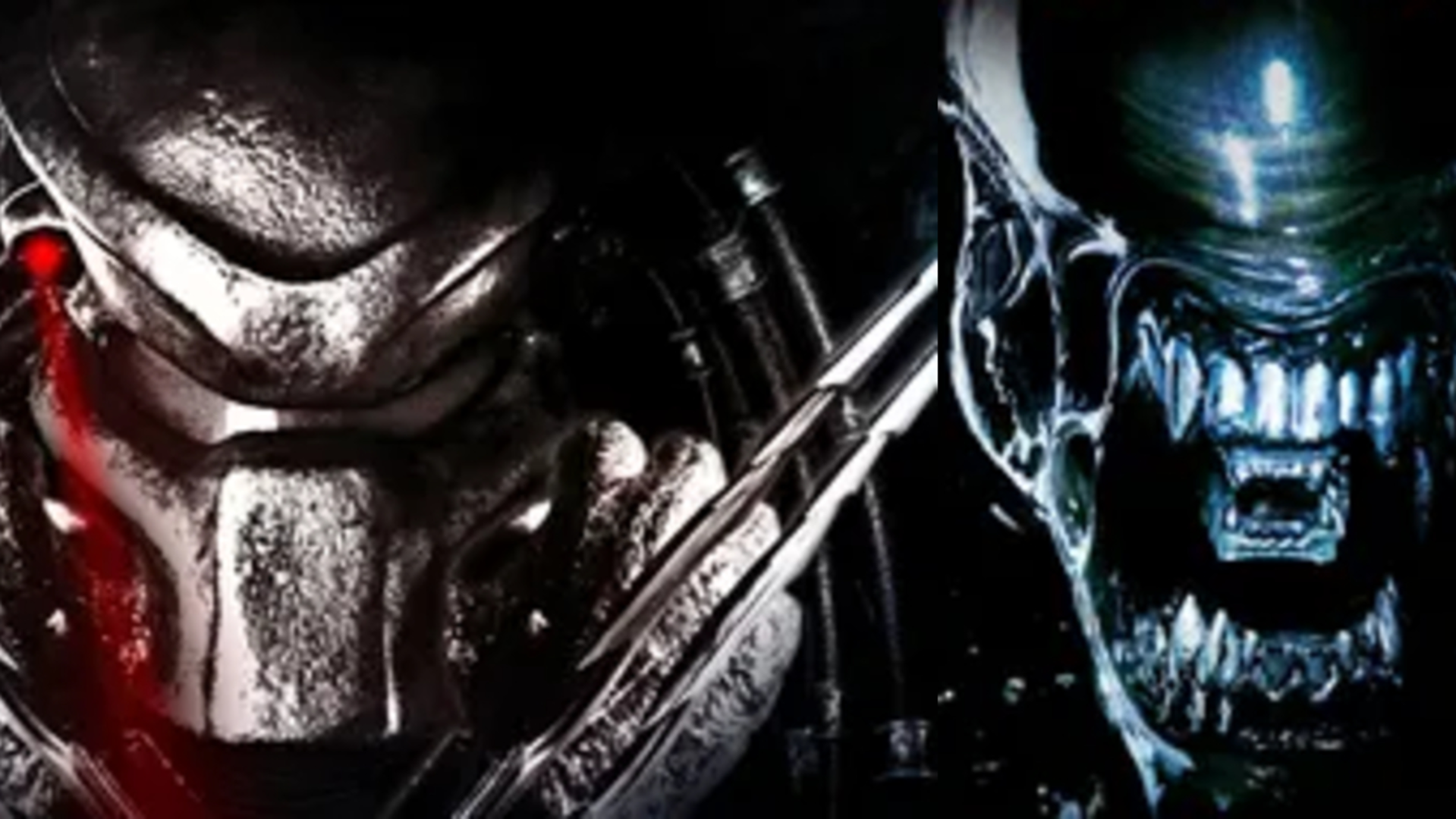
Title: Aliens Vs. Predators: Rift War
Authors: Weston Ochse & Yvonne Navarro
Publisher: Titan Books, 20th Century Studios
Release Date: September 6, 2022 (USA / CA) / August 16 2022 (UK)
Price: US / CA $15.95 (USD), UK / World £8.99
Certain sections of the following review contain spoilers, some mild and others major. These sections are clearly marked above the section heading and contain directions about skipping ahead should you wish to avoid spoilers.
To see our reviews of other Alien novels and coverage of content within the Alien or Predator franchises’ narrative universes, click here.
The Yautja and the Xenomorph, two of science-fiction’s deadliest killers, first appeared together in the iconic trophy wall scene in the 1990 film Predator 2. Tilted in a perfect side-profile, the skeletal-white Xenomorph skull shone in the low light just beyond Danny Glover’s Lieutenant Mike Harrigan. Perhaps it was an unserious nod to an accomplished “peer” franchise, or maybe it was truly a desire for an expanded universe; but once the idea entered the minds of fans worldwide, it took off like a USCM Faster-Than-Light drive. Books, video games, and eventually films all delved into this imaginative universe where these two legendary species faced off. Unfortunately, the results haven’t always been good.
No where has this been more apparent than in the 2007 sequel film AVP: Requim. Famously too dark to see (let’s be thankful that era of film has seemingly passed!), the story did have some bright spots—specifically Wolf (a Yautja Elite) and the Predalien (born from the fallen Yautja Scar). But ultimately, the film was a flop, felt rushed in its production, and left fans feeling frustrated. Whatever fans may have felt about the AVP films, the result left the majority in Hollywood declaring the franchise dead. But those who grew up reading the AVP comics and novels knew the potential the franchise had for serious storytelling. The apparent “death” of the franchise certainly brought disappointment.
Thankfully, the 2020s have seen a major resurrection for the franchise (in truth it was never dead, particularly within video games, novels, and comics). Now with the success of Prey (2022), Alien: Romulus (2024), and Predator: Killer of Killers (2025), fans have high hopes for a new AVP film, an idea certainly teased by the respective directors Dan Trachtenberg and Fede Álvarez, and by the trailer for the upcoming Predator: Badlands.
In the meantime, fans should sink their teeth into the 2022 thriller from Titan Books—Aliens Versus Predators: Rift War.
AVP: Rift War Synopsis
Titan Books describes the novel as follows:
“The planet LV-363 teems with exotic life, including a plant growing in the shadows of its deep rifts. The plant’s flower yields a valuable narcotic, and people are forced by the cartels to harvest it. When a Yautja (Predator) ship arrives for a hunting ritual, the Predators seed the rifts with Xenomorph eggs. The aliens emerge and the result is bizarre and deadly hybrids, with humans trapped between the Predators and their prey. These deadly Xenomorph hybrids—some of which possess the ability to fly—swarm out of control and may prove more than either the Yautja or the humans can defeat.”
The novel functions as a standalone story, though it could certainly be the beginning of a much larger story arc, should Titan Books decide to write follow-up novels for some of the characters. AVP: Rift War explores themes of addiction, revenge, courage, greed, and even the value of life itself. Long-time fans of these franchises, or even newcomers looking for a good story, will likely enjoy this 358-page novel from Weston Ochse and Yvonne Navarro.
The following section contains very mild spoilers. Should you wish to avoid these, skip ahead to the section marked “About the Authors”.
Balanced Storytelling

Image: Electronic Arts, SEGA
Any good AVP story must find a way to balance the Yaujta, Xenomorph, and human perspectives in a way that escapes trivializing the three species or prioritizing one over the others. I’m happy to report that AVP: Rift War excels in this area, telling three riveting stories that intermingle as one. While the narrative is not without its flaws, it more than lives up to the standard fans should expect from these stories.
- Human: The human story follows two groups of people, the former Colonial Marines turned mercenaries who work for a drug cartel and the Khatura addicts that work as slaves for them. The human characters are well developed, and the novel takes great efforts to build characters that readers will care about. Despite the fact that there’s a clear victim-perpetrator relationship among the humans, the characters are complex enough that readers will want to know what happens to each of them, and even find themselves rooting for characters they might despise at the same time. The tension between the humans drives the characters to pursue freedom at great costs, and not everyone is willing or able to walk away from what happens.
- Yaujta: The legendary hunters have chosen LV-363 as a new destination for the Blooding ceremony. The story opens with a Yautja named Ar’Wen who has been tasked with seeding the hunting grounds with Ovomorphs, the egg-like first instar of the Xenomorph. Ar’wen’s story serves as the container story for the novel, being narrated with “interlude” chapters that break up the tense action of the three main story arcs, before eventually joining the action as a primary character. Most of the novel, however, focuses on the fate of the three hunting captains (T’U’Sa, Ny’ytap, and Ca’toll) who are each charged with a group of unblooded Yautja. These groups compete and interact with each other as the three hunting captains train the young ones in the old ways and tradition of the hunt. The contrasting leadership styles of T’U’Sa, Ny’ytap, and Ca’toll greatly shape the behavior and character of the Yautja unblooded in their charge, and this becomes a source of great intrigue as the novel progresses.
- Xenomorph: Understandably, the Xenomorph storyline is the least developed in terms of direct narration; it’s notoriously difficult to develop “character” in a monster, though it has been done somewhat successfully elsewhere in the franchise (see Specimen Six in Alien Versus Predator (2010), Grid in AVP (2004), and the Necromorph in Alien: Prototype). Nevertheless, Ochse and Navarro do admirable work crafting a worthy portion of the novel that follows the Xenomorphs. From small sections narrated in single-word, instinctual phrases to deep exploration of the various mutations and life cycle stages of the Xenomorph, the Perfect Organism is well represented in AVP: Rift War. Fans will appreciate the fresh ground covered in the story.
All three of these stories interweave with the impressive setting of LV-363. Great cliffs formed from the broken crust of the planet, called rifts, tower hundreds of meters above the valley floor where very little sunlight ever reaches. Along the walls of the rifts grows a rare plant called Khatura, which produces a highly narcotic pollen that gives a high that won’t let go. Just one hit and people are addicts for life—a very profitable plant for the cartel.
Three distinct and interconnected ecosystems develop along the rifts, with the base being home to unspeakable monsters and creatures that hunt in the total darkness of the floor. These monsters climb and even fly into the higher “light” zones where the Khatura plant and other thorny vines grow, hunting the creatures that have adapted to these conditions (including the humans that harvest Khatura). Finally at the top of the Rifts is the mesa-like plateau where trees and vegetation grow thick, and it is here that the mercenaries working for the cartel have made their base camp.
The following section contains moderate spoilers; if you wish to avoid these, you can skip ahead to the section marked “About the Authors”.
A Return to Form

Image: 20th Century Studios
Aliens Versus Predators: Rift War shines in the variety of its “monsters,” giving fans plenty to gawk at, and even a return to some treasured, if not forgotten, aspects of the franchises. Long-time fans often lament the change of development speed in the Xenomorph life cycle; indeed, for those who cut their teeth on the original trilogy, there was an enduring sense that the Xenomorph posed a threat at all stages, from the ever-seeking Facehugger, to the (once) slowly growing Chestburster, to the adolescent Xenomorph shedding its skin in ventilation shafts.
This slow developing monster fascinated fans; as the franchise progressed, these distinct phases became lost, rushed, and mostly discarded for a rapidly developed adult Xenomorph. But something valued became lost. Perhaps the most egregious example of this was the first AVP film in which chests began to burst only moments after faces were hugged; or how about Alien: Covenant discarding the Chestburster altogether for fully formed Xenomorphs in miniature. (Now it is true that Alien 3 had a Burster that could walk, but this could be argued to be a result of the specific qualities of its host, as it became the first Runner Xenomorph.) I raise these examples to note that, while AVP: Rift War doesn’t devote time to the Chestburster or the incubation process, the novel gives extensive time to the adolescent Xenomorph, and in particular, shows off slowly growing Xenomorphs of all shapes and sizes. This is a welcome deviation from recent films and a return to something valuable that has been absent.
While I wasn’t always thrilled with the handling of the adolescent Xenomorph in terms of its behaviors and instincts, I appreciated that Navarro and Ochse explored these distinct phases of its life cycle. The young Xenos in the story were aggressive, sometimes taking too direct of an approach when hunting, rather than strategically stalking from the shadows. And this made sense; they lacked experience, had a desperate hunger to pursue prey to fuel their rapidly dividing cells, and of course the instinctual drive to kill. While I didn’t like how easily they were dispatched by the Yautja (sometimes it felt like little more than an exterminator disposing of vermin), it checks out that the mighty Yautja, even when unblooded, would be able to make short work of the adolescent monsters.
Another welcome return is that of the unique Xenomorph based upon traits of its host; this is perhaps the novel’s biggest success. Aside from the Predalien in AVP: Requiem, fans haven’t seen this kind of thing since the early 90s with Alien 3. (It’s worth noting that Noah Hawley’s Alien: Earth appears to fully embrace this aspect of the Xenomorph—and I can’t wait!) AVP: Rift War features a range of native wildlife from the terrifying Riftwing (a human-sized mosquito that grabs victims, liquefies their insides, and extracts their fluids through a giant proboscis) to the tiny rat-like creatures called jivenings. Readers are treated to unique forms of the Xenomorph from each of these indigenous life forms, with the flying Xenowing being the most spectacular. If you’ve ever wondered what a Xenomorph would look like mixed with a dragon, this is your moment. The massive creature has gigantic leathery wings that lift its enormous bulk into the skies, allowing it to drop on prey without warning. I can only hope we get to see the Xenowing on screen one day.
Because of the variation in size, age, and form of the Xenomorph in AVP: Rift War, readers are treated to complex storytelling and intricate battles in which human, Yautja, and Xenomorph must kill or survive in a manner befitting their abilities. This feels like Alien Versus Predator at its best.
Predator fans will also appreciate the deep dive into the culture of Blooding and the hunt. Predator stories, particularly those featured in films, have focused primarily on the lone-wolf Yautja that tests itself against humans or other dangerous prey. But there is so much more to Yautja culture (something we will hopefully see in Predator: Badlands), and AVP: Rift War gives readers plenty to dive into, including nuanced insights into Yautja honor codes, family histories, social rank, and bad blood status.
The following section has MAJOR SPOILERS; if you wish to avoid, please skip ahead to the section marked “About the Authors”.
A Small Frustration

Image: 20th Century Studios
While the novel does so much right when it comes to the creatures that want to kill humans, there are a few moments in the story that serve as the proverbial fly in the ointment. Indeed, two such moments are unforgivable.
Late in the story, Shrapnel—one of the mercenaries—is severely injured by Xenomorph acid, and his hand is rendered nearly unusable. He is attacked by a small juvenile Xenomorph, and as a last resort, “…shoved his ruined arm into its mouth, shoulder deep, pushing as far and as hard as he could until he felt something on the inside… in one great surge, he tore off a piece of the monster’s insides…then fell again, this time on top of the writhing, dying monster” (255). Not only is this treatment of science-fiction’s greatest monster disrespectful, it’s laughably improbable. The acid had already dissolved most of the nerves in Shrapnel’s arm, so the idea that he would have the dexterity required to pull this off is ridiculous. But far worse is the notion that the Xenomorph was unable or unwilling to shear off his arm with a clean bite. I understand the Xenomorph was only a juvenile, but it would still have enough strength and bite-force to do so, particularly to an arm wasted by acid.
Equally problematic is the scene with a juvenile Xenomorph and the Khatura addict Enid. Near the novel’s end, Enid is trapped in a spaceship with the young Xenomorph. While she is looking for a weapon, she distracts the creature with… cheese puffs. I’m not kidding. She explains, “…the ugly little shit was playing with a cheese puff like a cat with a fucking dust ball” (339). At this point, I had to close the novel and take a moment to process my feelings before I continued reading.
The novel is great. I mean that—it’s been a long time since I’ve enjoyed an AVP story like I did this one. And that’s why these two moments confound me. What were the authors thinking? The Xenomorph is the pinnacle of evolutionary biology, a relentless killing machine without mercy… and they gave it a cheese puff? Moments later Enid goes on to kill it by puncturing its armored carapace… with a screwdriver.
As David once said, “Big [problems] have small beginnings…” or something like that. Regardless, I love the inclusion of juvenile Xenomorphs. Maybe one day we will get a story where they are handled with more care.
About the Authors
At the time of the publication of the novel, Yvonne Navarro and Weston Ochse were a dynamic duo in the Alien and Predator expanded universes, and a rare husband-wife creative power couple within the community, each with a long history of contributions to these franchises. Sadly, Weston Ochse passed away from health complications in 2023.
As for their creative contributions to Alien, Predator, and AVP, as well as regarding their writing accomplishments, see the following:
Weston Ochse: Called by the American Library Association “one of the major horror authors of the 21st Century,” Ochse has won the Bram Stoker Award, been nominated for the Pushcart Prize, and taken home four New Mexico-Arizona Book Awards. He has published works in DC Comics and literary journals. He authored Alien: Infiltrator, the prequel novel to the hit video game Aliens: Fireteam Elite, as well as contributing short stories to Aliens: Bug Hunt and Predator: If It Bleeds.
Yvonne Navarro: Recipient of the Bram Stoker Award, the Chicago Women in Press Award, the Illiniois Women in Press Award, the Unreal Worldds Award, and the IATW Award, Navarro has published twenty-three novels and many short stories. She authored the 1996 novelization of the comic series Alien: Music of the Spears, as well as penning short stories in Aliens: Bug Hunt, Aliens Versus Predators: Ultimate Prey, and Predator: Eyes of the Demon.
Final Score

Overall, I thoroughly enjoyed Aliens Versus Predators: Rift War. It’s been a long time since I couldn’t put down a novel, and this one felt like the perfect summer read. After the high of Predator: Killer of Killers, and as I wait for Alien: Earth, this felt like the right time to pick up an AVP story.
There were, however, moments when the novel lacked polish, when just enough of the magic was lost that my trance broke, and I felt pulled from story. The issues with the Xenomorph deaths detailed in the previous section certainly constituted some of these moments. Another was in the language used at times by the Yautja. Specifically, it would have been better if there were Yautja terms for the Xenomorph life stages. It just felt odd for them to say “Facehugger,” a very human expression, but perhaps that can be excused as some kind of English translation of the Yautja language. Still, the novel includes Yautja curse words and other vocabulary; in fact there’s a Yautja glossary at the end of the book, so it wouldn’t have been that hard to include specific terms for the Xenomorph cycle if the authors had desired to do so.
In the end, I wanted a good Alien Versus Predator story, and that is what I got. I have no regrets reading this novel and would happily read any spin-offs or follow-ups to this story. I also think it would be a great foundation for a film adaptation. I tip my hat to Weston Ochse and Yvonne Navarro for their creative storytelling and dedication to these two franchises. The shortcomings of the novel, however, kept me from scoring it higher.
Boss Rush Network awards Aliens Versus Predators: Rift War three and a half stars out of five.
Tell us what you think! Have you read AVP: Rift War? Where does it fall on your list of favorite AVP stories? Share your reactions in the comments below or join the conversation on Boss Rush Network’s Discord, Facebook, and Twitter.
Featured Image: Titan Books
David Lasby is the Editor-in-Chief for Boss Rush Network. His favorite video games are The Legend of Zelda, Metroid, and the Aliens franchise. You can find him on Twitter to talk all things Nintendo, sci-fi / fantasy, and creative writing.


Leave a Reply