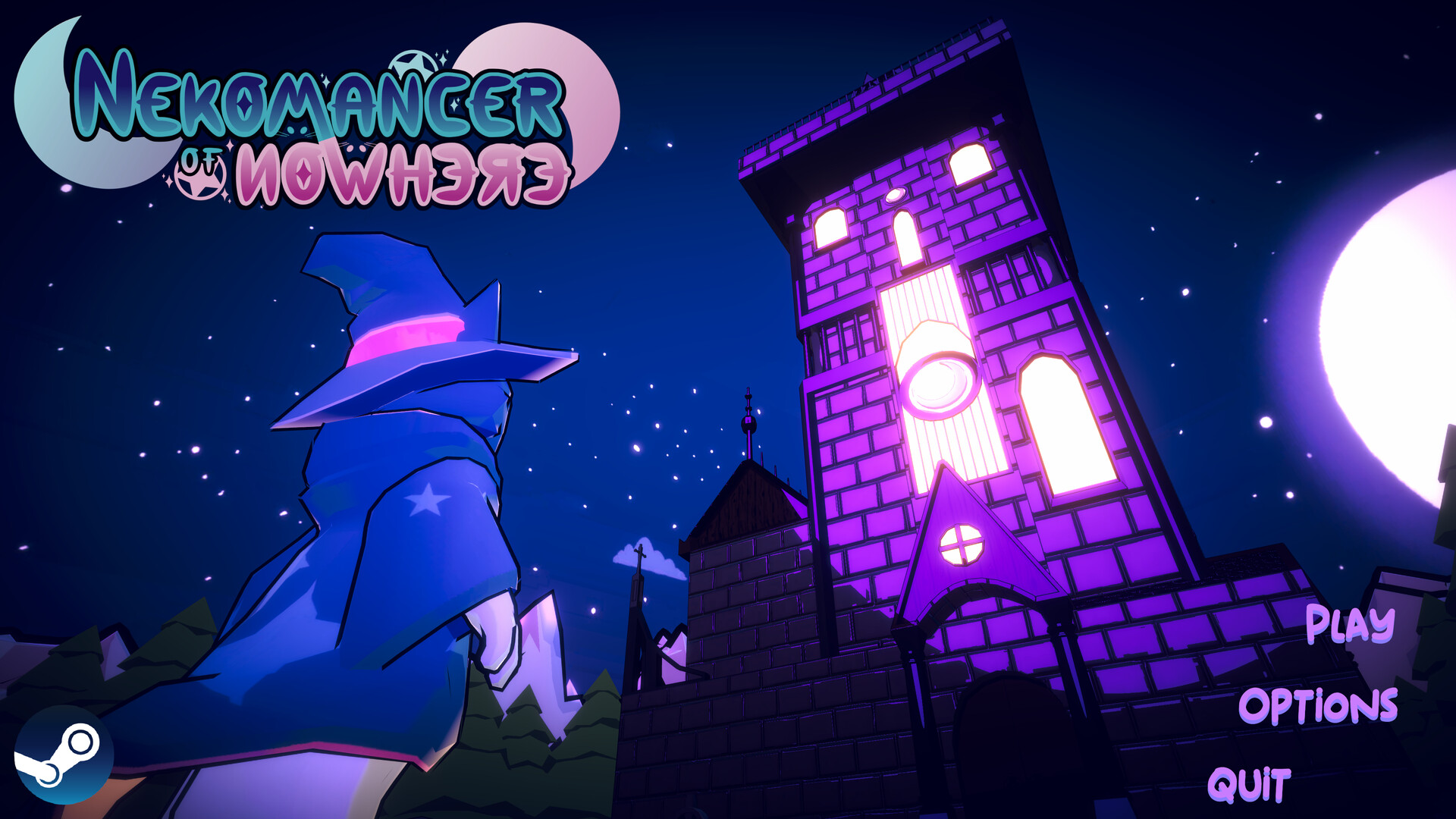
Ed: Hello, everybody. This is Eddie from Boss Rush Network. I’m here with Eric. He’s the creator of Nekomancer of Nowhere, developed and published by Standing Cat. Before we get into the interview, Eric, how did you get into video games, and then how did you get into game development?
Eric: Yeah, so growing up, my parents were actually pretty anti-video game. All I played were Lego games on PC. You may not know, but the PC ports of Lego games were awful. They were so bad, and they were so broken. I basically, like in elementary school, learned how to QA test to beat the games. So it would be like “oh, this level is completely softlocked. How can I glitch myself out of bounds so I can actually see more of LEGO Lord of the Rings?”
So that really kind of started to show me that it was a peek behind the curtain rather than it just being this, you know, nebulous thing that exists, a video game just enters the world, it’s something made by people. Just like a painting, you can see the brushstrokes; there are imperfections. That’s almost like playing the really bad PC ports of Lego games. I would say, “Oh, wait, this is something people actually make.” So that’s where I got started with game development.
Ed: Were you also into board games and puzzles?
Eric: Oh yeah, big time. I wasn’t huge into puzzle games, really, which I think is kind of funny working on this project. I was very much into a lot of board game stuff. I played a lot of light D&D-esque things. I, to this day, love Picross puzzles.
Ed: Oh my goodness. Oh my goodness. I love Picross so much. Nintendo keeps releasing them, and I think Konami just released one a while back. Well, can you give us the premise of Nekoomancer of Nowhere?
Eric: Yeah. So the concept for Nekomancer of Nowhere is you are a cat necromancer, you know, neko-mancer, going into this tombstone tower, and resurrecting ghosts. You go into this world as a cat necromancer, saying, “I’m gonna go do good. I’m gonna show and prove that necromancy is a good thing.” While going through this tower, you kind of interact with it by doing puzzles as well as drawing.
The main gimmick is how you interact with the world; you do all your necromancy by drawing shapes on the screen. So it’s kind of similar to like Okami, you know, you create shapes to make stuff happen. So yeah, you draw shapes on the screen to make your different spells happen. And that’s kind of the action element, but there’s a puzzle element of moving through the world.

Every single world is broken into a living world and a dead world. Two alternate worlds are layered on top of each other. So by drawing portals in specific locations, you can flip the whole world around you, which, weirdly enough, if you’ve ever played Titanfall 2, it was the laboratory level that was part of the inspiration. So, aesthetically, it doesn’t look like that at all. Though at a mechanical level, I was like, “That is such a cool puzzle design.” So that’s where the inspiration for having these two parallel worlds comes from. There might be a wall somewhere. You flip into the other world, and now there’s a gap in the wall. So you do all those kinds of spell casting, resurrecting ghosts, solving puzzles of how you move through these levels through this tower.
Ed: Titanfall 2, one of the best first-person games. I’m happy right now because I know another player who loves that game. Also, it’s giving Castlevania: Dawn of Sorrow. The way you draw the shapes on screen. When I was playing it, and I was doing the shape thing, I’m like, “Oh, this is a mix of Okami and Dawn of Sorrow.” How did you think of that as a component? Was that one of the gameplay ideas that you wanted to put into the game?
Eric: Yeah. Yeah, so the actual origin of where Nekomancer is now was a very interesting process. The first thing we knew about this game was the name, Nekomancer. I was setting up a team; it was a school project originally, so we were getting our group together for whatever this big senior project we were going to do. I had gotten this programmer with whom I wasn’t super close friends at the time, but I know he did great work. He came to me at an event we were at, and was like, “What if the game was called Necromancer?” My immediate thing was like, well, I don’t want to lose my programmer. Sure, it’ll be Necromancer. We spent a good while being, okay, so what game is that? So we pitched a lot of ideas.
One of them was like a murder mystery set in a modern-day hospital. There was, at one point, a single-player MOBA we were thinking of doing. There were some weird ideas. An idea that we really kind of nailed on, a little more in the Titanfall inspiration, was a first-person movement shooter where you would throw bones at skeletons. So you would shoot skeletons with their bones. We were like, well, our main artist is really good at character modeling. What if we made it third person so you could see the player? Oh, but where are you going to get the bones? Oh, Schrodinger’s cat is living and dead. You could go into a dead world. How are we going to show a dead world? Well, what if it were isometric? Also, it was kind of a full ship of Theseus of a first-person shooter.

The drawing element came from one of our programmers, who is really interested in mobile game design, actually. She was really pushing for us to have more mobile elements. That’s where the initial conceit of being in third-person, isometric, and you can’t really shoot bones that well. We imagine an isometric twin stick shooter would be kind of weird. So we were like, how can we do this? Well, a lot of mobile games have drawing elements. What if we bring some elements from mobile into this and lean into some of that DS aesthetic?
Ed: It’s funny that you guys went with the cat because in the game, in this demo that we played, a narrator is talking to the cat, but when everybody else talks to him, there’s a language like a paw or something or a smiley. Did you all plan that you wanted to make them a little bit quieter?
Eric: Yeah, so very early on, we wanted the Neckomancer to kind of communicate in a more, I guess, online is one way to say it. Using the colon, close parentheses, colon three. Like that’s the kind of classic cat face emoticon. We just didn’t necessarily want the Necromancer to talk, right? We liked them being this kind of whimsical character, but we also wanted them not to be a silent protagonist. So it’s like, what’s a little middle ground we can do, and we use those emoticons to just be like, here’s a face.
So we play into that a lot. There’s this one line in the demo, which we’re very proud of, where you meet the Gravekeeper character, who introduces herself. It’s like, “I’m the Gravekeeper. I work at Tombstone Tower.” The Nekomancer responds with “Oh, colon three.” I interact with you. It’s still a popular line. All of our developers know it’s our favorite line. The Gravekeeper responds, “ain’t nothing in my life to colon three about Nekomancer.”
Ed: Has it been an exciting and interesting learning experience developing a game?
Eric: Oh yeah, because this started as a student project at university, so our experience with bigger games really wasn’t there. So this is, for all of us, was a two and a half year development cycle, which I know in a lot of the industry, big time, not that long, all things considered. For us, doing these weekly meetings for two and a half years, that was a big ask for us. So we stayed very consistent during that time.

In those two and a half years of development, we only missed three weeks of our weekly meetings. So I like to think that we were very on it. It’s been very interesting committing to such a long process for us and being able to see now, and then we go back to earlier builds of the game, and we go, “Whoa.” Yeah, we’re a lot happier with where we’ve come from and just seeing what we’ve learned throughout development.
Ed: Are you using Unity or Unreal?
Eric: Yeah, so we operate in Unity at our university. It kind of only taught us Unity. We did odds and ends with other programs, but Unity is very much the one we are the most comfortable with. We were like, “Yeah, let’s go for it.”
Ed: Do you feel that this is a game that could come to console, maybe Nintendo Switch or anything?
Eric: So there are no promises yet. We would absolutely love it on Nintendo Switch. We’re still internally actually working on an update for controller support. We learned that it was difficult to get set up with the drawing and making it feel good. So we’ve been doing a lot of fine-tweaking to make sure it feels really good. Once we have that, we’d love to get into talks for a Switch port. We just have to find the right people to talk to, ensure that we do it in a way that doesn’t compromise the game’s experience, and playing it on that console is also a benefit. One thing, we still don’t know the full availability of Switch 2 dev kits. They do have that mouse functionality with the Joy-Con, and that is a very appealing piece of tech.
Ed: I just have two more questions for you. My first question is, is there a personal game that means something to you that kind of made you not only just a gamer but want to be a developer or a creator?
Eric: Yeah, I like that question a lot. So a lot of those kind of early roots of that, as I mentioned, was inspired by the Lego games on PC. The one that really nailed it home for me was No More Heroes on the Wii. I am a huge Grasshopper fan. Grasshopper Manufacture is my favorite studio. Something about their games, and I mean this in the kindest way to them, they’re a bit jank. It’s that jank where I can almost feel the passion, right?

It’s like going to a live concert, and even if they miss a note, there’s a little bit of like a scrape on the key, they may have dropped their guitar, it’s still a sick ass set. It’s an awesome experience. That raw passion is just being poured out into this unique vision. I love Grasshopper games, especially No More Heroes. That is the one where I wanted to be a game developer.
Ed: My last question, what is your go-to snack? Maybe it’s the weekend, or you’re developing, and you’re having a team meeting, and there are snacks there. What is that go-to snack for you?
Eric: Oh, there are options.
Ed: There are options here.
Eric: It’s not as much of a snack, but I do very much look forward to my White Monster Energy. Might not be the healthiest thing, but I look forward to it every single time.

Ed: I love the mango one.
Eric: Oh yeah, that’s good, that’s good, that’s good.
Ed: Eric? Thank you so much. You guys can check out Nekomancer of Nowhere on Steam. Is it available to purchase, or can they just wishlist it at this time?
Eric: Yeah, so the game is fully out. We released on Halloween last year. It’s currently on Steam and Itch.io if you’re more interested in that end. Yeah, thank you so much for this interview, man. Thank you.
Ed: This is your debut game, I should say.
Eric: Yes, this is our first game. I will say, we’re in talks for doing our next game. Can’t say anything more beyond that. Nekomancer of Nowhere is not going to be the Standing Cat team’s only project.
Ed: Well, thank you, Eric, for this interview. Everybody, you can check out the game on Steam and itch.io. This has been Eddie V. from Boss Rush, and we’ll have more content coming from PAX East 2026.
Featured Image: Standing Cat (via Steam)
Boss Rush Podcast – A Podcast about Video Games

The Boss Rush Podcast – A Podcast about Video Games – is the flagship show of the Boss Rush Network and Boss Rush Media. Each week, hosts Corey Dirrig and LeRon Dawkins are joined by friends, fellow creators, indie developers, and industry veterans to discuss the latest in the world of video games, including news, rumors, new releases, and what they’ve been playing. They also answer listener questions, debate important industry topics and Boss Rush Banter discussion points, and feature a rotating weekly segment. New episodes post every Monday.
Follow and Connect with Boss Rush Podcast on Social Media
X/Twitter + Bluesky + Instagram + Threads + YouTube
Listen to Boss Rush Podcast on Podcast Services
Apple Podcasts + Spotify + Goodpods + Amazon + More Links
Thank you for supporting Boss Rush Podcast and the Boss Rush Network
Thank you for watching or listening to The Boss Rush Podcast. If you’re watching this episode on YouTube, hit the Subscribe button, Like the video, and hit the notification bell so you don’t miss an episode! If you’re listening on Apple Podcasts or Spotify, consider leaving us a rating and a review as it helps with discoverability and growth. Support Boss Rush on Patreon for exclusive content, early access and audio versions of shows, become a Patreon Producer, and more. Visit our website for all of our content including reviews, news, daily Boss Rush Banter discussion topics, listicles, features, and more. However you support us, it means so much to us. Thank you for your continued support of the Boss Rush Podcast and the Boss Rush Network.

Leave a Reply