
Title: Feline Forensics and the Mewseum Mystery
Developer: Devcats
Publisher: Devcats
Release Date: May 13, 2026
Platforms: PC ( Steam)
Reviewed on: Steam
Synopsis
Feline Forensics and the Meowseum Mystery immediately sets itself apart with a concept that feels both playful and intentional. You step into the paws of a feline investigator navigating a museum mystery—an idea that could easily lean into novelty, but instead comes across as carefully considered and tonally cohesive. The setting of a museum provides a natural structure for intrigue, with exhibits, hidden clues, and layered storytelling baked into the environment.
What makes the premise work is how grounded it feels despite its whimsy. The game doesn’t rush to explain everything; instead, it lets the player absorb the setting through observation and interaction. This approach creates a sense of quiet curiosity, encouraging you to explore rather than pushing you forward with urgency.
There’s also a subtle charm in how the game treats its central mystery. It doesn’t rely on high-stakes drama or tension. Instead, it leans into a cozy, almost comforting investigative tone. That choice may not appeal to players seeking intensity, but it aligns perfectly with the game’s identity and audience.
Art Style & Presentation

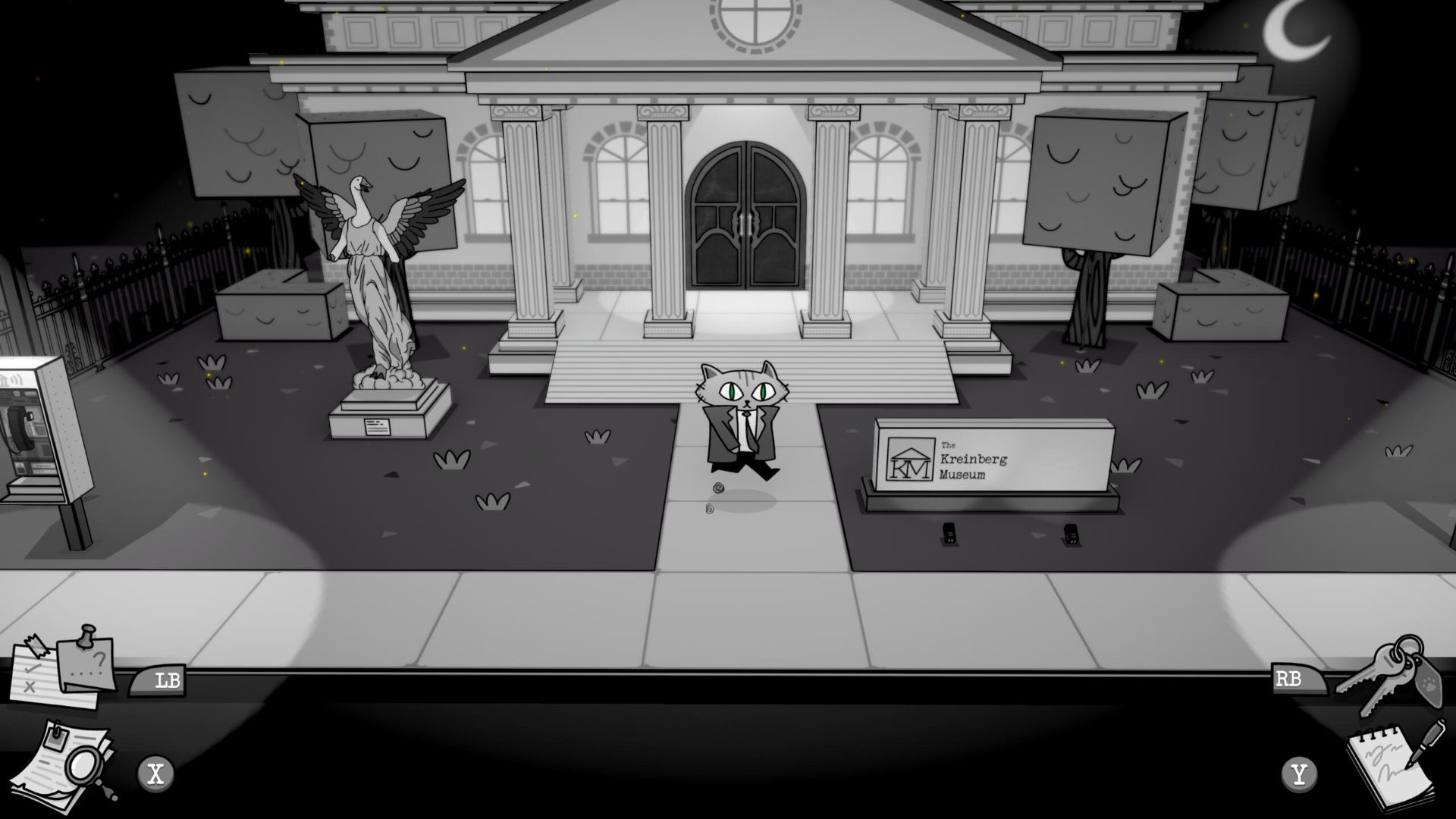
The art style is, without exaggeration, the defining feature of the experience. From the moment the game begins, it’s clear that a significant amount of care has gone into crafting a visual identity that feels distinct and memorable. The aesthetic leans toward a hand-drawn, illustrated look, giving everything a soft, storybook-like quality.
This visual approach does more than just look good—it actively enhances the gameplay. The environments are filled with small, intentional details that reward attentive players. Whether it’s the arrangement of objects, subtle animations, or the way lighting guides your attention, the art direction plays a functional role in exploration and clue-finding.
Character design deserves special mention. The feline protagonist (and other characters) are expressive without needing complex animation systems. Small movements, posture, and visual cues communicate personality effectively. It’s a reminder that strong art direction can often achieve more than technical complexity.
Additionally, the museum setting benefits immensely from this style. Each area feels curated rather than procedurally assembled. There’s a sense of place, of intentional design, that makes wandering through the environment enjoyable even when you’re not actively progressing the mystery.
Gameplay & Mechanics

At its core, the gameplay revolves around exploration, interaction, and light puzzle-solving. You move through the environment, examine objects, gather clues, and piece together information in a way that feels intuitive rather than mechanically dense.
The game clearly prioritizes accessibility. Interactions are straightforward, and puzzles are designed to be approachable. This creates a smooth gameplay loop where players can remain immersed without getting stuck or frustrated. It’s a design choice that lowers the barrier to entry, making the game appealing to a broader audience.
However, this accessibility comes with trade-offs. During a few hours of play, the mechanics don’t evolve dramatically. The puzzles remain relatively simple, and there’s limited escalation in complexity. For players who enjoy deep, layered deduction systems or challenging problem-solving, this may feel underwhelming.
That said, the simplicity isn’t necessarily a flaw—it’s a deliberate choice. The game is less about “solving” in a traditional sense and more about experiencing the act of investigation. It emphasizes pacing, atmosphere, and discovery over difficulty. Whether that resonates will depend heavily on player expectations.
Demo Experience & First Impressions

The demo is where the game truly shines as an introduction. Spending a few hours with it provides a surprisingly complete picture of what the full experience aims to deliver. It doesn’t feel like a fragmented slice or a heavily restricted preview—it feels like a carefully curated opening act.
One of the demo’s strongest qualities is its confidence. It doesn’t try to overwhelm players with features or mechanics. Instead, it presents its core strengths—art, tone, and exploration—and lets them speak for themselves. This restraint works in its favor, creating a focused and memorable experience.
My reaction, absolutely loving the demo, is easy to understand in this context. The game is designed to make a strong first impression through charm and cohesion. Within just a few hours, it establishes its identity clearly, leaving players with a solid sense of what to expect from the full release.
At the same time, the demo hints at potential concerns. Because it showcases a relatively narrow slice of gameplay, questions remain about long-term variety and depth. Will the full game expand meaningfully on its mechanics? Or will it rely primarily on its atmosphere to carry the experience? The demo doesn’t fully answer that—but it does enough to generate interest.
Strengths & Weaknesses
One of the game’s greatest strengths is its artistic direction. The visual style isn’t just appealing—it’s cohesive, purposeful, and deeply integrated into the experience. It elevates every aspect of the game, from exploration to storytelling.
Another major strength is its tone. The cozy, low-pressure approach to the mystery genre is refreshing. It creates a space where players can relax and engage at their own pace, which is increasingly valuable in a landscape filled with high-intensity titles.
Accessibility is also worth highlighting. The game is easy to pick up and understand, making it suitable for players who may not typically engage with puzzle or elective games. This broad appeal would be a significant advantage.
On the other hand, the lack of mechanical depth may limit its long-term engagement. Players looking for complex systems or challenging puzzles may find the experience too lightweight. The pacing, while intentional, can also feel slow at times, particularly for those accustomed to more dynamic gameplay loops.
Ultimately, these weaknesses are less about poor design and more about design priorities. The game knows what it wants to be—it just won’t be for everyone.
Final Score
Feline Forensics and the Meowseum Mystery is a game that succeeds by embracing its identity fully. It doesn’t chase trends or attempt to compete on complexity. Instead, it focuses on delivering a polished, charming, and visually distinctive experience.
Based on the demo, it’s clear that the game’s strongest appeal lies in its atmosphere and presentation. It invites players to slow down, explore, and enjoy the process of discovery. For many, that will be more than enough.
The biggest question moving forward is depth. If the full release can build on its foundation—introducing more variety in puzzles, expanding its mechanics, and maintaining its artistic quality—it has the potential to stand out in a crowded indie space.
For now, though, the demo leaves a strong impression and a clear sense of promise.
Score (Demo Impression): 4 out of 5 stars.
A beautifully crafted, cozy detective experience that prioritizes charm and style over challenge—and largely succeeds because of it.





Leave a Reply