
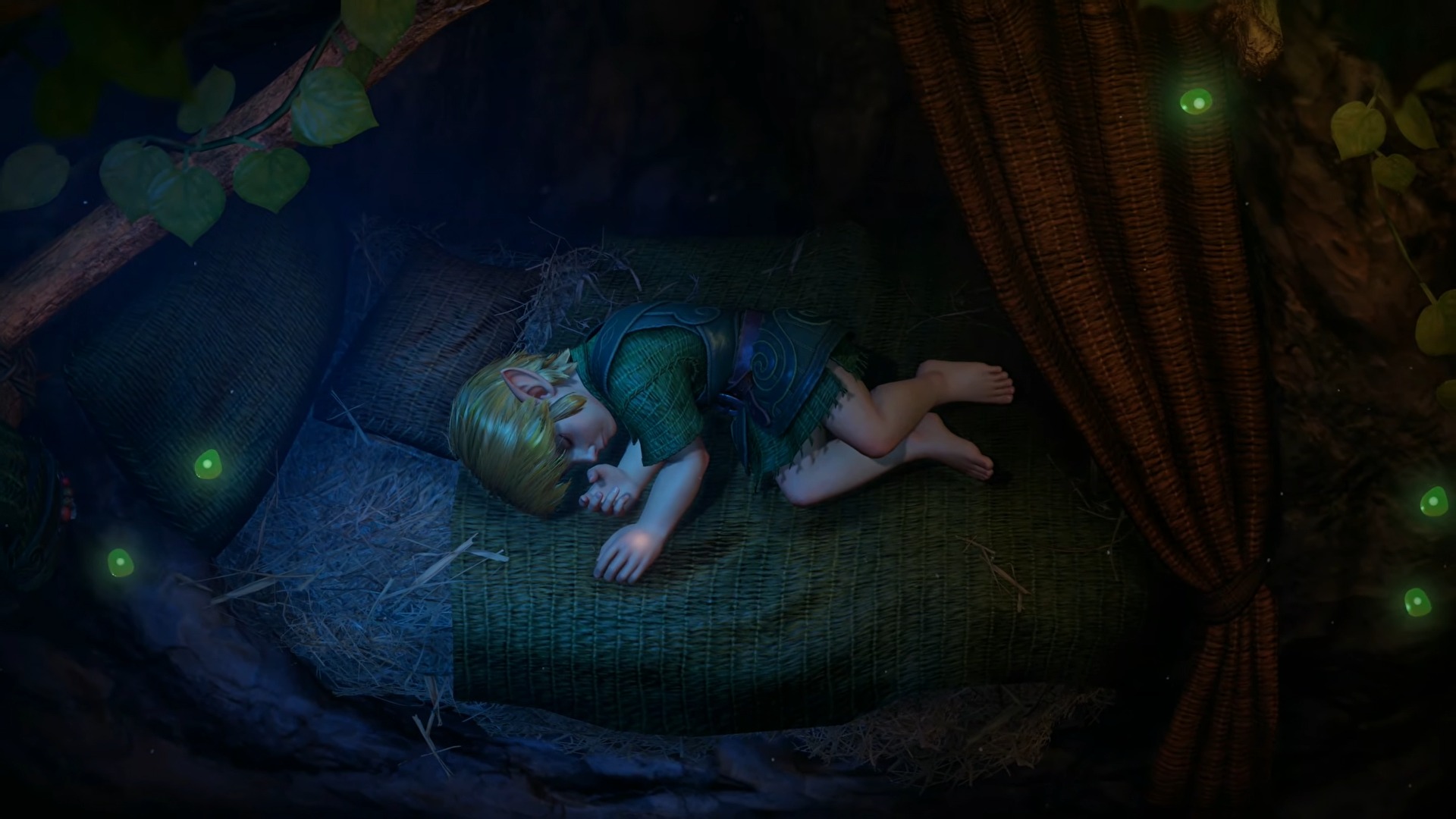
As had been expected for weeks now following widely circulated rumors, Nintendo has announced that a remake for the acclaimed Nintendo 64 title The Legend of Zelda: Ocarina of Time will be arriving later this year for the Nintendo Switch 2. However, is this something we really need?
The teaser trailer impressively includes a speaking narrator detailing the very opening moments of the classic game, in which a young boy–living within the Kokiri forest under the watchful eye of the massive Deku Tree–slumbers as the only child in these woods without a fairy companion. Longtime fans though will know that this boy is Link, and a fairy will soon awaken him, setting him off on an adventure for the ages.
The trailer however, was notably lacking of any gameplay, and fans are currently left to speculate on just how the reimagined adventure will look.
Ocarina of Time first released in 1998 for the Nintendo 64, and it quickly cemented itself as one of the greatest games of all time. In fact, numerous publications have since listed it as -THE- best video game ever, including IGN, Nintendo Power, Game Informer, Edge, and many, many more. The game still, after nearly 30 years, has the highest total score ever for a video game on Metacritic–a website that assigns a score based on an aggregate of reviews from other publications. In short, it’s kinda a big deal.
Ocarina of Time set new standards for 3D game development, and its influence is immeasurable. A game of this magnitude carries a lot of weight with gamers and playing it has become somewhat of a rite of passage. It’s a title that many, including myself, believe should be experienced at least once by anyone who is even the least bit interested in action-adventure titles.
It’s also for this reason that I contend that we don’t actually need an Ocarina of Time Remake.


Of course, I know why Nintendo is doing it: Ocarina of Time‘s reputation proceeds itself. As already stated, it’s a legendary adventure, a title that has made its mark on the industry, and has even grown beyond just the gaming community, but is recognizable to both gamers and non-gamers a like. It doesn’t need further marketing: all you need to do is say its name, and players everywhere will immediately have their minds rushed with nostalgic memories of carrying Princess Ruto through the bowels of a gigantic fish, or the sounds of a persistent fairy desperate calling for one’s attention.
Similar titles have always been alluring to publishers for the remake treatment, with numerous recent legendary games getting redone for a modern audience: games like Final Fantasy VII, Resident Evil 2 & 4, The Last of Us, Pokémon Red & Blue, Silent Hill 2, Dragon Quest III, and plenty of others have all had modern remakes that have proven to be big hits with both gamers and critics, and an accessible way for players today to take them in.
A big reason for their success is that they are able to balance nostalgia with modern enhancements. Few people for instance would say that the original 1997 release of Final Fantasy VII looked incredible, with it’s clashing color scheme and big, blocky characters on top of pre-rendered backgrounds. Improving on the technological limitations allows for modern gamers to embrace a classic, while old fans can still enjoy the nostalgic core experience.
These amazing titles also have incredible bones to build a game upon, and it’s much easier to, for example, build a replica of the Eiffel Tower than to create a whole new wonderous building from scratch. Using the template that these classic titles have established, developers can more easily insert modern conventions–things like 4k graphics, a simpler user interface, button mapping, etc–to make a great game even better. Another way to look at it is that it’s much easier for developers to polish a diamond than give luster to a turd.
Ocarina of Time in particular though is a game that still holds up very well as is. The title is a masterclass in nearly all areas, from art design to music, storytelling to world building, dungeon design to side quests. The fact that it is nearly 30 years-old now makes it even more remarkable, as gamers of all kinds can turn it today and marvel at was accomplished three decades ago. It’s a time capsule for what was possible on the N64 in 1998, and seeing where the inspiration began for countless future games is all part of the journey.
What few updates that the original release arguably did need have already been achieved with the 2011 3DS remake. This edition kept intact most all of the original game and improved upon the graphics while keeping the recognizable art style, as well as simplifying the controls to make for smoother gameplay. Famously, the developers intentionally kept the glitches from the N64 original in an effort to preserve the nostalgia, because they understood that even the tiniest things such as the bugs encountered while playing make up the whole of the experience. It didn’t mess with the formula, because the original recipe already tasted so good. A modern remake though has a chance of ending up like the notorious New Coke of the 80s.
I can already hear you saying that the 3DS game came out nearly fifteen years ago in 2011, which was only thirteen years after the N64 title. THE REMAKE IS NOW OLDER THAN THE ORIGINAL GAME WAS WHEN THE REMAKE RELEASED. I get that. This doesn’t change the fact that the remake accomplished nearly everything that I would want achieved in a remake made today, and any further tampering I believe could tarnish the original’s vision. Graphics, sound, controls, level structuring, and yes even the glitches, all of these make up a game’s identity, and even the simplest of adjustments can radically change a player’s perspective on the experience. Can the 3DS Ocarina of Time have better graphics, orchestrated music, and grander levels? Of course, but then, is it still Ocarina of Time? Will it not risk losing the charm that drew us into game in the first place so many years ago?


Others will say that a 2026 remake will not erase the original game, and that the N64 release is still available for any who would prefer that, and this is also true. A lot of older games are frequently remade because they are no longer accessible for modern audiences. This can come in the form of severely outdated controls or graphics, or the simple fact that the games haven’t been available to play on modern hardware. Ocarina of Time doesn’t suffer from either issue. Indeed, the game has famously been available on nearly every Nintendo console since its debut in the Nintendo 64 in 1998: it came to the GameCube in 2002, being packed along with the expanded Master Quest; the Nintendo Wii and Wii U hosted the game as part of the splendid Virtual Console; the 2011 3DS remake addressed numerous quality of life issues while largely keeping the original game intact; and the game was among the first titles available as part of the Nintendo Switch Online Expansion Pack in 2021.
All of this is to say that the game has been exceedingly accessible for all audiences. The original game is there, and can be easily enjoyed by most anyone right now, today. Gamers who have wanted to play Ocarina of Time have had ample opportunity that isn’t going to go away anytime soon, and so if they have ever wanted to embark on this particular quest of Link’s, there isn’t anything stopping them.
However, I cannot tell you how often it is that modern gamers will use the existence of a remake as a way to ignore the original work. Numerous friends of mine have played through–and loved–the modern remakes of Silent Hill 2 and Final Fantasy VII, but have not played their original incarnations. While great games, these newer titles are far from the same experience as the original titles. Yes, most of the story and settings and characters are extremely similar, but ultimately they are not one and the same. This isn’t entirely a bad thing–I also enjoyed these games for what they were–but as an academic and a fanatic of video games and the industry’s history, I cannot stress enough how important it is that the original titles remain playable in their initial form, that they remain authentic to the original developer’s vision, and that they remain the emphasis when discussing the legacy of these titles. Remakes threaten to weaken that legacy by simply existing.
Stepping away from video games, one needs to only look at the remakes of films to notice my point. For example, George Lucas’s numerous attempts at trying to improve upon the magic of the first Star Wars film has somewhat tarnished the movie’s legacy, leading to numerous debates on whether “Han shot first,” or if practical effects are inferior to shiny, computer graphics. While most moviegoers have seen Star Wars, the multiple revisions means that not all fans have had the same experience. It’s such an extreme case that the unaltered, original theatrical cuts of the first Star Wars Trilogy, hands down one of the greatest trilogies of all time in all of media, has virtually become lost media.
There are countless other examples, too, all with varying results: True Grit, Nosferatu, The Thing, A Star is Born, King Kong, The Mummy… the list keeps going. As good as some of these films are, no one will tell you that the remake provides the exact same experience as their predecessor. Again, the story, setting, and characters could all be extremely similar, but the altogether experience is something very different.

Video games are absolutely no different, and I’d argue that because they are so interactive, they suffer even more from any kind of tinkering. Ultimately, what do we remember the most from the games that we play? I don’t think it’s just the stories or the graphics or even the beautiful music, but how they feel when you have the controller in hand. We remember how seamlessly Mario jumps through the Mushroom Kingdom; we remember sweating bullets in Resident Evil as we wrestle with the tank controls when an undead monster lunges at us in surprise. We have ingrained in our DNA the exact way Link shouts “Hiya!” and Navi shrieks “Hey! Listen!” that any meddling with that sound will sound just… wrong. It is these elements that truly make for a memorable video game experience.
On the flip side, Ocarina of Time currently isn’t making Nintendo any money whatsoever. It is doubtful that many are subscribing to Nintendo Switch Online to play the nearly 30 year-old game, especially since it has consistently been available over the decades. A remake that simply adds a new coat of paint isn’t going to move merchandise, but a remake that completely re-envisions the classic title will at least have some general appeal to both new gamers and old fans alike.
Yet it’s not like Nintendo is out of ideas with The Legend of Zelda. As some have said, ideas are the most abundant resource in the gaming industry. An Ocarina of Time remake may certainly sell bucket loads, but wouldn’t an all new game with a fresh story, setting, and ideas also light the sales charts on fire? Wouldn’t the time and resources put into a Remake be better suited for making something new, and not revisiting the past?
Lastly, video game development has become notoriously complex, demanding untold man hours and copious amounts of funding. Because of this, even major game developers like Nintendo can’t take nearly as many risks as they used to, and instead choose projects that are sure to turn a profit–projects like remaking one of the greatest games of all time. However, I believe that it would be wholly more productive creatively, and thus more rewarding for the industry as a whole, to craft an all new adventure with fresh ideas. Alternatively, remaking a game that did not initially receive the warm praise as Ocarina of Time, and consists of more obvious faults would too provide a greater benefit to the industry than remaking an already certified classic. It would be much more challenging, but developers grow more individually when pushed to overcome a hard task, and they’ll gain skills to make even better titles down the road. Wouldn’t a remake of Zelda II: The Adventure of Link–a game marred by the fanbase as one of the worst Zelda games–not be even more impressive than a remake of Ocarina? Everyone already considers Ocarina of Time a must play, but if Zelda II could be ironed out, genuinely improved upon, and elevated to stand on more equal footing with its brethren, would that not be a much greater gift to the Zelda fanbase and the gaming community as a whole?
Regardless, The Legend of Zelda: Ocarina of Time is being remade, and judging from the brief trailer, it’s going to look incredible. It’s difficult for me to say much more on the matter due to there not being any actual gameplay being shared at the present, but that is certain to change very shortly between now and its quickly approaching release date less than six months from now. I’m most definitely going to play it sometime around it’s release (whenever I can pry myself away from Grand Theft Auto 6 anyway), and honestly I’m sure I will love it. But I don’t think that Remaking an all-time classic is always the best way to go in this competitive market. As a consumer, I think I would much rather all that time and money go towards crafting new adventures that I haven’t experienced before. As a gamer that appreciates history, I also think that most games should be preserved and largely left alone, so that their essence can be maintained, and players generations from now can experience the classic as intended, faults and all.
Nintendo Pow Block – A Nintendo Podcast by Boss Rush

Nintendo Pow Block is a weekly Nintendo podcast hosted by Edward Varnell, Corey Dirrig, and their friends from around the internet. Each week, they dive into the latest Nintendo news and rumors for Nintendo Switch and Switch 2, new and upcoming releases, updates to Nintendo Switch Online and the Nintendo Music app, and discuss what they’ve been playing in the Playing with Power segment.
Nintendo Pow Block Podcast – Now your Podcasting with Power!

Our Favorite Games from PAX West 2026 – Nintendo Pow Block Podcast – Now Your Podcasting with Power!
Listen to Nintendo Pow Block on Podcast Services
Apple Podcasts + Spotify + Goodpods + Amazon + More Links
Follow and Connect with Nintendo Pow Block: A Nintendo Podcast
X/Twitter + Bluesky + Instagram + Threads + YouTube
Thank you for watching or listening to Nintendo Pow Block, the Nintendo podcast from Boss Rush Network! If you enjoyed the show, be sure to subscribe to the channel, give the video a Like, and hit the notification bell so you never miss an episode. If you’re listening on Apple Podcasts, Spotify, or any other podcast app, please leave us a 5-star rating and a review—it really helps! For more great content, visit our website at BossRush.net. Thanks for your continued support of Nintendo Pow Block and our independent endeavor with the Boss Rush Network!
Featured Image Source: Nintendo

Leave a Reply