
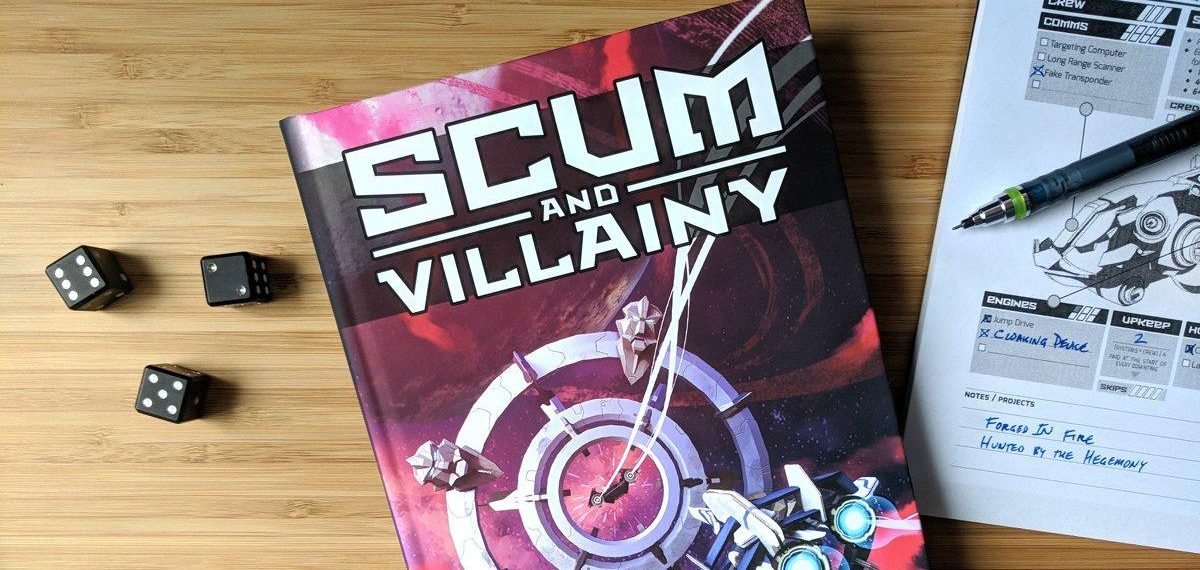
Normally, I am not the type of person to make declarations so absolute. There is not a single other genre of game, or even of tabletop RPG for which I feel this way. But after trying out dozens of tabletop roleplaying games, I have found myself completely dissatisfied with all but one of them, and that one is Scum & Villainy. “Why would you say that, Boss Rush Contributor Lev?” I hear you call out from behind your laptop or phone screen. “Don’t you know how good [Insert System Here] is?
To start with, Scum & Villainy is the best space TTRPG for a couple of reasons. For one, the system is easy to pick up, run, and prepare a session for. There are only six character classes, each mechanically simple, but full of customization options. Character creation takes like fifteen minutes, and yet there is still a lot of strategy and fun to be found while actually playing the game. And that is thanks to the game systems of Scum & Villainy. The Flashback system that Blades in the Dark is famous for has been ported into here, making heists, infiltration missions, and anything that requires advance planning go a lot smoother and not get bogged down. It’s supported by other systems that, while are no longer as rare as they once were, are still executed simply and well. Clocks, stress, harm, gambit / party dice, are all featured here, and they are so fantastic at stressing players out and forcing them to make hard choices. In other words, yes, Scum & Villainy is a simple system, but it is executed brilliantly, and it lacks a lot of the baggage that other systems have.
So what is that baggage that is so common amongst other space tabletop games? The answer is convoluted, meaningless mechanical complexity. While there are certainly people out there that enjoy GURPS levels of character customization, space TTRPGs tend to have a lot of poorly executed complexity. For example, Star Wars 5th Edition and Starfinder both drag character creation out endlessly. I remember watching the dragging expressions on my players’ faces as they tried to build Starfinder characters, micro-allocating points to skills for hours. And due to the stat complexity of these systems, it is miserable to build encounters and NPCs out. Another issue with these systems is that they struggle to execute on space combat. The systems that Starfinder & SW5E have are near completely disconnected from the characters outside of skill checks, due to the distances involved. These make for a grinding, dull experience.
Other systems that I have looked into that focus more on an existing world, such as The Expanse, do a good job of providing lore and background information on the world they represent, but fail to provide interesting mechanics. For many of these, I would rather just use Scum & Villainy and use the setting book just as a guide to the world.
Now that I have gotten all that out of my system, let me walk my position back a little bit. When you and your friends sit down to play one of these games, you’ll probably have a good time with most of them. These are good systems. And also, I haven’t tried every system. The next on my list to try is Ironsworn: Starforged. But when I start a new TTRPG campaign set in space, or even run a one shot, there is only one system on my mind.
Featured Image Credit: Evil Hat




Leave a Reply