
When you look at all the media available to tell a story, video games are ones that require visuals to do a lot of the work. Oftentimes, it’s up to the player to figure out what’s going on around them and make decisions based on what they find out. They have to learn about who they’re playing and the world they live in with only objects around the map or visual cues that point to a specific inference. The agency a player has can produce many different outcomes, leading to an analysis opposite to another player’s experience–intentional or not.
Sometimes all writers need is a room to tell a story with no dialogue or text on the screen needed. We’ll discuss a few examples here that do a good job of environmental storytelling. By no means do these games do it best, but they offer a good teaching moment with either their on-the-nose premises involving rooms or the genre alone.
Unpacking
Unpacking is a cozy puzzle game where players have to pull possessions out of boxes and place them in the correct spaces around the new place our main character has moved into. While unpacking, you learn clues about who these possessions belong to. You never see them, only the rooms they’re living in and the stuff that’s meant to populate those rooms. For example, during one level of the game, the main character moves into their boyfriend’s apartment. He’s got a lot of stuff laying around and it’s challenging having to find spots where our character’s things can go. With no spoilers, players learn what type of person her boyfriend is based on the place alone and the lack of space within it.

Playing that game is a fun experience throughout. From childhood to adulthood, you quite literally dig through her life as you help her unpack from place to place, learning about her with no dialogue or text needed.
What Remains of Edith Finch
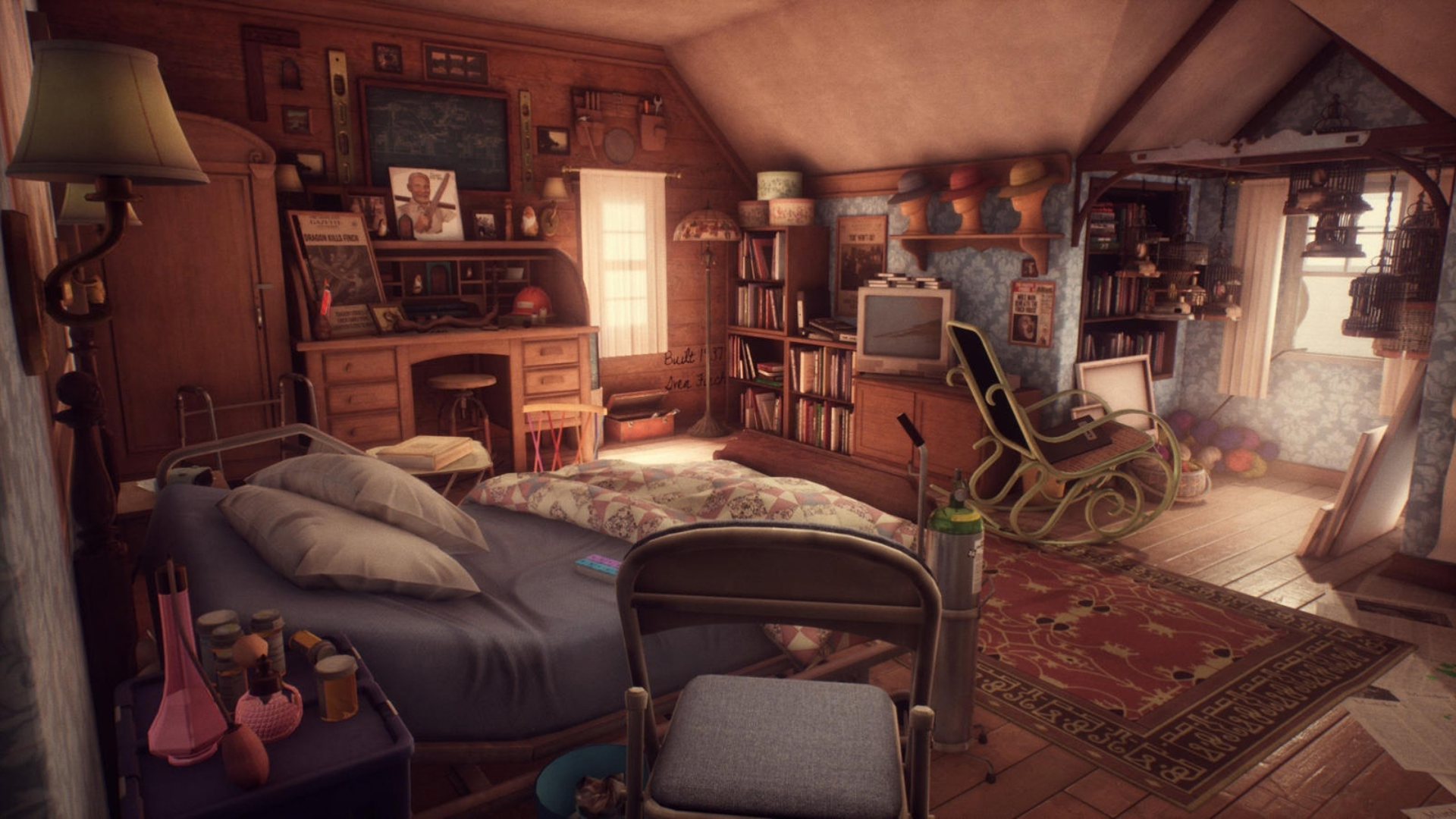
In this game, you play as Edith Finch who explores the large Finch house located in the state of Washington. In the house, players encounter her family’s fatal past by searching through each of their rooms. They are cluttered to the max, filled with clues about what kind of person existed within it. Their bedrooms literally tell a story. Remember that personal rooms reveal a lot about a person. Think about your own room. If a stranger walked in, wouldn’t they be able to guess a few things about you based on objects laying around, posters on the wall, or how you organize items? Bring this thought process to your visual storytelling.

This game has no arrows or prompts that direct the player throughout the massive house. You’re guided by design alone, making the gameplay deeply immersive and organic as you explore the emotional stories of every family member. It’s a beautiful video game throughout and I highly recommend playing it yourself to understand how the environment becomes such a powerful writing tool.
Life is Strange
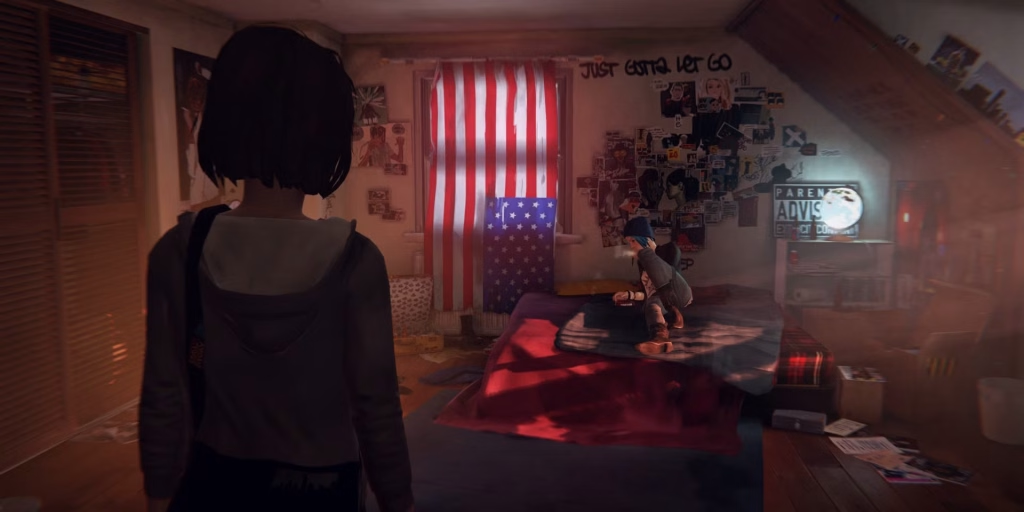
This example is on a much smaller scale. I want to talk about a specific area in the game after Max has reunited with her childhood friend, Chloe. The player is allowed to explore Chloe’s bedroom in “Episode 1.” You can be as nosy as you want while searching for a disc. It’s a good opportunity to learn exactly who Chloe is for both Max and the players. Max has spent time away from her friend and the players have just met her. Looking through her room is a perfect opportunity to obtain clues about Chloe and her relationship with the missing girl, Rachel Amber.
However, some of the dialogue during the exploration ruins the experience. Max picks up a postcard and thinks to herself, “This card is from Rachel Amber” before the player gets a chance to flip it over and see the note signed “Rach” for themselves.
Remember, your audience is not stupid. If there’s an exposition shot of the New York City skyline, you don’t need a character in the next scene saying, “Hey John, how’s NEW YORK treating you? Have you checked out any of the BODEGAS or visited the STATUE OF LIBERTY yet?”
It’s unnecessary. Always assume that your target audience has common sense and knows how to figure things out on their own. If you see a character wearing red in Avatar: The Last Airbender, you can guess they belong to the Fire Nation without them saying so, right? That being said, Max’s commentary isn’t all bad. She makes some comments that the audience wouldn’t have guessed otherwise.
Horror Games
There are a number of frightening video games that offer master classes in environmental storytelling. They employ all five senses to clue players into the story without having to spell it out and it works every time. Don’t get me wrong, there are some instances that literally do spell out stuff with blood on the walls:

When encountering an enemy, especially zombie-like in nature, a player will aim for the head 99.9% of the time unless there’s an obvious weak spot visible. In Dead Space, developers know that’s an automatic habit in gamers and decided to add the eerie, “cut off their limbs” note as a tip against the Necromorphs. I think this is a well-done example of the notorious graffiti storytelling tactic.
And humans are curious by nature. The first thing we do when we enter a room is have a look around. In the horror genre, players often construct what they think will happen in a room to them rather than what already happened to someone else. It’s important that the room lets a player use their imagination first. The job is to freak you out and maybe offer tips to help you survive until the next checkpoint. The goal doesn’t always have to be exposition and story. The environment is a hint about what’s to come.
In Resident Evil Requiem, you’re able to turn light switches on and off before you know why it’s relevant (ignore the door in the photo below. Attn: right wall).

Later, you find a creepy book that concludes with, “stay in light.”

The dark is already scary enough and then the game skillfully builds onto that fear with an unknown stalker who the player concludes will show up sooner than later. And it’s used as a subtle tutorial.
Questions to ask yourself when designing a room:
- Who does it belong to?
- Who are they? What are their traits? Likes and dislikes? Fears?
- How old are they?
- What would they need to survive? What don’t they need?
- What can you interact with in the room?
- What time period is it?
- What are the person’s hobbies?
- Who else might live within the environment?
All of these don’t have to be answered, but most are questions to consider when you want your surroundings in a visual medium to do all the talking. You can teach yourself better than I can. Open up any game, any genre and walk around. Try to guess the story behind the rooms you’re exploring. Read like a writer, play like a narrative designer.
Featured Image: Giant Sparrow (via Prodigal-Revan)
Boss Rush Podcast – A Podcast about Video Games

The Boss Rush Podcast – A Podcast about Video Games – is the flagship show of the Boss Rush Network and Boss Rush Media. Each week, hosts Corey Dirrig and LeRon Dawkins are joined by friends, fellow creators, indie developers, and industry veterans to discuss the latest in the world of video games, including news, rumors, new releases, and what they’ve been playing. They also answer listener questions, debate important industry topics and Boss Rush Banter discussion points, and feature a rotating weekly segment. New episodes post every Monday.
Follow and Connect with Boss Rush Podcast on Social Media
X/Twitter + Bluesky + Instagram + Threads + YouTube
Listen to Boss Rush Podcast on Podcast Services
Apple Podcasts + Spotify + Goodpods + Amazon + More Links
Thank you for supporting Boss Rush Podcast and the Boss Rush Network
Thank you for watching or listening to The Boss Rush Podcast. If you’re watching this episode on YouTube, hit the Subscribe button, Like the video, and hit the notification bell so you don’t miss an episode! If you’re listening on Apple Podcasts or Spotify, consider leaving us a rating and a review as it helps with discoverability and growth. Support Boss Rush on Patreon for exclusive content, early access and audio versions of shows, become a Patreon Producer, and more. Visit our website for all of our content including reviews, news, daily Boss Rush Banter discussion topics, listicles, features, and more. However you support us, it means so much to us. Thank you for your continued support of the Boss Rush Podcast and the Boss Rush Network.




Leave a Reply