
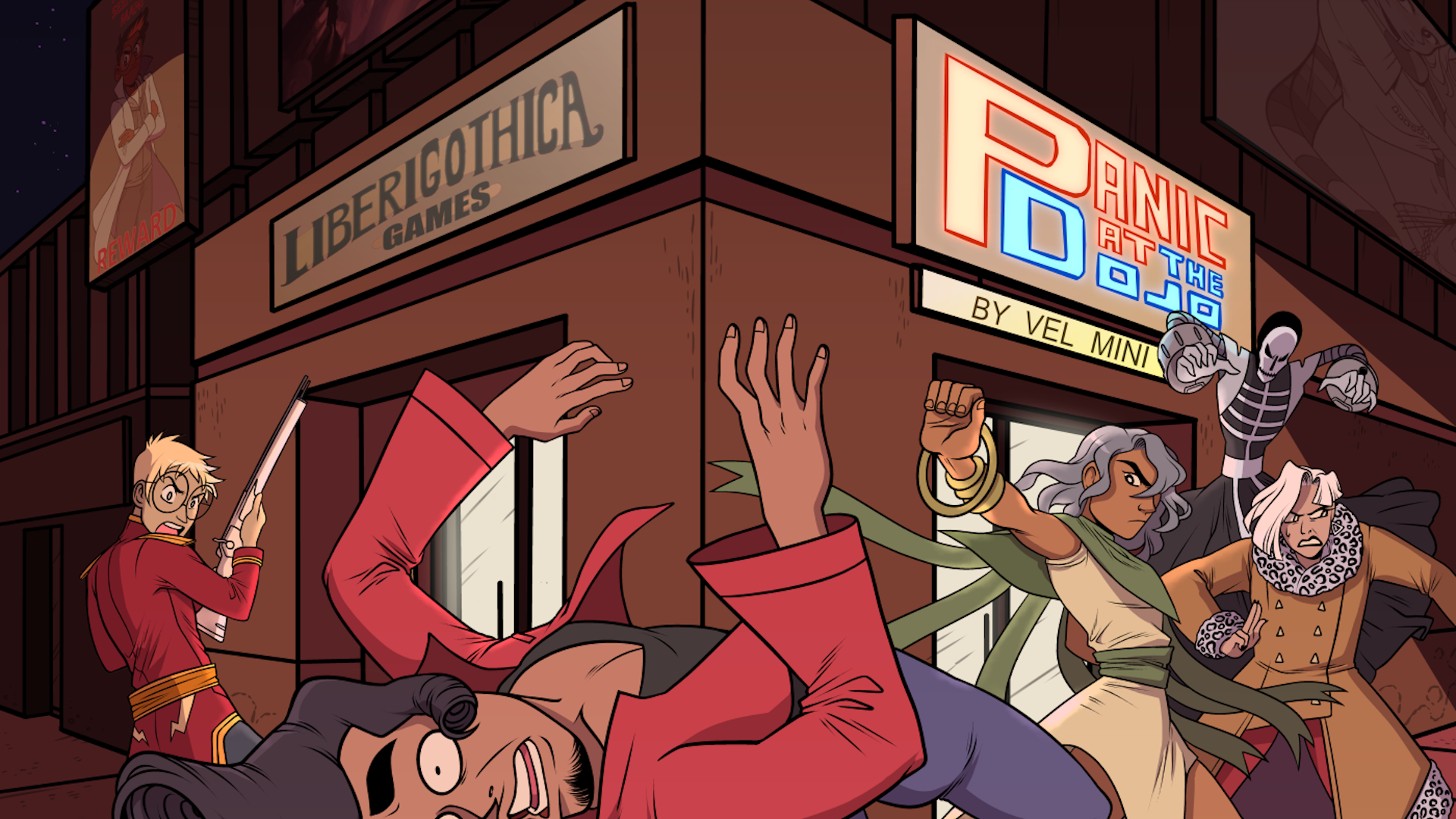
Boss Rush Network recently had the opportunity to interview Vel Mini, the game designer behind some tabletop role-playing games gems like Fellowship, Inverse World, and the main topic of this piece, Panic at the Dojo. Although originally released back in 2018, the game recently got launched back into popularity by a YouTube video from Sugarpunch Productions.
I did some research and reached out to the developer of the game, and she was kind enough to answer some questions I had about her history in the TTRPG space, design process, and any advice she has for aspiring creators. The full interview is available below. If any of the games sound interesting, Vel Mini’s Itch.io page is available here, with Panic at the Dojo specifically available to purchase here.
The Interview
How did you originally become interested in TTRPGs?
“There was an RPG club in my middle school, and I thought it sounded fun. We played D&D third edition, it was new and had just come out, and I remember having a miserable time my first couple sessions. Not sure why I stuck with it, but I did and ended up playing D&D all the way through middle school and high school.“
When did you first begin designing your own content for games, and how did that turn into creating your own games?
“I started writing homebrew almost immediately, I remember spending a lot of time on the library computers in high school writing up D&D ‘supplements’ and content that I never shared anywhere. I eventually got frustrated with D&D enough to try branching out into other games – FUDGE/FATE and Savage Worlds, mostly.
“My first year of college, I discovered Dungeon World, and that’s where my TTRPG writing seriously started. My first published works were Dungeon World thrid-party playbooks–they were fun to write, didn’t take a lot of pages, and people liked them a lot more than the baseline ones.“
What do you consider to be your first “big project” in the hobby?
“I got noticed by another TTRPG writer, Mikan, who published books like Last Stand, and she asked if I wanted to work on a book together. That book eventually became Inverse World–a Dungeon World supplement with 7 new playbooks and a whole setting to play in.
“From there, we split ways due to life issues on Mikan’s side of things, but I kept going. I was working on a second Dungeon World supplement book called Fellowship –and it was not fitting nicely. I was getting frustrated by the D&D-like limitations of Dungeon World, all this unnecessary chaff in the way of what I wanted, so I rewrote a new game from the ground up.
“Fellowship ended up being far and away my most popular game system, and put food on my table for like 3 years as I worked on supplements and extra content. So while Inverse World was a big project and my first book, I think of Fellowship as what kept me in TTRPG writing, and it wasn’t a collaborative work like IW was.“
What originally sparked the creation of Panic at the Dojo?
“The story for that is a fun one. The core mechanical idea for Panic at the Dojo started as a Stance System, for a dungeon crawler. You started in a Neutral Stance, and at the start of your turn, you could go one more Aggressive or one more Defensive. There were only five stances: Cautious, Defensive, Neutral, Aggressive, Reckless. Like how brave or cautious you were affected your character’s current options–their damage output, their defenses, the dice they rolled. I also started from the idea of ‘I hate missing, I’m gonna have you spend your dice to do things.’
“In practice, it wasn’t very fun. A neat idea but too clunky, didn’t work quite how I’d wanted it to, and every fix I tried made it fall to pieces. So I scrapped the whole thing, but Reckless Stance turned into Power Form, and Cautious Stance turned into Iron Form. As I was changing it, it went ‘here’s a list of five-ish Stances (which became Forms)’ to ‘Oh I should give these optional modifiers (which became Styles)’ into ‘This pile of styles isn’t interesting, I should group them up into archetypes.‘
And from there it was all refining into what we have now. It didn’t start as a fighting game RPG, it started from the mechanics. And as I was playing around with them, it FELT very fighting game-y. Like, moreso than any other TTRPG ever did. So I leaned into it–why not make a Jackie Chan Adventures, not-too-serious, crazy action movie themed fighting game? And so, Panic at the Dojo came to be.“
Were there any hiccups in the design process, or ideas you had that didn’t make the final cut?
“There were many hiccups along the way. I made all the formatting from scratch, which took trial and error, but the first real hiccup was the Kickstarter.
“The preview play test I put together to show people the game was half baked, all the play aids I put together basically didn’t work, and there was not one but two near-infinite combos just in the pre-made stances I used, one on a player and one on an enemy. But people thought it was cool, so the game did fund! Thank goodness.
“Now the second hiccup: It BARELY funded. The goal was 8,000 and it made like 8,100. That money vanished FAST. And the game wasn’t quick to put together–there was a lot of balancing, a lot of conceptualizing, and I was just one woman. It took two years to put it out, and I had so little art on hand that I had to reuse pieces multiple times throughout the book (and even then the art feels slim). I had to pad it out a bit with some of my own art, which folks generally consider the worst pieces in the book. Ouch.
“By the time I got Panic at the Dojo finished, I was so tired that I just shoved it out the door. There were some inconsistencies, there were a few overpowered combos I missed, but it was done. And people mostly liked it! …If they’d heard about it. It didn’t do as well as Fellowship, which was a far less frustrating game to write for than Panic was, so I sighed, took the hit, and went back to my main game for a while.“
How does it feel to have your work suddenly in the spotlight again, several years after you originally made it?
“It is indescribably awesome. I cannot overstate how much this has been life changing–people LOVE Panic at the Dojo now, its got an active homebrew scene, people are playing 1v1’s on Discord every night. It is insane. I went from lifetime Panic sales of about a thousand to selling a thousand copies in three days.
“The Sugar Punch video on my game was a life saver, money’s been tight for a while now and suddenly not only do I not have to worry anymore, I have a fanbase actively asking for more. It’s been incredible.“
Now that you’re working on errata and an expansion to the original book, is there anything that you’re especially keen on revisiting or adding in?
“The biggest things I wanted to hit were the biggest two complains people had with the game: the lack of level ups, and the extremely thin non-combat section of the book. The original go around, I was having so much trouble balancing out thirteen Archetypes, sixty-five Styles, and twelve Forms that I could not conceive of a way to add Advancement to the mix that wouldn’t upend everything. And I was so tired I just threw together the non-combat part of the rules to tie it together as a game–it was absolutely an afterthought. I still think what I had was fun and works; but it is threadbare, and I don’t blame people for not enjoying it much.
“Of course, I’ve already addressed both of these in the PATCH’d UP update, and I like where both of those systems ended up a lot. Advancement mostly widens characters–you get more Stances and more Archetypes as you level up. The only hard numbers increases apply equally for everyone–the bonus die increases at the same rate, you get Super Moves at the same time, you get the Archetype upgrades at the same time. So it should mostly balance itself out!
“And the new Stance Checks feel like a logical and honestly inspired non-combat resolution system. You can still use Skills to solve problems that aren’t dangerous, but now if a danger pops up, you fight it out. You enter a Stance, you try to beat it within a single turn, and if you can’t, you take damage that carries into the next fight. It’s really fun!“
Is there any advice you would give to aspiring game designers in the tabletop space?
“My advice to new designers is you will need to be patient. This is a tough space to work in–TONS of people are making things, and you need something excellent to stand out. It’s hard, I don’t recommend it as your day job, but sincerely, it is an incredibly enjoyable hobby. Both playing tabletops and writing them has lead to some of the best experiences of my life. Be patient, think everything through, and cut judiciously. Ask about every part of your project ‘What play experience does this create? Is it fun? Do I need this?’ And don’t be afraid to answer with an ax.“
What does the future look like for you and Liberi Gothica Games?
“I have an announcement post about this actually!
“But the short version is: With all this excitement for Panic at the Dojo, it’s become my current focus for a bit. PATCH’d UP is out, and I am working on moving it over to an update to the print and PDF of the main book. After that, Second Strike is next–an expansion book with more Forms, Archetypes, a new Hero type, some new Enemy types, a lot of fun stuff.
“I’d also like to make some playing cards for Panic at the Dojo. Making stances by combining a Form card and a Style card, having your entire character sheet on a sleeve of like nine cards, that was something I really wanted from a Kickstarter stretch goal that was never reached. I don’t know when I will get to these, though.
“And after that, I go back to what I was working on before all this exploded. I was in the middle of writing a new edition for Fellowship, and had been working on that every day for two months now. So that’s what’s next–Fellowship Third Edition.“
Final Thoughts
I have to say, it was a delight to hear Vel Mini talk about all of this. Game design is a fascinating topic, and she has a lot of great advice for anybody curious about the field. I highly recommend checking out her work if you’re looking for not only quality products, but fun ones too.
If you’ve got any games or developers in mind that deserve some more love, drop them down below in the comments or join our Discord.
Featured Image: Cover Art of Panic at the Dojo, Art by Maddi Gonzalez
The Boss Rush Podcast – A Podcast About Video Games
The Boss Rush Podcast is the flagship podcast of The Boss Rush Network and Boss Rush Media. Each week, hosts Corey Dirrig, Stephanie Klimov, LeRon Dawkins, and Pat Klein come together with their friends, colleagues, and fellow creators to talk about their week in video games, discuss industry topics, conduct interviews, answer listener questions, and more. New episodes every Monday. Get each episode one week early and more perks over on the Boss Rush Network Patreon page.
This feed also includes Boss Rush Spotlight podcasts and Boss Rush Video Game Book Club. Get both shows early on Patreon.
Email the Show: podcast.bossrush@gmail.com
Listen to The Boss Rush Podcast:
Apple Podcasts | Spotify | Anchor | YouTube
Follow and Connect:
X (Formerly Twitter) | Instagram | Threads | Facebook | LinkedIn
Join Our Community:
Discord | Facebook | LinkedIn

Leave a Reply