
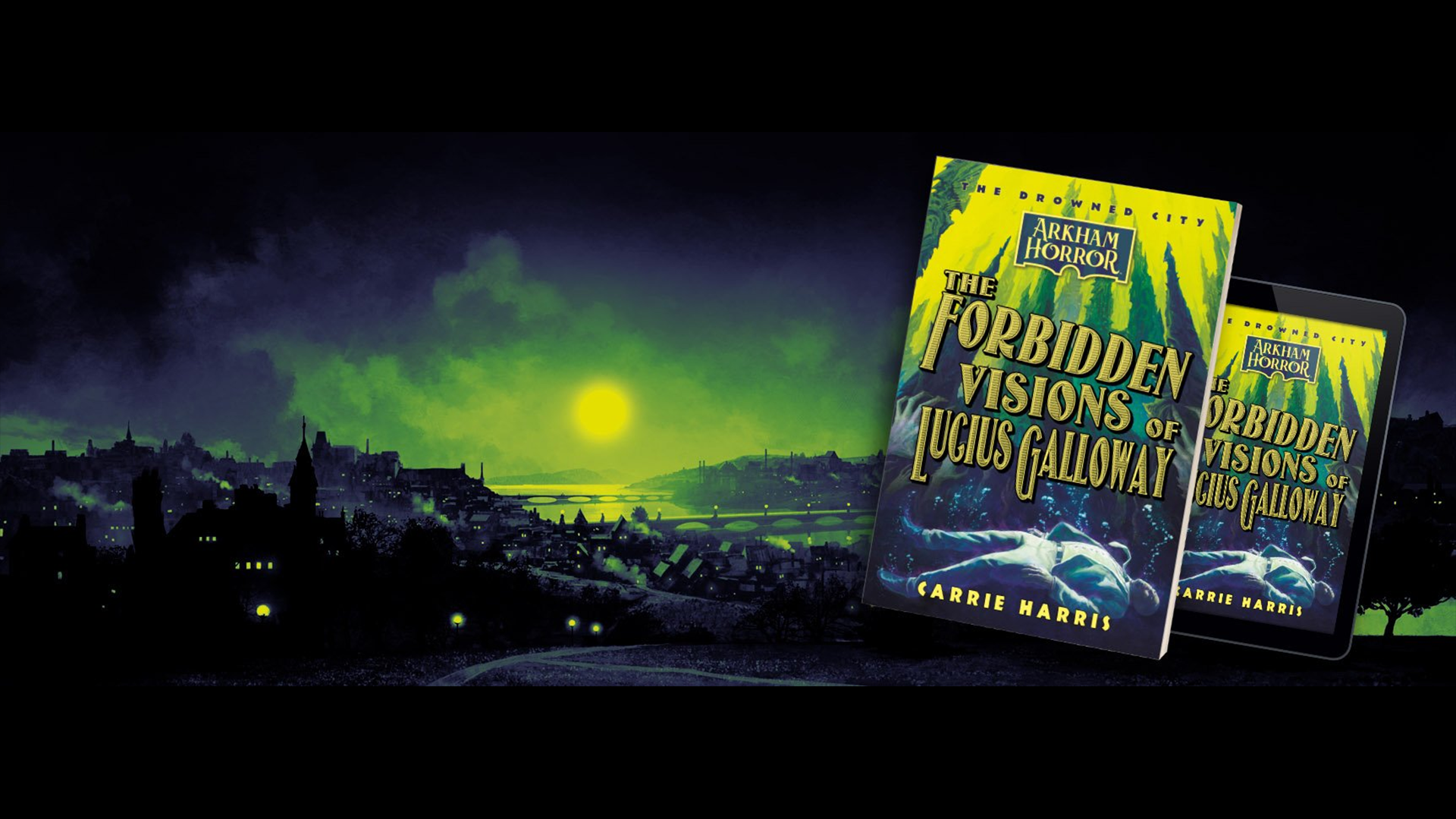
TITLE: The Forbidden Visions of Lucius Galloway
AUTHOR: Carrie Harris
PUBLISHER: Aconyte Books
RELEASE DATE: November 19, 2024 (US/UK)
PRICE: Paperback – $16.95 (USD)
After nearly a century of retellings and reinterpretations, the horrors of Lovecraft Country have still yet to be fully tapped. The latest journey into this eldritch world comes from Aconyte Books’ Arkham Horror series, populated with its own recurring series and characters. The Forbidden Visions of Lucius Galloway is the first book in the new Drowned City series, bringing with it both the merits and flaws intrinsic with being a series’ first book. Fortunately, the former far outweighs the latter.
The Story
The Lucius Galloway of the title is a celebrated poet whose latest collection, The Drowned City, is often interpreted as a metaphor for the state of modern (i.e., 1920s) society. What readers don’t know is that the anthology was based on strange, recurring dreams of an eldritch underwater civilization. Or, at least, most readers don’t know that.
As the book begins, Lucius is offered two paths: a visit to Arkham, or an academic job at Harvard. Preferring the prestige of Harvard academic work (and also knowing Arkham’s reputation), Lucius opts for the latter. Being a Black gay man in the 1920s (although only one of those aspects of his identity is readily evident) means his opportunities for unhindered research are few, placing him in good company with the women on the project whose access is similarly impeded. But while it is fulfilling work, being separated from his partner Rudi isn’t the worst part of it. The deeper he dives into the ancient poetry he’s helping to interpret, the more frequent and vivid his underwater dreams become. Before long, they become a part of his daily life, with tentacles grabbing at him during boating trips and swimming lessons.
What Lucius doesn’t know, but the reader finds out as early as page one, is that this project has an uncommon sponsor. The book’s author, Abdul Alhazred, is many lives (and many borrowed bodies) separated from his own work. Once someone helps him interpret his own ancient writings, he can open the gates of the lost city of R’lyeh for himself and the cultists descending on the city of Cambridge.
What Works
Right off the bat, Lucius Galloway is an excellent choice for a protagonist, especially knowing he’ll be leading a series of books. In many ways, he is a bit of a nobody in the Lovecraftian sense: the sort of small, insignificant life that can be so easily swept up in the affairs of gods and magicians. But in ways that matter, he flies directly in the face of Lovecraftian tropes—not to deconstruct or insult them, but to explore and transform them.
One of Lucius’s talents as a poet is putting things into words that others cannot; his partner Rudi comments on this quite a bit, and Lucius himself will occasionally file away good turns of phrase for later use. In a setting where horrors are notably “indescribable,” having an audience association character who tries—who, moreover, rose to fame by describing the city of R’lyeh as seen in his dreams—provides a counterpoint to the old trope of horrors beyond words. The angles are non-Euclidian, the monsters are mind-bending, but Lucius will do his best to put them into words nonetheless.
Placing a Black gay couple at the center of the narrative is also an interesting choice, and one that could have gone a number of ways. However, Harris uses Lucius’s identity to highlight ways that these settings do have room for such characters, and in fact how Lovecraft’s own web of fear can be repurposed to house these stories. One of R’lyeh’s siren calls to Lucius is that it is a place so far removed from the human condition that it could offer him a life free from the sting of bigotry—a technical truth, granted, since all humans are equally insignificant in the eyes of the Elder Gods.
Lucius, at least so far, feels like a character who can support the weight of a series. He’s strong but has room to grow, and he brings multiple perspectives that make his view of this setting unique. And the final few pages of the book offer a cliffhanger that will terrify and tantalize anyone who knows even the basics of the Cthulhu Mythos.
What Doesn’t Work
Much of where The Forbidden Visions of Lucius Galloway falls short is not to do with the writing itself, but rather with the heaviness of writing a first book in a series. There’s a lot to do in one volume: introduce the central figure and concept that will carry the rest of the series, bring in other recurring characters, and balance all of that with this book’s “day players.” That last is where things get a little messy, primarily toward the end. Discussing them in too much detail would break the seal on some spoilers; in short, though, there is an attempt made at a red herring that ends up being spun out to such a degree that the character’s proper introduction (and setup for return in later books) comes a bit late to get one’s head around it.
A great deal of the meat of the story—how Lucius the poet becomes embroiled with Aconyte’s greater Arkham Horror setting beyond the Mythos itself—is packed and condensed into the end. On the one hand, it makes some degree of sense for Lucius’s introduction to be a bit of a whirlwind; on the other, it leaves the book feeling somewhat imbalanced and the payoff a bit too swift. There’s a bit of anxiety that comes with seeing the eldritch horrors unleashed with not nearly enough pages left to give them their due. As interesting and evocative as Lucius’s own experiences were, it feels like a little of that could have been trimmed to give the climactic battle some breathing room.
Final Score
The Forbidden Visions of Lucius Galloway is a creative dive into Lovecraft Country that suffers from the understandable weight of being a series’s first book. Building up a character who is unique, lovable, and followable led to a squashed third act, but it’s hard to say if there’s any better way around that.
That doesn’t stop this book from being an excellent read. Lucius Galloway belongs in the Mythos: a man whose only desires are to live, love, and write, finding his poetic voice repurposed to describing the indescribable. With the heavy work of Book 1 done, the rest of this series promises to be even stronger.
Featured Image: Aconyte Books
Boss Rush Podcast – A Podcast about Video Games

The Boss Rush Podcast is the flagship show of Boss Rush Media and The Boss Rush Network. Each week, hosts Corey Dirrig, LeRon Dawkins, Stephanie Klimov, and Pat Klein, as well as their friends, fellow creators, developers, and industry veterans, share their gaming experiences. They discuss what they’ve been playing, explore rotating segments, debate the Boss Rush Banter topic of the week, answer community write-ins, and more. Patreon subscribers at any tier enjoy exclusive access to the Boss Rush Podcast Patreon Show twice a month along with other perks and extras.
Follow and Connect with Boss Rush Podcast on Social Media
X/Twitter + Bluesky + Instagram + Threads + YouTube
Listen to Boss Rush Podcast on Podcast Services
Apple Podcasts + Spotify + Goodpods + Amazon + More Links
Thank you for supporting Boss Rush Podcast and the Boss Rush Network
Thank you for watching or listening to The Boss Rush Podcast. If you’re watching this episode on YouTube, hit the Subscribe button, Like the video, and hit the notification bell so you don’t miss an episode! If you’re listening on Apple Podcasts or Spotify, consider leaving us a rating and a review as it helps with discoverability and growth. Support Boss Rush on Patreon for exclusive content, early access and audio versions of shows, become a Patreon Producer, and more. Visit our website for all of our content including reviews, news, daily Boss Rush Banter discussion topics, listicles, features, and more. However you support us, it means so much to us. Thank you for your continued support of the Boss Rush Podcast and the Boss Rush Network.





Leave a Reply