
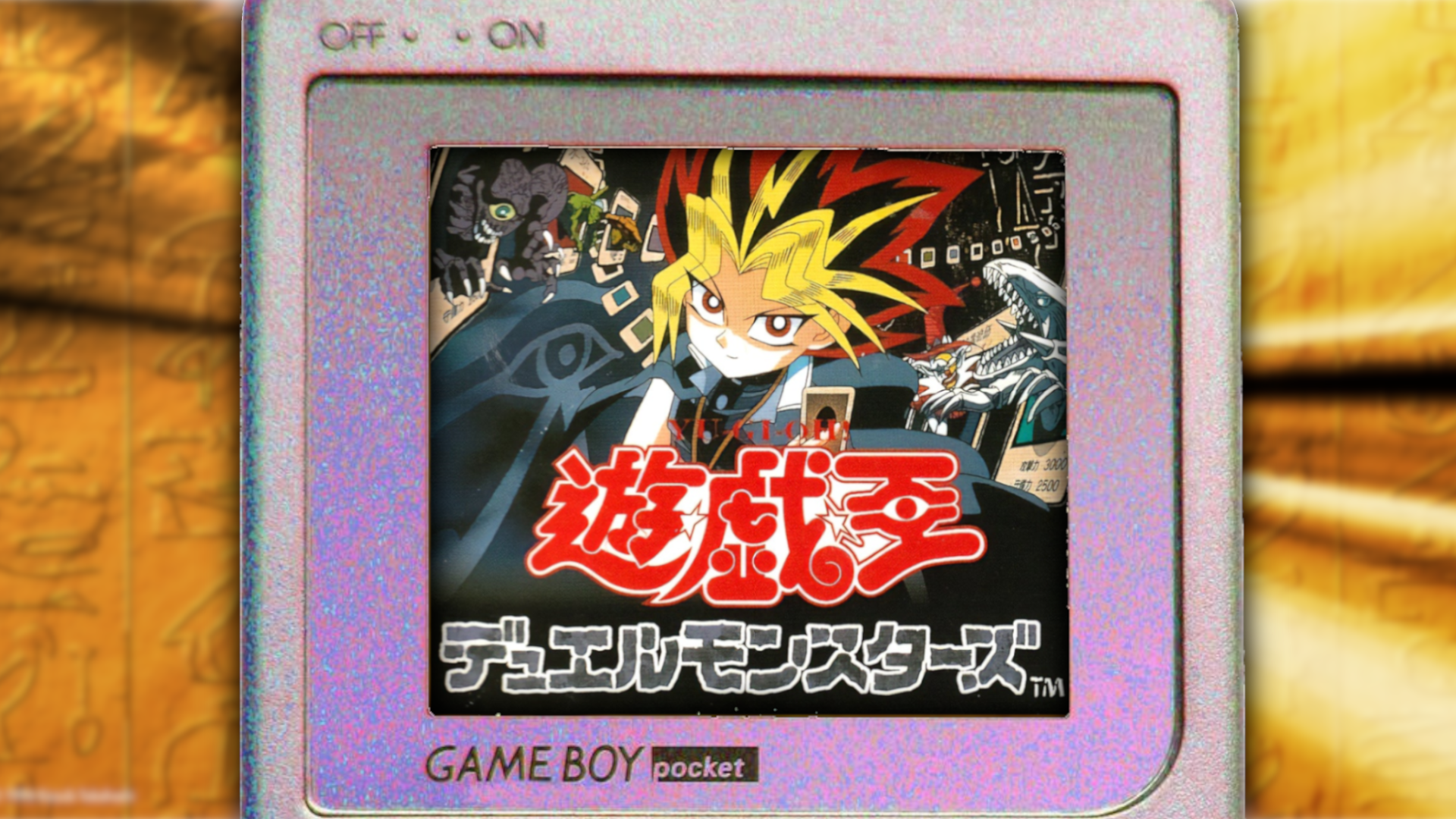
Have you ever found yourself watching the early episodes of Yu-Gi-Oh!, and wondering why they were blatantly ignoring every rule in the game? Why can Kaiba play a Blue-Eyes White Dragon directly onto the field, and attack the same turn? Have you ever felt a desire to actually play this insane version of Yu-Gi-Oh!?
1998’s Yu-Gi-Oh!, Duel Monsters is exactly that.

Review
Please Note: This review is based on an English fan translation of the original Japanese title. The game has since been officially translated, and is available via the Yu-Gi-Oh! Early Days Collection, available for Nintendo Switch and PC. This rerelease comes with a number of quality of life changes, which are not present in the original. As I am reviewing the original version, those changes are not reflected in the review.
Developed and published by Konami, Duel Monsters is actually the second ever Yu-Gi-Oh! game. Earlier that year saw the release of Yu-Gi-Oh! Monster Capsule: Breed and Battle, which is the true first video game based on Yu-Gi-Oh!, however Duel Monsters is the first to be about the actual card game. That being said, you’d be wise to avoid going into this Game Boy title with expectations of stringing together impressive card combos, or springing brutal counter-traps.
Duel Monsters is Yu-Gi-Oh! in a tremendously distilled, simplified form, much closer to the early episodes of the anime as opposed to the tabletop game. You are playing with basic monsters that have no effects. Traps are removed entirely, spells are few in number, and played directly to the field. Tribute summons don’t exist, and much like the infamous Seto Kaiba strategy, you can indeed play a Blue-Eyes White Dragon directly from your hand to the field. Fusions are done by playing one fusion material overtop another, with no need for polymerization.
This results in a version of Yu-Gi-Oh! that feels bizarre and chaotic, and the limits of the simplicity becomes apparent very quickly. Once you remove card effects as well as the spell and trap zone, the game entirely comes down to who draws the highest monster, quickest. The upside is that this leads to an experience that feels very pure. It is nothing but you, your opponent, and a rapid gauntlet of monsters being thrown down. There are no 3-paragraph spells effects to memorize, or waiting around while your opponent executes a 7-card combo, nor the frustration that comes from dealing with your every action being negated by a trap or monster effect. Things are quick and snappy, even on a Game Boy that struggles to provide enough power for the AI. Likewise, the ability to ignore the rules and play a version of Yu-Gi-Oh! similar to the early anime, is a real novelty. It is genuinely thrilling to simply play a Dark Magician directly from your hand.

The simplicity comes at a major cost though. Battles aren’t won with strategy, they are won by drawing a beatstick bigger than anything your opponent has in their deck. Not once did the computer player ever use an offensive spell against me, so once I played a strong enough monster, there was nothing they could do about it. Likewise, If they put out a bigger monster, you are stuck to spamming defensive monsters and hoping to draw Raigeki in time. Yu-Gi-Oh! Duel Monsters functionally has no strategy aside from some very low level decision making about fusion summons, and it results in no real thought going into deck building. Since strong cards can be played to the field directly, there is no reason to keep weaker cards in your deck. “Deck building” consists of just swapping out weaker cards the moment you get a stronger one. Unless you do it for pure novelty, there is no reason to build themed decks. Outside of magical equips, your themed cards will not have synergy with one another.
While the thrill of being able to break so many rules is exciting at first, it eventually gives way to an experience that is devoid of strategy, and somewhat dull. It never became truly boring for me, and playing powerful monsters directly from my hand was always thrilling. I was entertained enough to see the game through to the end. But it certainly began to feel fairly monotonous about halfway through the experience, and I began to feel grateful my emulator had a fast-forward button.
The game itself is formatted via a campaign through the Duelist Kingdom arc of the anime, ending shortly after the battle against Maximillion Pegasus. The campaign is broken into different areas, each one with a number of duelists waiting to be battled. Each duelist must be defeated five times, in order to advance to the next area. Beating opponents additional times is profitable though, as they reward a card after every loss, and this is how you build your deck. 80% of the cards they award are chaff, so you must repeatedly play against them to earn the worthwhile cards. Additionally, every 10 victories against an opponent earns you a milestone card, up to the 100th victory, which sees you earn the opponent’s signature card.

There is also a mode for battling with friends, but I was unable to try it out.
Visually, this is a nice looking game, especially for the Game Boy. Animation is sparse, but the pixel art is gorgeous, especially the character portraits and card art. I find the latter to be less impressive, often blurry where I feel like there was room for additional clarity, but they still looked nice overall. This is a pleasant game to look at, and the music was reasonably enjoyable as well.
Final Score
Yu-Gi-Oh! Duel Monsters is an admirable start to what would become a long-running video game franchise. They did a respectable job of bringing the card gaming experience over to an underpowered handheld, even if it is one that is markedly different from what we would eventually experience on our own tabletops. The changes make the game much more similar to the loosey goosey vibes of the early anime, and it can be thrilling, but it also results in a game that is lacking meaningful strategy, and becomes a bit monotonous. It was a good decision to bring the games in line with the official rules eventually. However, the choice to play fast and loose with the rules turns Yu-Gi-Oh! Duel Monsters into an interesting curiosity piece, and while I can’t say it is worth trucking through to the end, it certainly is worth playing around with a little bit.
Featured Image: Konami



Leave a Reply