
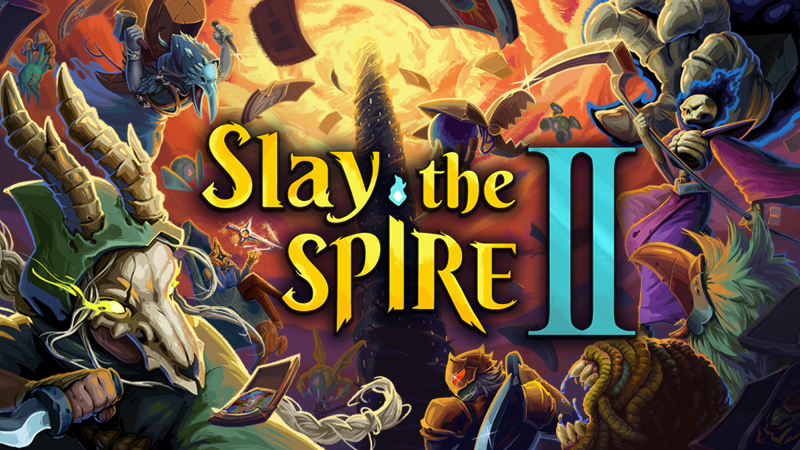
Title: Slay the Spire 2
Developer: Mega Crit
Publisher: Mega Crit
Release Date: March 5th, 2026
Platforms: Windows, Mac, Linux (via Steam)
Reviewed on: Windows
Price: $24.99 (USD)
I played over 150 hours of the original Slay the Spire, so my expectations were high for the second installment of the hit deckbuilding roguelike. The original title offered juicy tactics and strategy that made it easy to obsess over, to the point that I reached Ascension 15 (the game’s challenge mode) on most characters. The first Slay the Spire was not without flaws, however. Some of the characters, such as the Watcher, were far more poorly balanced compared to its peers, and the variety of events, enemies, and potions was limited. It’s a testament to the quality of gameplay that the lack of variety, a critical element of most roguelikes, did not kneecap the game.
Slay the Spire 2 seeks to build on the previous installment, and promises to address that variety issues: more characters, more bosses, more enemies, more cards, more events, more potions.
Note: This is an early access review, meaning that much of the art is still unfinished, characters are still being balanced, and not all content has been released yet. I will note those but not necessarily penalize them in this review.
Gameplay

The goal of Slay the Spire 2, as with the original, is to ascend the Spire by fighting through enemies in turn-based card combat. You start, by selecting one of five characters, which determines your starting health, relic, and pool of cards available. All characters share the same crummy set of strikes and defends in their starting deck, with two or three cards unique to them in addition. Then, you traverse an upward map of the spire, picking encounters that mostly contain enemies to fight.
Within that encounter, you take turns playing cards to either attack your enemy, or defend yourself largely through usage of block cards. Cards can be divided into three types, either Attack cards, which are used to reduce the enemy’s health, skill cards that either grant you Block against enemy attacks or provide special effects, and Power cards that provide more potent effects that persist across turns. Each of these cards typically cost between 1 and 3 energy to play, and you start your turn with 3 energy. Unlike many card games, energy production doesn’t naturally scale across turns, unless you play rare and specific cards that improve your energy generation. This means a lot of the mid-game or late-game in a Slay the Spire combat comes from the synergies between cards and effects, rather than unlocking punchier cards to hit the opponent with.
At the end of each encounter, you receive rewards: You can pick between one of three new cards (or consider skipping!). You also get gold, occasionally potions, and if you were fighting an elite enemy, a relic. Then, you choose the next encounter by consulting a map. Some of those include shops: where you can spend your gold on cards, relics, more potions, and the card removal service. There’s rest sites, where you can either regain some health or upgrade cards to better versions of themselves. There’s also unknown encounters which can contain events, treasure, or other enemies. Each run follows a three-act structure, with each act starting in choices between sets of boons, and ending with a boss fight.

Slay the Spire 2 has kept this structure largely unchanged from the original. It does have a different set of bosses from the original, and the boons at the start of the second or third act have more complexity than the boss relics the original offered to them. Many run-defining relics or perks can be acquired from these boon encounters. Though I certainly miss the easy energy access boss relics offered, the way these change your run are far more interesting.
One other significant gameplay improvement is the quality of colorless cards. In the first Slay the Spire, most of these were borderline useless. But in the sequel, most of them are fantastic, or at least interesting. They used to be a small but consistent disappointment, but now I am happy to see them. But most of the interesting decisions and gameplay come down to the specific characters, which I’ll go over in this next section.
Characters
But the majority of the strategy is found in the specific characters that you choose to play. Thankfully, Slay the Spire 2 has five, one more than the original offered. Even in the early access state, most of them feel polished and fun to play, though I will admit to having favorites. Each of these characters, aside from the Ironclad, are unlocked when you reach a certain level of score accumulated across runs.
- The Ironclad
- The Silent
- The Regent
- The Necrobinder
- The Defect.
Notably, one of the characters from the original, the Watcher, is absent. This character was notably more powerful than the other ones, and was easy to create infinite combos with. It’s unclear if the character will be added in eventually, but good riddance as far as I am considered.
The Ironclad

The Ironclad is the most straightforward of all the characters, and remains one of the more enjoyable ones for me to play. The character starts with a large pool of health, a relic called “Burning Blood” which heals you for 6 HP at the end of combat, and an expensive and not very good attack called Bash. Both the extra health, and the free regeneration (which is rare in the game) make the character easy for new players to learn. That forgiveness can teach some bad lessons for other characters regarding when to block attacks, but other than that is a great starting character.
Ironclad cards often revolve around attacking in some way, unsurprisingly. Many of its cards grant you strength, which provides a flat bonus to all attack damage output, or apply vulnerability, which increases damage to a specific enemy by a percentage amount. There are a couple of strategies that the game tries to lead you toward aside from inflicting mass casualties. Those include the exhaust mechanic, which allows you to prune bad cards from your deck temporarily during combat. There’s also a strategy revolving life loss in exchange for stronger attacks and other benefits.
Notably missing is its Status effects strategy, which has been given to the Defect for reasons beyond my comprehension. I am disappointed with this change because adding status cards to your deck synergizes well with exhausting cards.
The Silent

I’m going to be honest, this is my least favorite character in Slay the Spire 2. The Silent starts with a lower health pool, but a great relic called the “Ring of the Snake” which grants you two additional cards at the start of your first turn. The biggest challenge of this character, as far as I am concerned, is that so many of its cards feel outright bad.
Maybe I haven’t adjusted yet to it in this new version, but most of the rares are disappointing and take a lot of set up to make work. Whenever a card has the “Sly” keyword, that’s a hint that it’s going to be completely unplayable unless you are specifically playing a discard deck, in which case it will feel okay. The other major mechanic that you’re encouraged toward is poison, which slowly chips away at health turn by turn at a flat amount that decreases each turn. So an enemy with five poison would take 5 damage the first turn, four the next, and then three, and so on. And the last major mechanic, which I quite like, are shivs, which are small, free attacks that deal a small amount of damage generated by other cards.
My opinion may come down to skill, but even after playing all the other characters for some time, the Silent is the one I least want to come back to.
The Regent

The Regent is one of the more interesting characters, and is definitely the goofiest in both lore and gameplay. The arrogant monarch has it’s own extra energy resource that persists between turns called stars. The Regent’s cards focus on either generating this star resource, and using it on more powerful cards, but also around card conjuration. The main card that the regent creates is called the Sovereign Blade, which is a persistent giant sword that you build up over turns in order to hit for ridiculous amounts of damage. But it also has some cards that create minions to sacrifice, or debris which pollutes your deck.
Overall, the Regent is a huge amount of fun to play. It’s not necessarily the strongest character, but swinging a big sword for fifty damage is a lot of fun.
The Necrobinder

The Necrobinder is the other new character introduced in Slay the Spire 2. The character centers around three primary mechanics. The first is Summoning: You have a giant skeleton hand minion named Osty that will tank some amount of damage for you. You increase the health of it through anything with the Summon keyword. Some of your attack cards also direct Osty to attack rather than directly fighting. The second mechanic is Doom, which is a negative condition that accumulates on opposing enemies (or yourself!) and kills them at the end of their turn if doom exceeds their health. Doom’s biggest weakness is that it almost always gives your opponent extra damage chips against you, which hurts when the Necrobinder’s health is so low. But, it is easy to accumulate a lot of doom cheaply, and some of the cards are quite powerful just by how much of it they apply. The last mechanic is Souls, which are created cards that cost zero, draw two cards, then exhaust themselves. Free card draw tends to be a nice bonus, but the Necrobinder often lacks the resources to capitalize on it.
Overall, I like this new character a lot even though I haven’t cracked the strategy on how to play it completely. It’s a fun puzzle, and frankly, I just need to play less greedy when running the Necrobinder.
The Defect

The Defect is a character from the original Slay the Spire, and frankly the one I am happiest to see. Its main mechanic revolves around orbs, little spheres of either lightning (damage), frost (block), dark (damage potential), that chip and accumulate slight amounts of value each turn. These orbs can be further improved by accumulating focus, which might increase the lightning damage from 3 to 4 per turn, for example. These orbs are also evoked when they exceed your orb capacity (starting with 3), where they do a more powerful amount of damage, or in the case of dark orbs, activate their effect that’s been passively ramping up.
Its other mechanics surround either the Powers card type, where you can generate value by playing additional powers,. The other one is Zero cost cards. I have found Powers decks to be a lot harder to pull off compared to the original. Zero cost cards, however, tend to just be good without too much support, and are easier to build a deck around. Additionally, negative status cards that are usually made by enemies, are also a strategy that has been given to the Defect, though this was originally an Ironclad mechanic.
Final Score (4.5 / 5)
Overall, Slay the Spire 2 is a great step up from the original. There are more characters, more perks, more buffs, more enemies, more cards. That’s all that I could ask from a sequel to such a treasured title. Some of the original characters, such as the Ironclad, feel a little spread thin, as they have had some of their mechanics spun off and given to characters such as the defect, and therefore lack some of the depth they had in the original, but there is ample time for this to improve. Balance is also still in the works.
Currently, there are some quirks that come with the game still being in early access. For one, the art style is still in beta. Mechanically, Slay the Spire 2 could be a finished game at this point (though I hope we will get more content in the future!) Artwise, however, this is not the case. Beta art is charming but crude, and reminds me that this game is still in Early Access. I will not ding the game for that in this review, but it is a caveat worth noting. The game does have a few bugs, of course, but I’ve run into maybe 3 across my 20 or so hours of playtime.
What about you? Do you feel like Slay the Spire 2 lives up to the original? Are you going to wait until it’s out of Early Access? Let us know on the Boss Rush Discord.
Featured Image Credit: Mega Crit Games



Leave a Reply