
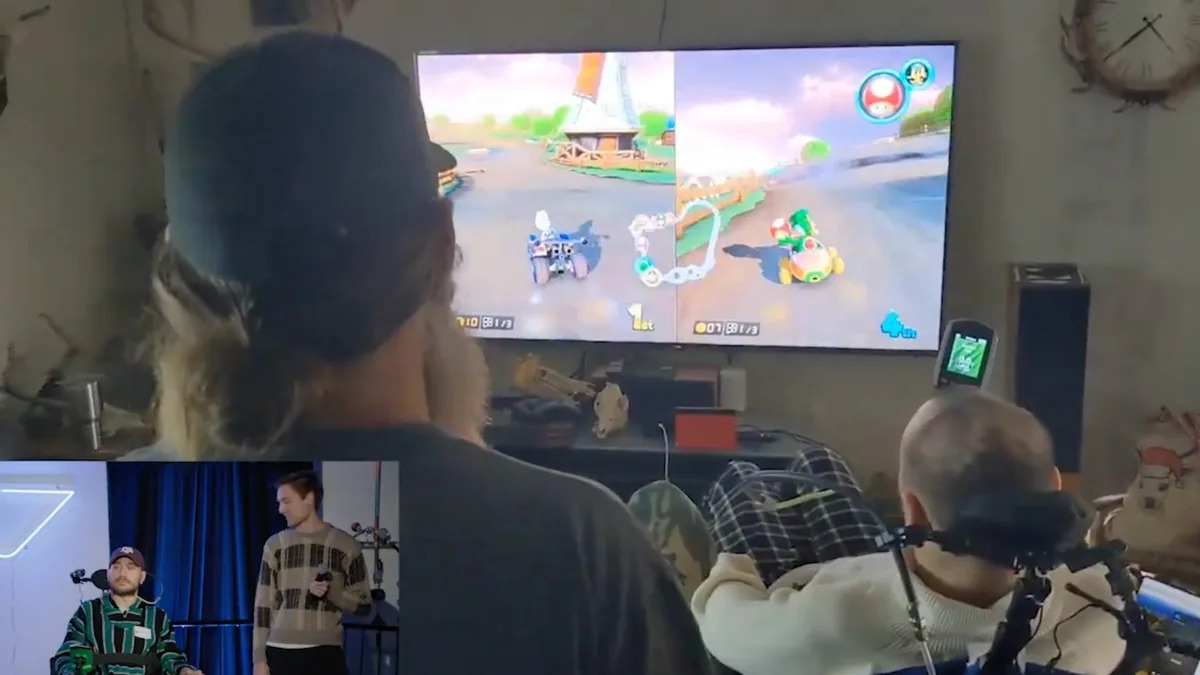
Two years ago, a paralyzed man named Nolan Arbaugh played a game of Civilization VI through a Neuralink. Nolan sometimes played the game for over eight hours at a time. While the commercialization of cybernetics will have many more significant impacts on the future of disability and life more broadly, that moment was what stuck out to me. It led me to wonder: If these implants eventually become commonplace, video games will surely not limit themselves to making control schemes for brain implants, but also be developed specifically with them in mind as a medium.
One interesting consideration is for competitive gaming. Not having to physically move a cursor represents a massive advantage in reaction time. The speed is near instantaneous. According to Neuralink, “Noland, the first Neuralink recipient, [reporting] the cursor arriving at the right place before they consciously realized where they wanted it to go.” The rest of us have to wait hundreds of milliseconds to move the cursor or controller to where we need it to go. In shooter games where fights between players can be over in mere seconds, that represents a huge advantage. This is still ways away due to the early stage that the technology is currently in. But, I find it easy to imagine this advantage coming into play in a few decades’ time.
Further down the line, if neural chips go beyond a medical product and become a part of everyday life for a large part of the population, games may be developed with brain chips specifically in mind, rather than just as an adaptation. The main question is, how many streams of input can the human brain reasonably send to neural chips. In this early stage, it seems like the answer is one or two: a cursor, and a slow pace of words. But as the options of what can be sent to or from the brain increase, expanding to imagery and audio, one can imagine some incredibly interesting and immersive gaming experiences. Input and output are those two limiting factors; from there, I have no doubt that developers will start making some fascinating games.
Surprisingly, we don’t have a ton of previous inspiration from fiction to go off of. Books like Neuromancer have the concept of a simstim, where you can use a brain chip to live vicariously. More often, stories lean on virtual reality rather than direct neural input, such as in Ready Player One. Perhaps the best example in media is Sword Art Online, where players get trapped in a vivid role playing game where they have to live out their lives in. Even so, SAO, from my limited knowledge of the matter, mostly uses the brain chip technology to make the world feel real, rather than take advantage of the medium’s uniqueness.
I won’t be pushing my own theories of what these games will look like here, except to push the game I would want to play, if I somehow trusted tech companies with chips in my brain. I would want to play a “speed-chess” style game that tests how good you are at snap strategy decisions, unrestricted by physical reflexes.
What about you? Would you get a chip in your brain if the games were good enough? What would you want to play in your brain? Let us know in the comments or the Boss Rush Discord.
Featured Image: Neuralink
Boss Rush Podcast – A Podcast about Video Games

The Boss Rush Podcast – A Podcast about Video Games – is the flagship show of the Boss Rush Network and Boss Rush Media. Each week, hosts Corey Dirrig and LeRon Dawkins are joined by friends, fellow creators, indie developers, and industry veterans to discuss the latest in the world of video games, including news, rumors, new releases, and what they’ve been playing. They also answer listener questions, debate important industry topics and Boss Rush Banter discussion points, and feature a rotating weekly segment. New episodes post every Monday.
Follow and Connect with Boss Rush Podcast on Social Media
X/Twitter + Bluesky + Instagram + Threads + YouTube
Listen to Boss Rush Podcast on Podcast Services
Apple Podcasts + Spotify + Goodpods + Amazon + More Links
Thank you for supporting Boss Rush Podcast and the Boss Rush Network
Thank you for watching or listening to The Boss Rush Podcast. If you’re watching this episode on YouTube, hit the Subscribe button, Like the video, and hit the notification bell so you don’t miss an episode! If you’re listening on Apple Podcasts or Spotify, consider leaving us a rating and a review as it helps with discoverability and growth. Support Boss Rush on Patreon for exclusive content, early access and audio versions of shows, become a Patreon Producer, and more. Visit our website for all of our content including reviews, news, daily Boss Rush Banter discussion topics, listicles, features, and more. However you support us, it means so much to us. Thank you for your continued support of the Boss Rush Podcast and the Boss Rush Network.

Leave a Reply